


The UAE’s VAT framework treats precious metals and precious stones differently depending on the nature of the transaction, by assessing who is buying, who is selling, and for what purpose. Whether you are a jewellery manufacturer, a bullion trader, a gemstone wholesaler, or a retailer, understanding which VAT treatment applies to your transactions is essential to staying compliant and avoiding unnecessary costs.
This article breaks down the three key VAT treatments i.e. Zero Rating, Reverse Charge Mechanism (RCM), and Standard Rating.
What are included in Precious Metals and Precious Stones?
Precious metals include the following: Gold, silver, palladium, and platinum
Precious stones include Natural and synthetic diamonds, pearls, rubies, sapphires, and emeralds.
Zero Rating of Investment Grade Precious Metals
Certain precious metals are treated as financial instruments rather than ordinary goods. Accordingly, their supply and import attract VAT at 0%, yet the supplier retains the right to recover input tax on related costs.
Key conditions for zero-rating:
- The metal must be gold, silver, palladium, or platinum.
- It must have a purity of 99% or more.
- It must be in a form tradeable in global bullion markets (e.g., bars, ingots, or coins that meet international trading standards).
Jewellery or other manufactured articles of these metals generally do not qualify for zero-rating under this provision.
Example: A UAE-based bullion dealer sells 1 kg gold bars (99.9% purity) to a registered jewellery manufacturer. The dealer issues a tax invoice at 0% VAT as the gold is a precious metal and the is traded in bullion form with a purity of 99.9%.
Applicability of Reverse Charge Mechanism (RCM)
For most business-to-business (B2B) transactions involving precious metals, precious stones, and jewellery within the UAE, the Reverse Charge Mechanism applies, provided certain conditions are satisfied.
For jewellery manufacturer and retailers, the key point to note that the RCM can be applied for jewellery made from these materials but only where the value of the precious component exceeds the value of all other elements such as clasps, settings, and packaging. If it does not, the RCM under CD 127/2024 does not apply.
Key conditions that must be met for RCM to be applied
For the RCM to apply, three conditions must be satisfied simultaneously:
- The recipient must be VAT-registered in the UAE at the time of supply.
- The recipient must intend to resell the goods or use them in the production or manufacture of precious goods.
- The recipient must provide a written declaration to the supplier, before the date of supply, confirming both their VAT registration and their commercial intent.
The recipient must obtain and retain the declaration received from the supplier and verify the supplier’s Tax Registration Number (TRN) through the FTA’s online verification tool, while retaining evidence of such verification. Although no VAT is charged by the seller, a compliant Tax Invoice must still be issued, clearly stating that the Reverse Charge Mechanism (RCM) applies to the transaction.
How the Reverse Charge Works
Under the RCM, the VAT obligation shifts from the supplier to the recipient. The supplier does not charge or report VAT on the supply. Instead, the VAT-registered recipient self-accounts for VAT, reports it in their VAT return, and may recover it as input tax subject to standard recovery rules.
This mechanism applies to B2B transactions only. Supplies to unregistered end consumers fall outside the RCM and standard 5% VAT is applied for B2C unregistered consumers.
Example:
- A diamond trader supplies lab-grown diamonds worth AED 500,000 to a VAT-registered jewellery company that intends to resell them. The jeweller provides the required written declaration. The trader issues a tax invoice with no VAT charged. The jeweller self-accounts for AED 25,000 (5%) under RCM by disclosing output VAT in its VAT return and simultaneously claim this as input tax, resulting in a net nil effect.
Standard Rating (5% VAT) — Retail and Non-Qualifying Transactions
When the conditions for zero-rating and RCM are not met, the supply of precious metals, precious stones, and jewellery is subject to standard VAT at 5%, which the supplier charges and remits to the FTA.
Common scenarios where standard rating applies:
- Sales to unregistered individuals (retail / B2C transactions).
- Sales to VAT-registered businesses that do not provide the required written declarations.
- Sales where the recipient has no intention to resell or manufacture precious goods.
Example:
- A jewellery retailer sells gold bangles to a walk-in customer (an unregistered individual). The retailer charges 5% VAT on the sale price and pays this to the FTA.
- A VAT-registered company purchases sapphires to use as corporate awards or gifts — not for resale or manufacture. Since the company does not intend to resell or use the stones in production, the RCM does not apply. The supplier charges 5% VAT.
- A diamond dealer fails to receive a written declaration from the recipient before the supply. Even if the recipient is VAT-registered, the RCM cannot apply, and the dealer must charge standard 5% VAT.
Making Charges — A Nuance to Watch
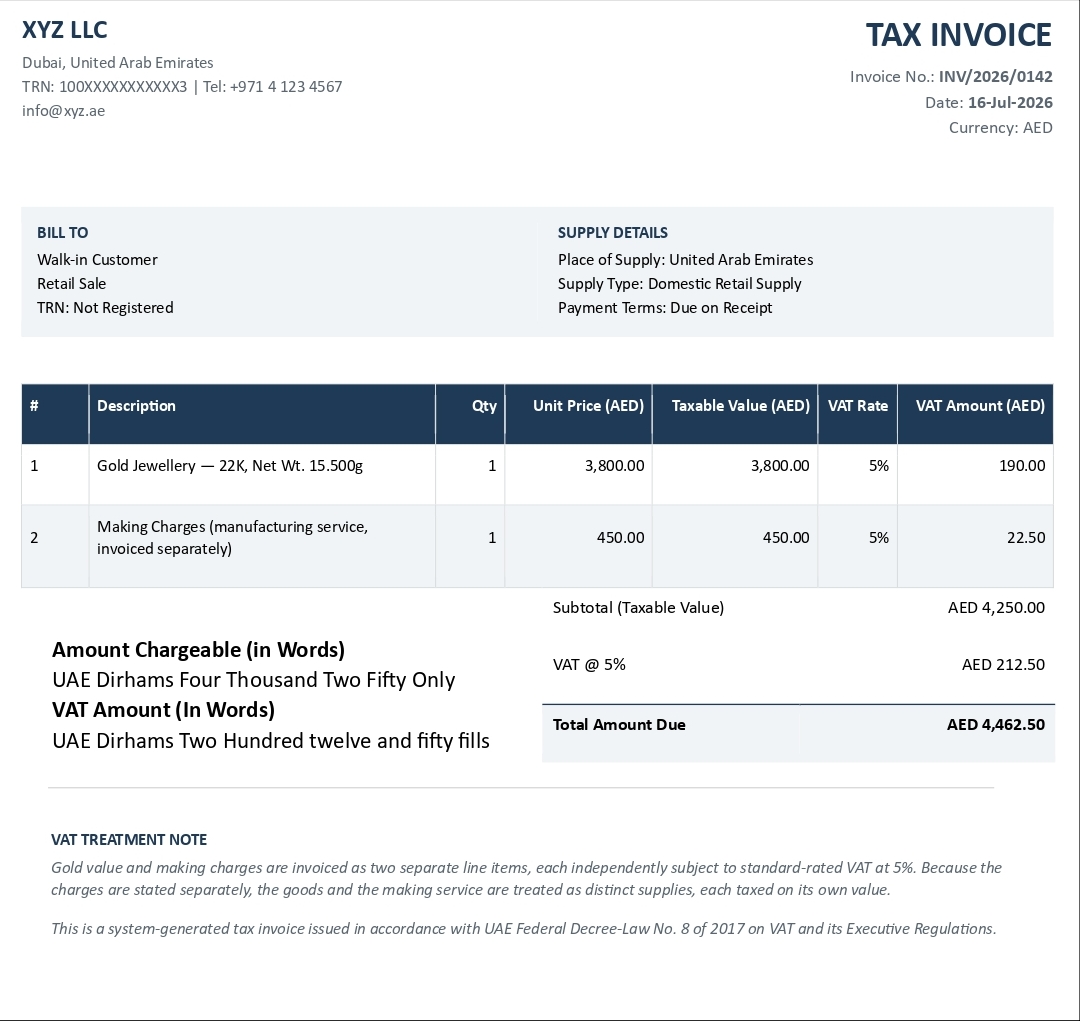
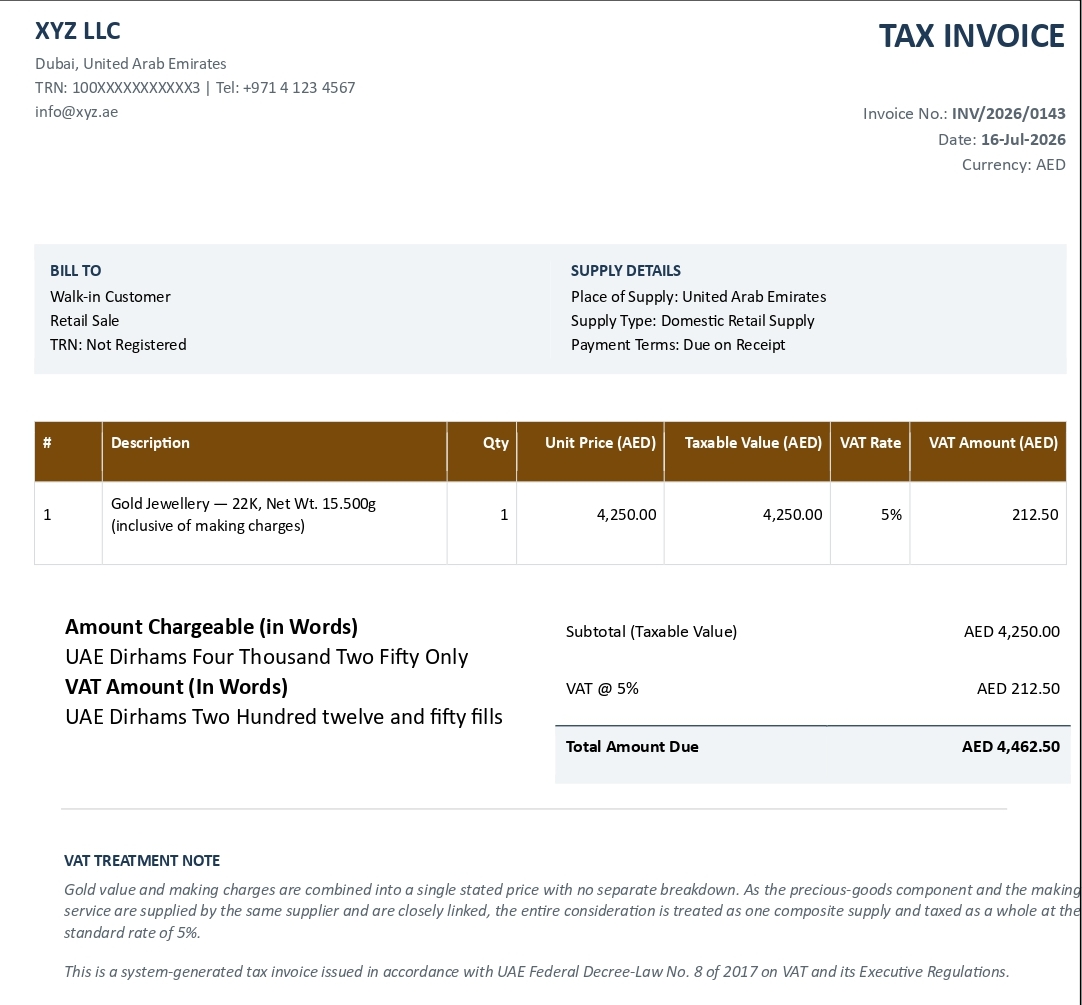
Where a jeweller charges separately for manufacturing services (“making charges”), those services remain subject to standard 5% VAT. The RCM applies only to the precious goods component. If a single composite price is charged for both goods and services by the supplier to VAT registered customer the entire supply fall under the RCM provided all conditions are met.
Composite Supply
Following conditions shall be met for the supply to be treated as a composite supply.
- The supply consists of a principal component (Precious Goods) and ancillary / incidental elements (including Making Services), closely linked that splitting them would be impossible or unnatural.
- The price for the Precious Goods and related services is not charged separately. One combined price is stated.
- The Precious Goods and all related services are supplied by the same supplier.
Sample Tax Invoice for Taxable Supply
Sample Tax Invoice for Composite Supply
Record-Keeping Requirements
Given the interplay between zero-rating, RCM, and standard rating, robust documentation is essential to support the VAT position taken on each transaction. The specific records to maintain vary depending on which treatment applies.
Zero-Rated Supply
- Evidence that the metal is in a recognised tradeable bullion form (bars, ingots, or coins meeting international trading standards)
- Compliant tax invoice reflecting 0% VAT.
- Records supporting input tax recovery claimed against the zero-rated supply
Reverse Charge Mechanism (RCM)
- The recipient’s written declaration confirming VAT registration and intent to resell or use the goods in production/manufacture, obtained before the date of supply
- Evidence of TRN verification carried out via the FTA’s online tool, retained by the supplier
- A compliant tax invoice issued despite no VAT being charged, clearly mentioning VAT will be accounted by customer on behalf of supplier under RCM
- Records distinguishing separately-invoiced making charges (standard-rated) from composite pricing (fully under RCM), where applicable
Standard Rated Supply
- Compliant tax invoice showing VAT charged at 5% on the full consideration
- Records of the customer’s registration status (or confirmation of non-registration for B2C sales)
- Where a declaration was requested but not obtained, records evidencing that RCM could not be applied, justifying standard rating
- Records of VAT collected and remitted to the FTA in the relevant tax period
All of the above should be retained for the statutory five-year period (or longer where applicable) and be readily available for FTA audit, as the burden of proof for zero-rating, RCM, or input tax recovery rests with the taxpayer.
Conclusion
The VAT treatment of precious metals, precious stones, and jewellery in the UAE depends on the nature of each transaction and who is buying, for what purpose, and how the supply is structured, rather than the product alone. Zero-rating applies to qualifying investment-grade bullion, RCM shifts the VAT burden to registered recipients where all conditions and declarations are met, and standard 5% rating is the default otherwise. The making charges distinction is particularly important: whether these are invoiced separately or bundled into a single price can determine whether RCM extends to the whole supply or only its precious component. Businesses should review their invoicing practices and documentation carefully to apply the correct treatment and safeguard their input tax position.
Search
Recent Insights