


The shipping and logistics sector is the backbone of global trade. In the United Arab Emirates (UAE), this sector holds strategic importance because of the country’s geographical location and its ambition to be a world-class logistics hub connecting Asia, Europe, and Africa. The UAE’s state-of-the-art ports, airports, and free zones have made it a preferred destination for global supply chains and multinational businesses.
With the introduction of Value Added Tax (VAT) in January 2018, companies operating in shipping, freight forwarding, and logistics have had to understand and comply with a new set of tax rules. While the VAT framework is designed to be business-friendly, the sector’s complex mix of local and cross-border services makes it critical for companies to know when to charge VAT, when zero-rating applies, and when a transaction is outside the scope of UAE VAT altogether.
This article explores the key VAT implications for the shipping and logistics industry in the UAE, providing an in-depth understanding of how different services are treated under the law and highlighting practical scenarios that businesses frequently face.
Understanding Shipping and Logistics
A shipping and logistics company is responsible for moving goods efficiently and securely from one location to another, whether within the UAE or across international borders. The services provided in this sector are diverse and often involve multiple stages of a supply chain. Typical activities include:
- Transportation by land, sea, and air
- Customs clearance and documentation
- Warehousing and inventory management
- Multimodal coordination (sea-air, land-air, etc.)
- Order fulfilment and last-mile delivery
- Freight forwarding and supply chain consultancy
- Planning and managing the flow of goods from suppliers to customers
- Preparing necessary paperwork (bills of lading, customs declarations, etc.)
- Some logistics companies offer broader services like supply chain consulting, procurement, and returns management.
Because of this wide scope of operations, VAT treatment varies depending on the nature of the service and whether it relates to domestic transportation, international movements, or import/export activities.
Modes of transportation
Modes of transportation include Sea, Air, Road, transportation and multimodal transportation.
Sea Transport
Air Transport
Road Transport
Multimodal Transport (combining different modes)
Shipping Companies
Shipping companies are businesses that specialize in transporting cargo for a fee, primarily via sea using container ships, but also through other modes like air, rail, and road. They play a vital role in global trade by moving goods, such as raw materials and finished products, between different ports and destinations worldwide, ensuring that products reach consumers and industries efficiently and safely.
VAT Treatments
International transportation
Transactions Type | VAT Applicability | Examples |
|---|---|---|
International Transportation of goods and passengers | 0% | Freight from Jebel Ali to Europe; passenger flight from Dubai to London. |
International Transportation of goods and passengers includes more than one stops | 0% | Shipment Dubai → Riyadh → Cairo → Europe (entire trip qualifies as international). |
Air passenger transport in the state considered as “International Transport Service” | 0% | Abu Dhabi → Dubai leg of a flight continuing to New York. |
Inbound and outbound transportation of passengers and goods (including intra-GCC) | 0% | Inbound and outbound transportation of passengers and goods (including intra-GCC) |
Transport related services for inbound and outbound transportation | 0% | passengers flying out to Saudi Arabia.
|
Transportation starting and ending outside UAE | Out of Scope | Shipping goods directly from India to Oman without transiting through the UAE |
Transport related services for cross border trade | Out of Scope | Goods are shipped directly from India to Oman without passing through the UAE, while the freight is billed by a UAE company. |
Local Transportation
Transactions Type | VAT Applicability | Examples |
|---|---|---|
Local Transportation of goods and services | 5% | Trucking goods from Dubai to Abu Dhabi (not linked to import/export). |
Transport related services for local transportation of goods | 5% | Loading, warehousing, and packaging for a domestic delivery. |
Local transport which is part/for the purpose of inbound and outbound transportation | 0% | Trucking goods from Sharjah to Jebel Ali for onward shipment to Europe |
Local transportation of passengers in non-qualifying means of transport | 5% | Tourist desert safari, limousine service. |
Local transportation of passengers in qualifying means of transport | Exempt | Mono Rail, Dubai Metro, Taxi and Bus |
Supply of means of transport for the transportation of passenger and goods | 0% | Sale of a cargo vessel or aircraft for commercial use |
Freight Forwarding Companies
A freight forwarding company acts as an intermediary to manage the complex process of shipping goods internationally by arranging transportation, handling documentation, and coordinating logistics on behalf of a business. They do not own the transport vehicles, but instead use their network of carriers and partners to find the most efficient and cost-effective way to move cargo via sea, air, rail, or road, ensuring it arrives safely and on time.
Usually undertaking the following:
- Arrangement of transportation (Door to door, door to port, port to door and port to port transportation.
- Handling documentation
- Insurance
- Warehousing
- Arrange transportation by air, sea, road, rail
- Multimodal transport co-ordination
VAT Treatments
Transactions Type | VAT Applicability | Examples |
|---|---|---|
Local transport which is part/for the purpose of inbound and outbound transportation | 0% | Trucking goods from Sharjah to Jebel Ali for onward shipment to USA |
Freight Brocker service fee | 5% | Service fee charged for arranging freight forward service for an international shipment from Jebel Ali to Europe |
Warehousing service for local sales | 5% | Warehousing fee charged for storing goods in the port |
Local transportation of goods and transport related services for local transportation of goods | 5% | Goods transport from Dubai to Sharjah, and Loading, warehousing, and packaging for a domestic delivery. |
Transport related services for cross border transportation | Out of Scope | Shipping goods directly from India to Oman with no UAE leg, freight charges issued UAE Company |
Means of Transport
Goods can be moved by air, sea, rail, or road, and the choice of transport depends on factors such as cargo size and how urgently delivery is required. Because international transport supports the UAE’s trade and tourism growth, the VAT law provides zero-rate (0%) VAT on following types of transport and related services.
Under UAE VAT rules, the following supplies are subject to 0% VAT when used for commercial purposes:
- Aircraft – Planes designed or adapted to carry passengers or goods for commercial transport (not for recreation or sports).
- Ships or boats – Vessels intended for commercial activities such as cargo or passenger transport (not for leisure or private use).
- Buses or trains – Vehicles built or modified to carry 10 or more passengers as part of public transportation.
Goods and services directly connected to these means of transport—such as operation, repair, maintenance, or conversion—are also zero-rated, provided the conditions of the VAT law are met.
Warehousing
Warehousing services refer to the storage of goods in a designated facility before they are distributed to their final destination, whether to retailers, other businesses, or end consumers. They are a critical component of the global supply chain and logistics sector.
VAT Treatments
Transactions Type | VAT Applicability | Examples |
|---|---|---|
Warehousing service provided to customer in UAE | 5% | A UAE customer stored or used warehouse facility at a warehouse in the port before clearing the goods. |
Packing, re-packing, labelling etc.. | 5% | Re-packing service provided at warehouse for a UAE company. |
Transaction Scenarios and Their VAT Implications
Scenario 1: International Shipment (Zero-Rated)
A freight forwarder arranging shipment of goods from Sharjah to Germany charges 0% VAT, as the service qualifies as international transport.
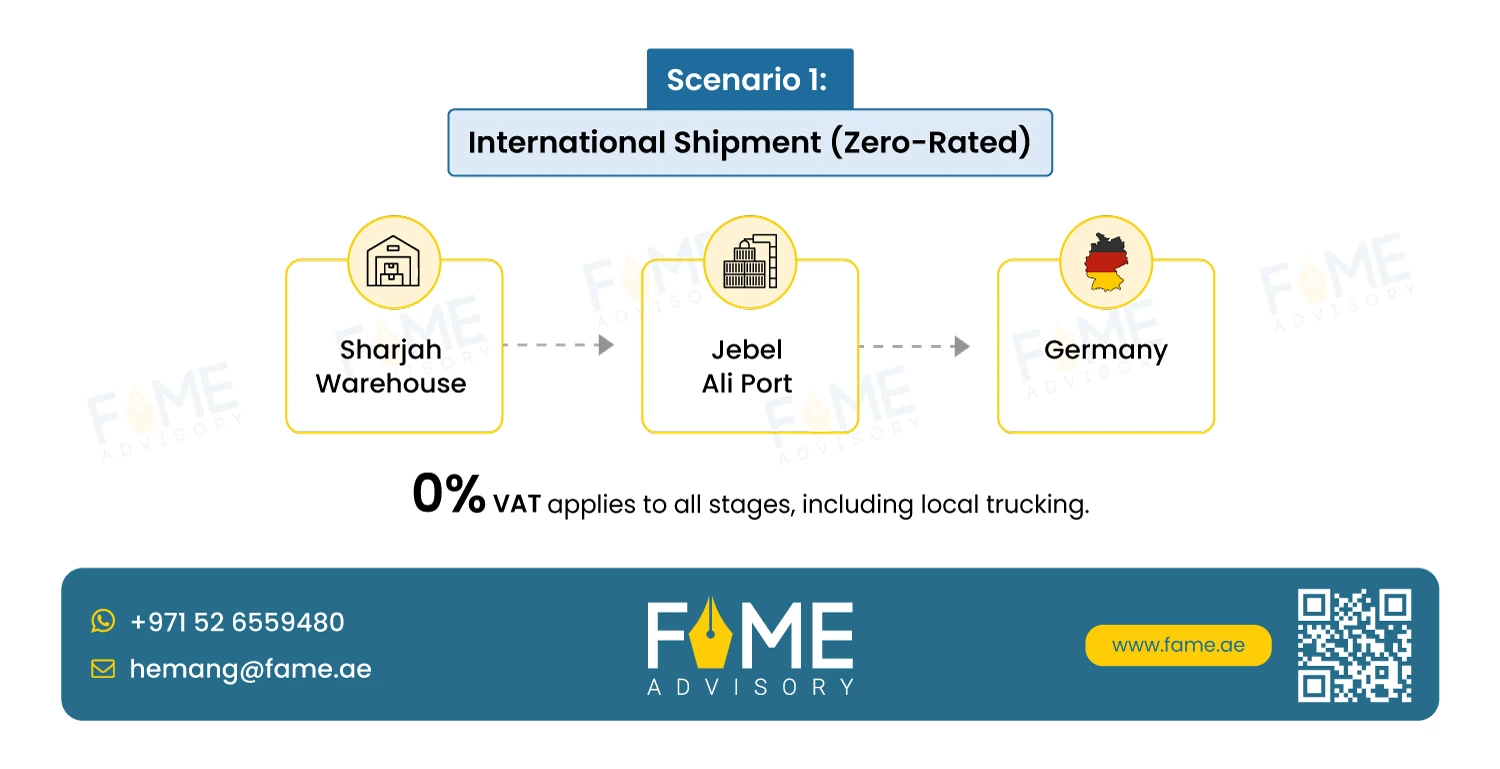
0% VAT applies to all stages, including local trucking.
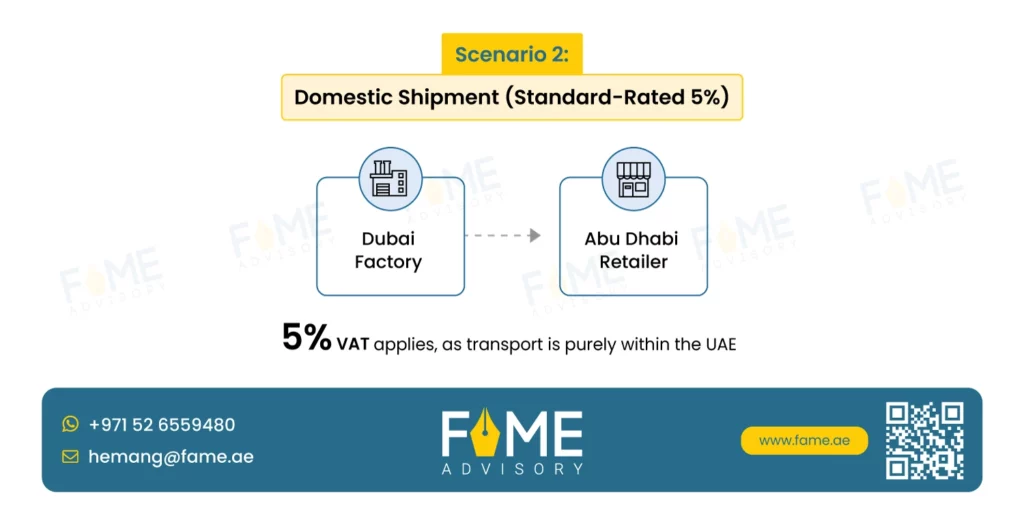
Scenario 2: Domestic Shipment (Standard-Rated 5%)
A trucking company delivering goods from Jebel Ali Free Zone to a retailer in Abu Dhabi applies 5% VAT.
5% VAT applies, as transport is purely within the UAE
Scenario 3: Domestic Passenger Transport (Exempted)
A metro ride in Dubai is exempt from VAT, but a desert safari tour bus is subject to 5% VAT
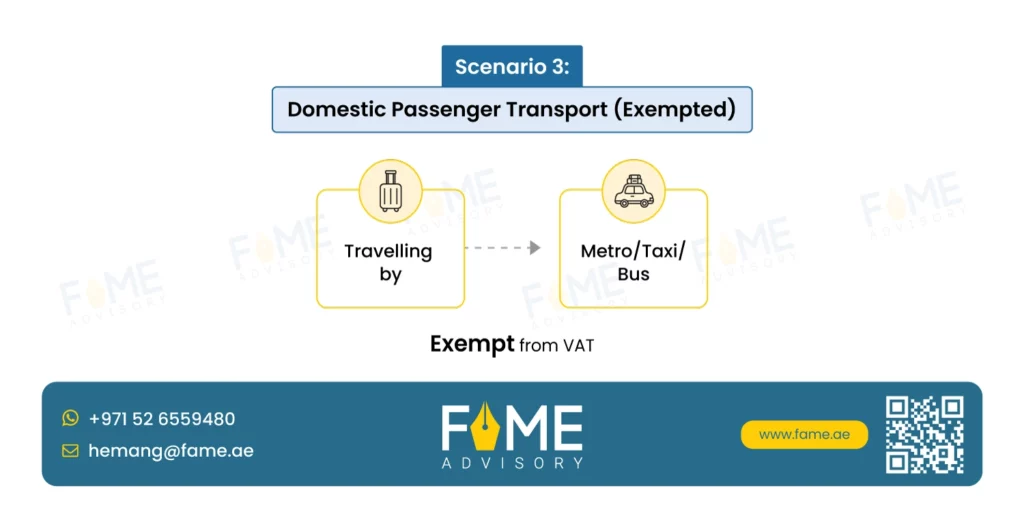
Exempt from VAT
Scenario 4: Cross border transport of goods (Out of scope)
A freight forwarder arranging shipment of goods from India to Germany, this will be out of scope of UAE VAT as the transport is not starting or ending in the UAE.

Out of scope of UAE VAT
Conclusion
VAT treatment in the UAE shipping and logistics sector depends on whether the service is domestic, international, exempt, or outside the scope of UAE VAT. To remain compliant and competitive, businesses must apply the correct VAT rate and maintain precise documentation to avoid penalties.
Key compliance priorities for shipping and logistics companies include:
- Accurate classification of services (domestic vs. international).
- Proper documentation, such as bills of lading, Custom declarations, Exit Certificate and transport contracts, to justify zero-rating.
- Timely and accurate VAT reporting to secure input VAT recovery and avoid fines.
When applied correctly, VAT does not add to the cost of international trade; instead, it promotes transparency, efficiency, and operational integrity. By understanding VAT implications and maintaining robust internal controls, shipping and logistics businesses can remain compliant, cost-effective, and well-positioned to thrive in the UAE’s strategic logistics market.