


Effective from 1 October 2026
FTA Decision No. 13 of 2026 introduces enhanced due-diligence requirements before businesses claim input VAT
The Federal Tax Authority (“FTA”) has issued Decision No. 13 of 2026 – Measures, Procedures and Conditions Required by Taxable Persons for the Verification of the Validity and Integrity of Supplies Before Deduction of Input Tax.
The Decision, issued on 22 July 2026, will come into effect from 1 October 2026 and introduces a more structured framework for taxable persons to verify both their suppliers and the underlying supplies before claiming input tax.
The new requirements are particularly relevant to finance, procurement, accounts payable and tax teams, as businesses can no longer rely solely on the availability of a valid tax invoice. They will need to demonstrate that appropriate due-diligence procedures have been undertaken, and that adequate supporting evidence has been maintained.
Why is Supplier Verification Becoming Important?
Under Article 54(bis) of the UAE VAT Law, a taxable person must ensure that they did not know, and should not reasonably have known, that a supply formed part of a tax evasion arrangement before deducting input tax.
Decision No. 13 of 2026 provides greater clarity on the practical measures and conditions that taxable persons are expected to follow when verifying the validity and integrity of supplies.
In practice, this means businesses should strengthen their existing:
- Vendor onboarding and KYC procedures
- Procurement controls
- Accounts payable processes
- Supplier risk assessments
- VAT review procedures
- Documentation and record-keeping controls
The focus is therefore moving from an invoice-based approach to a broader supplier and transaction due-diligence approach.
Article 6 – Exceptions to the Verification Requirements
AED 10,000 and AED 100,000 thresholds
One of the key practical considerations under the Decision is the exception applicable to smaller taxable supplies.
The verification measures prescribed under the Decision are generally optional where the consideration for a taxable supply, excluding VAT, is less than AED 10,000.
However, this exception does not apply where the total value of supplies received from the same supplier:
- Exceeded AED 100,000 during the previous 12 months; or
- Is expected to exceed AED 100,000 during the next 12 months.
Practical implication
Businesses should therefore monitor supplier purchases on a rolling 12-month basis rather than assessing each invoice in isolation.
For example:
- An individual taxable supply of AED 8,000 may fall within the AED 10,000 exception.
- However, if purchases from the same supplier exceed AED 100,000 during the relevant 12-month period, the exception may no longer be available.
- Accordingly, supplier-level spend monitoring will become an important part of the VAT control framework.
Article 3 – Verification of the Supplier
Know Your Supplier
For suppliers falling within the verification requirements, taxable persons are expected to undertake appropriate checks to establish the supplier’s identity and legitimacy.
Where the supplier is an individual
The taxable person should:
- Obtain valid identification, such as an Emirates ID or passport; and
- Meet the supplier either physically or virtually before the supply.
Where the supplier is a legal entity
The taxable person should verify the supplier’s incorporation through official databases or obtain appropriate incorporation documentation.
The information obtained should be valid and consistent with the supplier’s details, including its:
- Legal name
- Address
- Business activities
- Relevant employees or representatives
The identity of the authorised director, agent, or employee representing the supplier should also be appropriately verified.
This places greater emphasis on maintaining a robust vendor onboarding and KYC process.
Verify the Supplier's Physical Presence
Businesses are also expected to verify the supplier’s address and place of business.
This includes:
- Confirming that the supplier has an actual place of business, through appropriate electronic means or, where appropriate, a physical visit; and
- Assessing whether the supplier’s premises are reasonably compatible with the nature and scale of its business activities.
This is particularly relevant where the supplier’s stated business activities, transaction volumes, or operating model appear inconsistent with its physical presence.
Assess Supplier Risk Indicators
The Decision identifies certain circumstances that may indicate increased risk and therefore require closer consideration.
Frequent changes in address
A supplier changing its address more than twice during the preceding 12 months is identified as a risk indicator.
Frequent changes in key personnel
Frequent changes in key employees, including managers or individuals dealing with the taxable person, more than twice during the preceding 12 months, may also indicate increased risk.
Unusual or disproportionate transactions
Transactions that appear disproportionate or unusual when compared with the suppliers:
- Business size
- Transaction value
- Transaction volume
- Business history
- Normal commercial activities
Should also be appropriately assessed.
Importantly, the presence of a risk indicator does not automatically mean that the transaction should be rejected.
However, businesses should undertake appropriate additional review and maintain a clear commercial explanation together with supporting evidence for the transaction.
Enhanced Verification for Suppliers Exceeding AED 375,000
Additional verification requirements apply where supplies received from a supplier exceed, or are expected to exceed, AED 375,000 during the previous or next 12 months.
For such suppliers, the taxable person is required to obtain written confirmation from an authorised UAE bank confirming that the supplier maintains a bank account, subject to the conditions specified under the Decision.
The decision also requires consideration of publicly available reviews and media coverage relating to the supplier from reliable sources.
For businesses dealing with high-value suppliers, this represents a significant expansion beyond traditional vendor documentation and invoice checks.
Article 4 – Verification of the Underlying Supply
Supplier verification is only one part of the new framework.
Businesses must also consider whether the actual supply received is genuine and commercially justified.
The taxable person is expected to undertake a general assessment of the transaction and consider whether the supplier’s involvement is supported by genuine commercial reasons.
Key considerations may include:
- Whether the pricing and profit margin are commercially reasonable;
- Whether the transaction is consistent with prevailing market conditions;
- Whether the goods or services are consistent with the supplier’s ordinary or licensed business activities;
- Whether the goods are genuine and their origin can be established;
- Whether the supplier owns the goods or has the legal right to dispose of them; and
- Whether any intermediary involved in the transaction has a clear and commercially justifiable role.
Verification for goods
Businesses should maintain appropriate commercial evidence, such as:
- Purchase orders
- Contracts
- Goods receipt notes
- Delivery documentation
- Shipping records
- Customs documentation, where applicable
- Other relevant commercial records
Verification for services
Businesses should maintain sufficient evidence demonstrating that the services were actually performed and received, together with evidence of the commercial purpose and benefit of the services.
A tax invoice alone may therefore not be sufficient to establish the validity and integrity of the underlying supply.
Payment Arrangements Will Also Be Considered
The decision also addresses payment arrangements.
The method and terms of payment should be commercially justifiable and consistent with the nature of the transaction.
Where:
- A third party makes or receives payment; or
- Payment is made to a bank account outside the supplier’s country of incorporation,
The taxable person should have a reasonable commercial explanation supported by appropriate evidence.
Electronic payment is also expected. Where cash payments are made, businesses should maintain a documented commercial justification, comply with applicable tax-law requirements, and ensure that the transaction remains readily verifiable.
Accordingly, unusual payment arrangements should be treated as a potential tax compliance risk indicator, rather than merely an accounting matter.
Verification Should Be an Ongoing Process
Supplier verification should not be treated as a one-time onboarding exercise.
The Decision requires verification:
- When dealing with a supplier for the first time; or
- When dealing with an existing supplier where the supplier has not been verified during the preceding 12 months.
Businesses should therefore consider implementing a formal 12-month supplier re-verification cycle, supported by transaction-level controls.
Documentation and Audit Trail
One of the most important aspects of the Decision is the requirement to document the verification procedures undertaken and retain the relevant supporting records.
Businesses should consider maintaining an audit trail covering, as applicable:
- Supplier identification and incorporation documents
- Verification of authorised representatives
- Supplier address and business-location checks
- Supplier risk assessments
- Bank confirmation for relevant high-value suppliers
- Contracts and purchase orders
- Goods receipt and delivery evidence
- Service completion or acceptance evidence
- Pricing analysis and commercial rationale
- Payment records
- Explanations for unusual transactions or payment arrangements
- Evidence supporting the authenticity and origin of goods
The objective should be to ensure that the business can clearly demonstrate what checks were performed, when they were performed, by whom, and what evidence was considered.
What Should Businesses Do Before 1 October 2026?
With the Decision becoming effective from 1 October 2026, businesses should use the remaining implementation period to assess their current processes and identify any gaps.
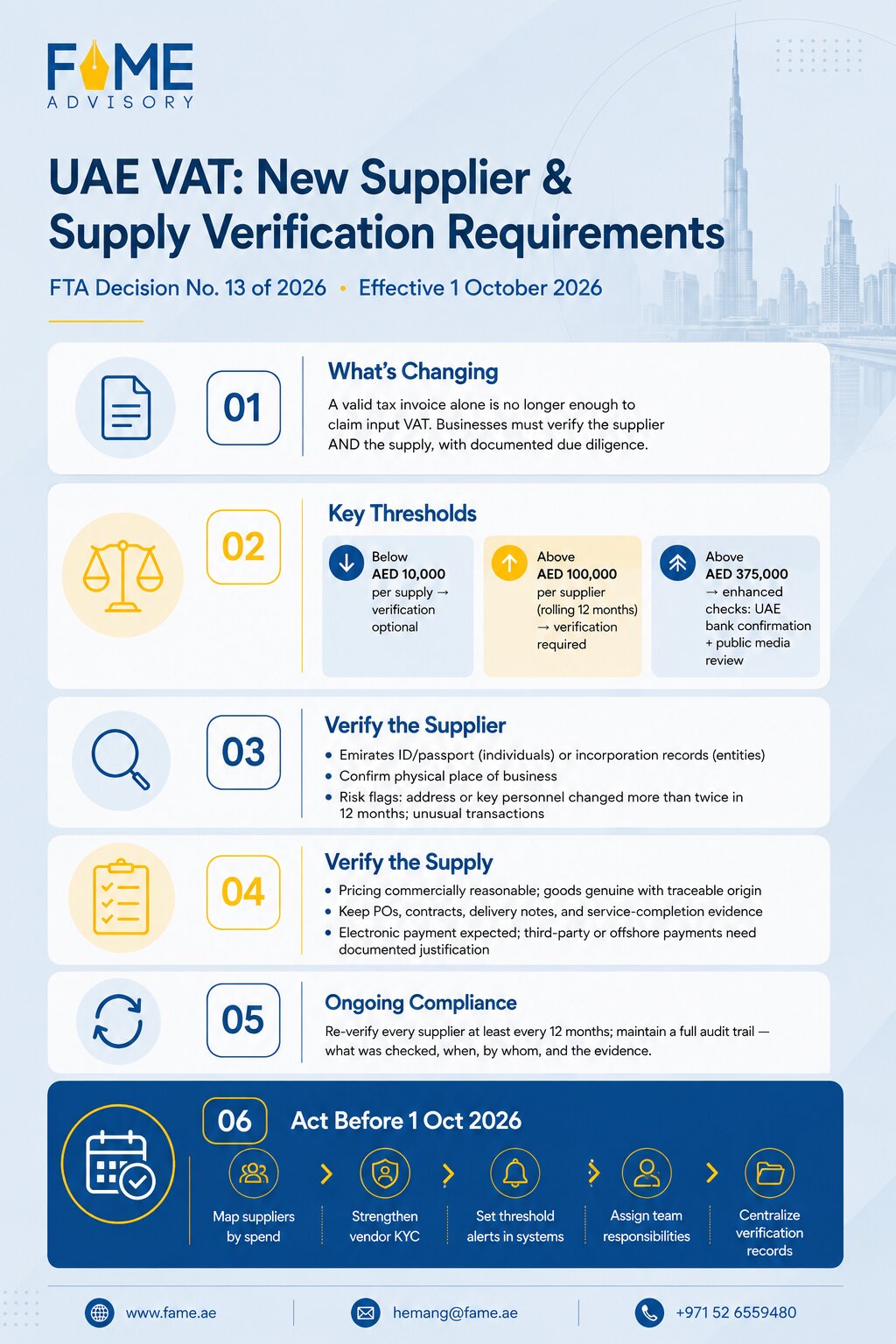
Recommended Action Plan
1. Identify the supplier population:
Prepare a comprehensive supplier list and analyse purchases on a rolling 12-month basis.
2. Categorise suppliers by value:
Identify suppliers based on the relevant thresholds, including:
- Supplies below AED 10,000 per taxable supply
- Suppliers exceeding AED 100,000 on an aggregate basis
- Suppliers exceeding AED 375,000 on an aggregate basis
3. Review vendor onboarding procedures:
Assess whether supplier identity, incorporation details, authorised representatives and business locations are adequately verified.
4. Introduce a supplier risk assessment:
Establish controls to identify changes in supplier addresses, key personnel, and unusual transaction patterns.
5. Strengthen transaction-level verification:
Ensure that contracts, purchase orders, delivery documents, service evidence and payment records adequately support the underlying transaction.
6. Establish enhanced verification procedures:
For suppliers exceeding the AED 375,000 threshold, introduce the additional bank confirmation and public-information review procedures required under the Decision.
7. Technology-driven approach:
A technology-driven approach should play a key role in this process, with accounting and tax systems configured to automatically monitor supplier transactions and identify alerts when the above threshold is approached or exceeded.
8. Develop a formal verification policy:
Clearly define the responsibilities of procurement, finance, accounts payable and tax teams, including review and approval responsibilities.
9. Maintain a centralised audit trail:
Ensure that verification records and supporting evidence are properly retained and can be readily retrieved if requested by the FTA.
Conclusion
FTA Decision No. 13 of 2026 represents an important development in the UAE VAT compliance framework.
The focus is moving beyond the traditional question:
“Do we have a valid VAT invoice?”
Businesses should now also consider:
“Have we taken appropriate and reasonable steps to verify the supplier, the transaction and the commercial substance of the supply before claiming input VAT?”
The Decision highlights the importance of strengthening supplier due diligence, procurement controls, accounts payable procedures, and VAT governance.
Businesses should therefore consider reviewing their existing processes before 1 October 2026 and implementing appropriate controls based on their supplier base, transaction volumes, and risk profile.
Search
Recent Insights