UAE VAT Clarification on Concerned Services (VATP044)

UAE VAT Clarification on Concerned Services (VATP044) in detail

Insights
UAE VAT Clarification on Concerned Services (VATP044) in detail

Purpose of the UAE VAT Clarification on Concerned Services

This Public Clarification, issued by the UAE Federal Tax Authority (FTA), provides clarification on the VAT treatment of Concerned Services. It clarifies the circumstances under which VAT must be accounted for, the requirement for issuing tax invoices, and the documentation needed to recover input tax.

1. What are Concerned Services?

Concerned Services are services received by a VAT-registered business in the UAE from a supplier outside the UAE, where the place of supply is considered to be within the UAE. These services are subject to VAT unless they would have been exempt if provided within UAE.

Example

A Dubai company hires a UK-based consultant. The UAE company must treat this as imports of services.

2. VAT Treatment – Reverse Charge Mechanism

When a UAE-registered person imports Concerned Services, the law treats this as imports of services.

Therefore, the recipient is required to:

  • Account for the output VAT using the reverse charge mechanism;
  • Report this VAT in Box 3 of the VAT return for the relevant tax period.

Example

If a UAE company pays AED 10,000 to a foreign service provider, it must account for 5% VAT (AED 500) under RCM on its VAT return in Box 3 and Box 10.

3. Requirement to Issue Tax Invoices

Generally, a tax invoice must be issued within 14 days of the date of supply. Since the recipient is treated as both the supplier and recipient, they are required to issue a tax invoice to themselves.

However, the FTA allows an exception to this requirement in the following case:

  • If the recipient retains the original invoice issued by the foreign supplier, which contains sufficient details (e.g., service description, amount paid etc), than recipient is not required to issue an additional tax invoice to themselves.

In exceptional cases where the supplier does not issue an invoice (e.g., in reinsurance), the recipient must keep alternative documentation that includes key details like:

  • Name and address of the supplier and recipient
  • Date of supply and service completion
  • Description of the service
  • Consideration including relevant currency and payment terms

If no proper invoice or acceptable documentation is available, the recipient may apply to the FTA for an administrative exception.

Example

if UAE entity receives an invoice from a US software provider showing date, service details, and amount. Then UAE entity doesn’t need to issue the TAX invoice.

4. Input Tax Recovery

A VAT-registered recipient may recover the VAT paid (input tax) under the reverse charge mechanism if the Concerned Services are used to make taxable supplies.

To recover input tax:

  • The recipient must have valid supporting documentation (e.g., a supplier’s invoice);
  • The recipient must have paid or intend to pay the consideration within six months of the agreed due date.

Input tax can be recovered in the tax period in which:

  • The tax invoice or supporting document is received and retained; and
  • The consideration has been paid (or is intended to be paid within the allowed timeframe).

Notes: 

  • This clarification reflects the FTA’s interpretation of Federal Decree-Law No. 8 of 2017 and Cabinet Decision No. 52 of 2017 and its amendments.
  • VATP044 constitutes an official clarification of the law.

UAE VAT Clarification on Concerned Services (VATP044): In Summary

Issued: 27 May 2025 by UAE Federal Tax Authority

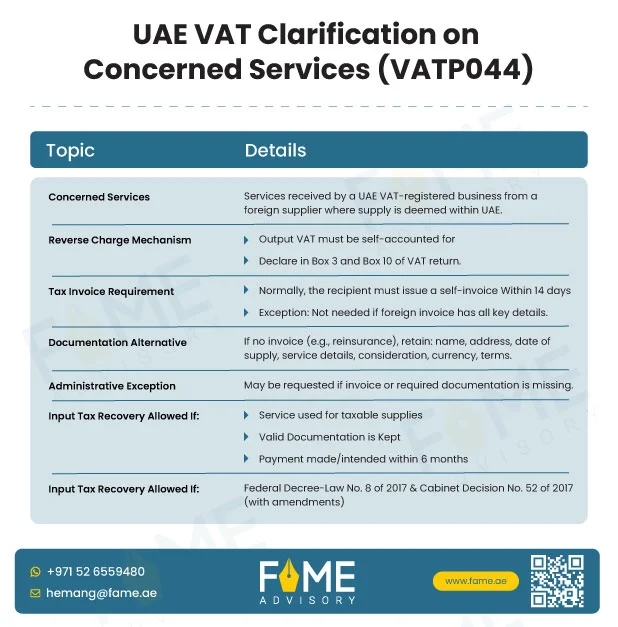
UAE VAT Clarification on Concerned Services (VATP044)
Topic
Details
Concerned Services
Services received by a UAE VAT-registered business from a foreign supplier where supply is deemed within UAE.
Reverse Charge Mechanism
Output VAT must be self-accounted for – Declare in Box 3 and Box 10 of VAT return
Tax Invoice Requirement
-Normally, the recipient must issue a self-invoice within 14 days – Exception: Not needed if foreign invoice has all key details.
Documentation Alternative
If no invoice (e.g., reinsurance), retain: name, address, date of supply, service details, consideration, currency, terms.
Administrative Exception
May be requested if invoice or required documentation is missing.
Input Tax Recovery allowed if:
-Service used for taxable supplies -Valid Documentation is Kept – Payment made/intended within 6 months
Relevant Laws
Federal Decree-Law No. 8 of 2017 & Cabinet Decision No. 52 of 2017 (with amendments)

VAT Applicability on the Real Estate Sector in the UAE

VAT Applicability on the Real Estate Sector in the UAE

Insights

VAT Applicability on the Real Estate Sector in the UAE

The introduction of Value Added Tax (VAT) in the UAE on January 1, 2018, represented a significant shift in the country’s taxation framework. The real estate sector, a key contributor to the UAE’s economy, was directly impacted by this change. VAT, at 5%, applies to goods and services, including real estate. However, the VAT treatment of real estate transactions in the UAE is distinct, with specific rules that depend on the type of property involved and the nature of the transaction. 

VAT Applicability on Real Estate Supplies in the UAE

In the UAE, the VAT treatment of real estate is categorized into two main types: commercial and residential properties. The VAT liability differs significantly depending on whether the transaction involves the supply of residential or commercial real estate. 

1. Residential Properties  

The supply of residential properties is typically exempt from VAT under UAE tax laws. This exemption applies to: 

  • The sale or lease of residential properties (houses, apartments, villas). 
  • The granting of long-term leases for residential purposes. 

This exemption aims to make residential properties more affordable and accessible for individuals and families. However, it is important to note that while the sale of residential properties is exempt from VAT, developers and property owners may still incur VAT on expenses related to the development, construction, and maintenance of residential properties. These VAT costs may be recoverable if the property is subsequently used for taxable supplies. 

2. Zero-Rating of Residential Properties 

In addition to the exemption, there are specific circumstances in which residential properties are subject to zero-rated VAT. Zero-rating means that VAT is charged at 0%, and the seller or developer can recover VAT incurred on related costs. 

  • First Supply of a Newly Constructed Residential Property: The first sale of a newly constructed residential property is subject to zero-rated VAT but it must be made within 3 years of the building’s completion date. This allows developers to recover VAT on construction and development costs, which can reduce the overall cost of building new homes. 
  • Leasing of New Residential Properties: The leasing of newly built residential properties (those never leased before) can be zero-rated, provided the lease is long-term (more than six months). Short-term leases of residential properties remain exempt from VAT. 

Exception of Zero rating the export of services 

According to Article 31 of the VAT Public Clarification on Amendments to the Executive Regulation of Federal Decree-Law No. 8 of 2017 on Value Added Tax – Cabinet Decision No. 100 of 2024 (VATP040), services directly related to real estate located in the UAE that are supplied to a non-resident do not qualify for the zero-rated export of services. 

3. Commercial Properties 

Unlike residential properties, the supply of commercial real estate is subject to VAT at the standard rate of 5%. This includes: 

  • The sale or lease of office buildings, retail spaces, and industrial properties. 
  • The supply of vacant land intended for commercial use. 

Commercial property transactions, including both the sale and leasing of such properties, attract VAT at the standard rate 5%, and the buyer or tenant is required to pay VAT on the transaction. Businesses that engage in such transactions can recover VAT paid on expenses incurred during the purchase, construction, or development of these properties, provided they are using the property for taxable business purposes. 

4. Mixed-Use Properties 

Properties that are used for both residential and commercial purposes, such as mixed-use developments, present a more complex VAT treatment. The VAT liability depends on the proportion of the property’s use that is residential versus commercial. The commercial portion will generally be subject to VAT 5%, while the residential portion will be exempt. Developers and property owners must carefully assess and allocate the VAT treatment based on the intended use of each part of the property. 

Place of Supply of Real Estate 

For real estate-related services, the place of supply is where the property is located. This includes services such as construction, leasing, and maintenance. If the property is in the UAE, the supply is considered made within the UAE, and UAE VAT applies (subject to the usual rules).  

Additional Key Points from the UAE VAT Real Estate Guide

To ensure comprehensive compliance, real estate professionals must also consider the following nuanced areas from the UAE VAT Real Estate Guide: 

1. VAT on Property-Related Services 

In addition to the sale and lease of properties, the VAT Real Estate Guide also covers property-related services that may be subject to VAT: 

  • Property Management Services: Services such as maintenance, cleaning, and security for properties, which are subject to VAT at the standard rate of 5%. However, for residential properties where the lease is exempt, related services may still attract VAT. 
  • Real Estate Agency Fees: Commissions and fees charged by real estate agents or brokers for selling or renting properties are subject to VAT at 5%. 
  • Ancillary Services: Additional services that are provided in connection with the supply of real estate, such as leasing services, parking, and utilities, may also be subject to VAT 5% depending on the nature of the service and the type of property. 

2. Sale of Land 

Sale of land is generally exempt from VAT unless the land is being developed or used for a commercial purpose. The VAT treatment on land sales depends on whether the land is sold for development or commercial use. 

  • Sale of Vacant Land: The sale of vacant land is typically exempt from VAT, but VAT may apply if the land is being used for taxable supplies or is part of a commercial development. 
  • Development of Land: If a developer constructs or improves property on the land, the resulting sale of the developed property (whether residential or commercial) may be subject to VAT 5%. The VAT Real Estate Guide encourages developers to assess the VAT implications of land sales carefully, particularly in relation to the potential for future taxable developments. 

3. Mixed-Use Developments 

For mixed-use developments (e.g., developments with both residential and commercial spaces), the VAT treatment depends on the use of the property. The residential portion is generally exempt from VAT, but the commercial portion is subject to VAT at the standard rate of 5%. 

  • Proportional Allocation: Developers and owners must properly allocate VAT treatment between the residential and commercial parts of the development. The VAT Real Estate Guide emphasizes the importance of maintaining accurate records and ensuring the correct allocation for VAT purposes. The treatment of common areas in mixed-use developments should also be assessed to determine if VAT applies to services or common property. 

Conclusion

In summary, the VAT liability for real estate in the UAE varies based on the type of property and the nature of the transaction: 

  • Residential properties: Typically exempt from VAT, but subject to zero-rated VAT for the first sale of new homes and leases of new residential properties. 
  • Commercial properties: Subject to VAT at 5% for both sales and leases. 
  • Mixed-use properties: VAT applies to the commercial portion of the property; the residential portion is exempt. 
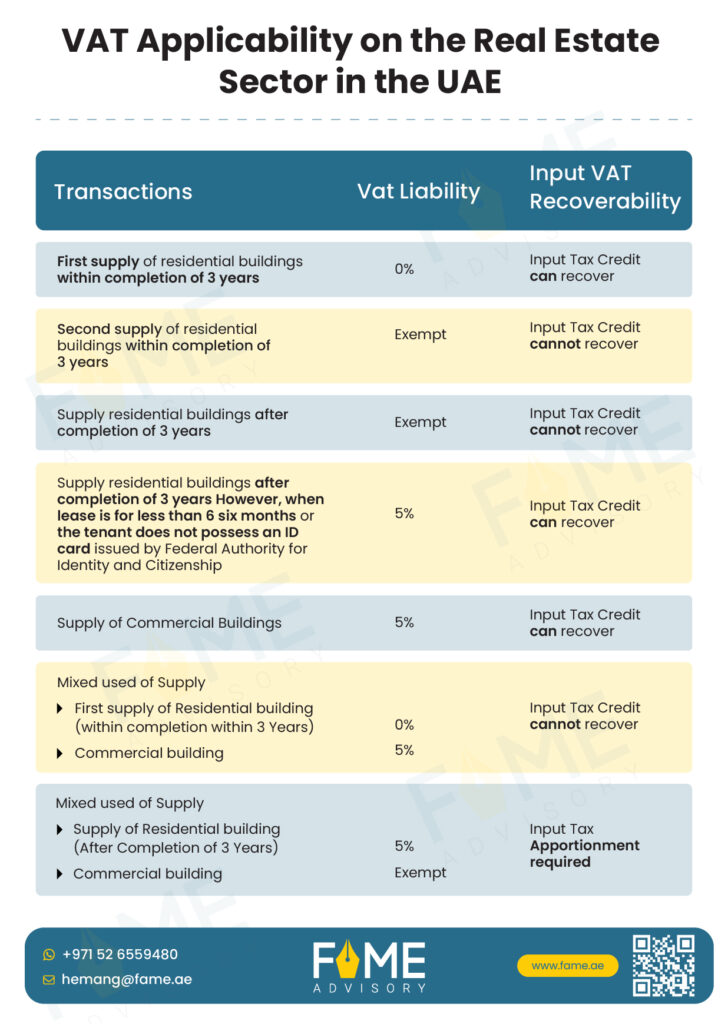
VAT Applicability on the Real Estate Sector in the UAE
Transactions
VAT Liability
Input VAT Recoverability
First supply of residential buildings within completion of 3 years
0%
Input Tax Credit can recover
Second supply of residential buildings within completion of 3 years
Exempt
Input Tax Credit cannot recover
Supply residential buildings after completion of 3 years
Exempt
Input Tax Credit cannot recover
Supply residential buildings after completion of 3 years However, when lease is for less than 6 six months or the tenant does not possess an ID card issued by Federal Authority for Identity and Citizenship
5%
Input Tax Credit can recover
Supply of Commercial Buildings
5%
Input Tax Credit can recover
Mixed used of Supply
Input Tax Credit can recover
1. First supply of Residential building (within completion within 3 Years)
0%
2. Commercial building
5%
Mixed used of Supply
Input Tax Apportionment required
1. Supply of Residential building (After Completion of 3 Years)
Exempt
2. Commercial building
5%

These guidelines ensure that the real estate sector operates within the VAT framework while balancing the need for affordable housing with the commercial viability of development projects. Real estate professionals must remain mindful of the specific VAT treatments applicable to their transactions to ensure compliance with UAE tax laws. 

Understanding these provisions, as outlined in the UAE VAT Real Estate Guide, is crucial for developers, investors, and property owners navigating the real estate market in the UAE. 

FTA Clarifies UAE VAT Amendments in VATP040

Insights

The Federal Tax Authority (FTA) in the United Arab Emirates (UAE) has released its Value Added Tax (VAT) on Amendments to the VAT Executive Regulation which were effective from 15 November 2024. To provide further clarity, the FTA published Public Clarification VATP040 regarding these amendments on March 14, 2025.

FTA Clarifies UAE VAT Amendments in VATP040

Clarifications on changes in documentary requirements for export of goods (Article 30)

The recent Public Clarification has provided clarity on the amendments to Article 30 of the Executive Regulation, which aim to streamline the proof requirements for suppliers applying the zero-rate for exporting goods, whether directly or indirectly. 

The updated regulations allow taxable persons exporting goods to retain any of the following documentation: 

  • Customs declarations and commercial evidence verifying export. 
  • Shipping certificates and official proof of export. 
  • For goods under customs suspension as per the GCC Common Customs Law, customs declarations confirming the suspension status. 

Starting from 15 November 2024, additional official evidence forms will be accepted, including: 

  • Export certificates issued by local customs authorities, confirming the goods have departed the UAE. 
  • Clearance certificates from local customs or relevant UAE authorities. 
  • Certified documents from authorities in the destination country confirming the goods’ entry. These documents must clearly display official stamps or seals and be either in Arabic or English, or include a certified translation should be retained in one of these languages. 

It is important to note that exports made before 15th November 2024 will still be subject to the previous documentary evidence requirements under Article 30. Before this date, both a customs declaration and an exit certificate will continue to be required as proof of export 

Zero-rated services (Article 31)

Recent changes to Article 31 of the Executive Regulation clarify when services provided to non-residents do not qualify for zero-rating under UAE VAT law. The term “personal” has been removed from “personal moveable assets,” meaning any moveable assets located in the UAE at the time of service now disqualify the supply from zero-rating.

The following services supplied to a non-resident do not qualify for zero rating under this Article: 

  • Installation Services related to goods supplied by others; the place where the service is performed.  
  • Transport Services Provided to lessees who are not taxable persons; the place where the means of transport were placed at the disposal of the lessee.  
  • Hospitality Services: Restaurant, hotel, and catering services; at the location of service performance.  
  • Cultural and Educational Services; place where the services are performed.  
  • The supply of services that are directly connected with real estate located in the UAE.  
  • Transportation Services; place where the transportation begins.  
  • Telecommunications and Electronic Services; where the services are enjoyed 

Zero-rating international transportation services (Article 33)

The Public Clarification outlines the VAT treatment of international transportation services under Article 33, emphasizing conditions for applying the zero-rate. 

  • Domestic transportation of goods can be zero-rated only when it is supplied by the same entity that provides the international leg of the transport. If different parties handle each segment, the domestic portion does not qualify for zero-rating. 
  • Zero-rating applies only to services provided directly to the recipient of the international transport. Any supporting services offered to third parties (e.g., warehousing or handling provided to someone other than the transport recipient) are subject to the standard VAT rate. 

Zero-rating goods and services in connection with means of transport (Article 35)

Article 35 is hereby amended to specify that only the following services, when supplied directly in connection with a qualifying means of transport, shall be eligible for zero-rating: 

  • Repair Services: when the repair services are carried out onboard. 
  • Maintenance Services: Includes inspection, testing, cleaning, and similar services if carried out onboard. 
  • Conversion Services: Should maintain compliance with conditions of Article 34 on post-conversion. 

Tax Treatment for financial service (Article 42)

The recent amendment to Article 42(2) introduces additional categories of financial services. However, it is important to emphasize that inclusion under Article 42(2) does not automatically qualify a service for VAT exemption. 

The actual application of the exemption is determined under Article 42(3), which sets out the specific conditions that must be met. Only services that satisfy these criteria are eligible for VAT exemption, regardless of their listing in Article 42(2). 

The following newly added categories in definition of financial services has been clarified through this public clarification –  

  • Management of investment funds – Services provided by an independent fund manager to funds licensed by the UAE authority, including the management of the fund’s operations, the management of investment for or on behalf of the fund, monitoring and improvement of the fund’s performance, are exempt from VAT. 
  • Transferring ownership of virtual assets and conversion of Virtual Assets – This includes virtual currencies like bitcoin and conversion of virtual assets. These services are exempt from VAT retroactively from 1 January 2018. 
  • Keeping and managing Virtual assets – Services related to keeping and managing virtual assets (e.g., managing crypto wallets) are taxable if supplied in the UAE for an explicit fee, commission, or similar charge. Crypto currencies are a subset of virtual currencies and from a VAT perspective are not regarded nor treated as money. 

It clarifies that Investment fund management services, transfer of virtual assets/currencies and conversion of virtual assets are considered as exempt financial services from VAT. Therefore, taxable person only engaged in these supplies has to assess the recoverability of input VAT and necessity of VAT-Deregistration. 

Input VAT Recovery on Health Insurance for dependent (Article 53 - Non-Recoverable Input tax)

This article is amended to allow recovery of input VAT for health insurance, including enhanced health insurance for employees and their dependents within the limit of one spouse and three children under the age of 18. 

The public clarification has clarified that this amendment is only effective from 15 November 2024 and shall not be applied retrospectively. 

For example, if the employer paid health insurance premiums in January 2024 in respect of the full calendar year, only the VAT incurred on the portion relating to the period 15 November to 31 December 2024 may be recovered to the extent the employer incurs these costs to make taxable supplies, and provided the relevant supporting documents are retained. 

Input Tax Apportionment (Article 55)

Article 55 now clarifies that standard input tax apportionment also applies to government entities and charities. Notwithstanding the amendments introduced under Article 55(7)(a)—which clarify the “sum of input tax for the tax period”, the simplified input tax apportionment method as outlined in “VATGIT1” still be used. 

Other Key Changes

Further clarifications have been issued regarding the updated VAT Executive Regulation. Below is a illustrative list of the topics that have been addressed: 

  • Tax registration cancellation and deregistration – The authority has the right to cancel a VAT registration of a taxpayer under certain circumstances (e.g., registration requirements not met) and also now deregister entities that have applied but not completed deregistration or no longer meet VAT registration conditions. 
  • Profit margin scheme – The definition of “purchase price” has been clarified to includes all costs and fees incurred in addition to the price of the goods. 
  • Tax invoice requirements – New timelines have been introduced to issue summary tax invoices (in case of multiple supply to same person). Now, business has 14 days from the end of calendar month to issue summary tax invoices. 
  • Tax Credit Note – FTA clarify the treatment of multiple tax credit notes issued for the same tax invoice. In such cases, the “value of supply shown on the tax invoice” in any subsequent credit note should reflect the adjusted value after accounting for the previous credit note(s). 
  • Zero-rating healthcare services- Article 41(4) of the Executive Regulation was amended to clarify that not only a supply, but also an import of the goods referred to in that Clause may qualify for zero-rating 

It is important for all taxpayers to familiarize themselves with the published changes and clarifications, and assess their impact on their business. Businesses should conduct an internal review to determine whether they are in compliance with the updated Executive Regulation and Public Clarification. 

VAT Treatment of Barter Transactions – VATP042

VAT Treatment of Barter Transactions, VATP042

Insights

VAT Treatment of Barter Transactions, VATP042

The Federal Tax Authority (FTA) has issued a Public Clarification (VATP042) to clarify the VAT treatment of barter transactions. In this clarification, the FTA outlines the tax applicability of non-monetary transactions and provide detailed guidance on methods to determine the market value of the goods or services involved in the barter.

What are Barter Transactions?

Transactions which involve the exchange of goods and/or services are known as barter transactions.

VAT Treatment of Barter Transactions

Barter transactions are treated similarly to supplies made for monetary consideration for VAT purposes, with a few key differences compared to non-barter transaction:

  1. A barter transaction involves at least two supplies, with each party making a supply to the other.
  2. Special valuation rules apply to barter transactions.

VAT Treatment of Supplies in Barter Transactions

Each party must evaluate the VAT treatment of the goods or services they are providing. A supply in a barter transaction can be:

  1. Taxable at 5%: Subject to VAT at the standard rate.
  2. Zero-rated: Subject to VAT at 0% if specific requirements are met.
  3. Exempt: Not subject to VAT if specific requirements are met.
  4. Out of Scope: If the place of supply is outside the UAE.

Valuation of Supply

  • Generally, the value of the supply is the consideration less the tax amount.
  • The value of supply within a barter transaction is the market value of the non-monetary consideration received by a supplier excluding the tax amount

Where a supplier receives both monetary and non-monetary consideration

To the extent the consideration is non-monetary, the transaction constitutes a barter transaction, and the value of the supply is the sum of

– Any monetary consideration received.

– The market value of the non-monetary consideration, excluding tax.

Determining Market Value of Non-Monetary Consideration

To the extent the consideration is non-monetary, the transaction constitutes a barter transaction, and the value of the supply is the sum of

  • Any monetary consideration received.
  • The market value of the non-monetary consideration, excluding tax.

Determining Market Value

To determine the market value of non-monetary consideration, the following principles apply:

  1. Similar supply in the UAE:

The market value of a supply of goods or services is the amount of monetary consideration it would typically fetch if supplied under similar circumstances in the UAE, between unrelated parties dealing freely and independently.

Example: A graphic designer provides logo design services valued at AED 2,000 (inclusive of VAT) to a software developer in exchange for AED 1,000 in cash and a software license worth AED 1,000. Both parties are required to account for VAT as follows:

  • The graphic designer accounts for VAT of AED 95.24 (calculated as AED 2,000 × 5/105).
  • The software developer accounts for VAT of AED 47.62 (calculated as AED 1,000 × 5/105).
  1. Alternative approach:

If the market value can’t be determined using principle 1, it’s considered to be the monetary consideration a similar supply would fetch in similar circumstances in the UAE, between unrelated parties dealing freely and independently.

Example:

An artist exchanges a painting with a photographer for photographic services. Although the specific painting isn’t sold in the market, similar artworks are sold to unrelated buyers in the UAE for AED 20,000 then the market value of the supply will be considered AED 20,000 for VAT purposes.

  1. Replacement cost:

If principles 1 and 2 don’t apply, the market value is the replacement cost of identical goods or services offered by an unrelated supplier.

Example:

A company exchanges goods for custom-made machinery. Since similar machinery is not sold in the market, the market value is determined by the cost of an unrelated supplier to build identical machinery, say AED 80,000. This becomes the market value.

Both parties to a barter transaction must apply these valuation rules to the supplies they make.

Tax Invoices

Registrants making taxable supplies, including those under barter agreements, must issue a tax invoice to the recipient. In a barter transaction where both parties are registrants and make taxable supplies, each party is required to issue a tax invoice to the other.

Example:

A VAT-registered web development firm and an advertising agency have entered into a barter agreement involving the exchange of services. Under this agreement, the web development firm will provide website design services valued at AED 30,000 (inclusive of VAT), while the advertising agency will offer social media advertising services valued at AED 20,000 (inclusive of VAT) and will pay AED 10,000 in cash.

Tax Invoice Requirements:

  1. Web Development Firm’s Tax Invoice
    • Value of supply (Net Amount): AED 28,571.43
    • VAT (5%): AED 1,428.57
    • Total Consideration (Gross Amount): AED 30,000
  2. Advertising Agency’s Tax Invoice
    • Value of supply (Net Amount): AED 19,047.62
    • VAT (5%): AED 952.38
    • Total Consideration (Gross Amount): AED 20,000

The Public Clarification offers essential guidance on the application of VAT for barter transactions. It clarifies how to determine the value of supplies in such cases and simplifies VAT obligations for non-monetary exchanges, ensuring compliance with tax regulations.

UAE eInvoicing Model Explained: Data Dictionary

Inside-UAE’s-eInvoicing-Model-Mandatory-Fields-Explained-from-the-MoF-Consultation-Paper

Insights

Inside-UAE’s-eInvoicing-Model-Mandatory-Fields-Explained-from-the-MoF-Consultation-Paper

On the introduction of e-Invoicing in the United Arab Emirates, Ministry of Finance (MoF), UAE has released an eInvoicing Programme Consultation Paper (Consultation Document) which outlines the main features of the proposed e Invoicing model, the framework of e Invoicing in the UAE and the expected Data Dictionary, along with specific use cases.

Our article has been published, covering the background of eInvoicing, the UAE eInvoicing framework, and an overview of the Data Dictionary (https://fame.ae/uae-ministry-of-finance-program-for-e-invoicing-in-uae/) .As a continuation, we now outline the contents of the Data Dictionary, providing explanations of the mandatory fields.

Decoding UAE’s eInvoicing Data Dictionary: Mandatory Fields You Must Know

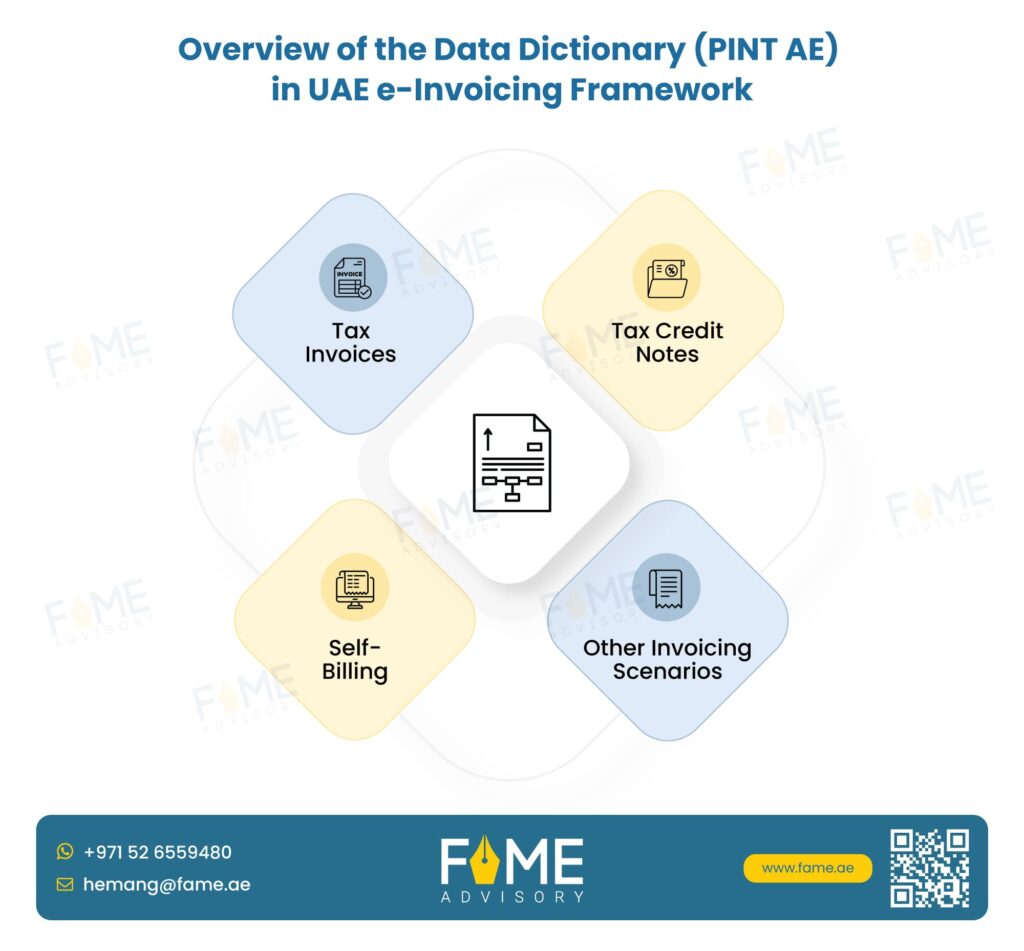
Consultation paper of MoF elaborate “Data Dictionary” which forms the basis of eInvoicing and outlines the essential data elements (fields) and their attributes for the most commonly used invoice types by businesses in the UAE. It covers tax invoices, tax credit notes, self-billing, and other relevant scenarios. There are minimum required fields for issuing tax invoices (50 fields) and commercial invoices (49 fields) in XML format, including several that are not currently addressed by UAE VAT legislation. The Consultation Document also confirms the presence of additional conditional fields in the complete Data Dictionary, which is yet to be published.

The below table lists the mandatory fields when issuing a tax invoice:

Invoice Details

Invoice Details

1. Invoice Number (IBT-01)

A unique identifier for the invoice, mandatory for all invoices. The invoice number must be provided to ensure traceability and compliance with UAE standards.

2. Invoice Issue Date (IBT-02)

The date when the invoice was issued, formatted as YYYY-MM-DD. This is mandatory and must adhere to specific formatting rules for consistency.

3. Invoice Type Code (IBT-03)

A code specifying the functional type of the invoice (e.g., standard, credit note). It must follow the UNTDID 1001 code list.

4. Invoice Transaction Type Code (BT UAE-02)

A sequence of flags identifying the transaction type (e.g., Free Trade Zone, Deemed Supply). Each flag indicates applicability (1) or non-applicability (0).

5. Invoice Currency Code (IBT-05)

The currency in which all invoice amounts are given, except for the total tax amount in accounting currency. It must use ISO 4217 alpha-3 codes.

6. Payment Due Date (IBT-09)

The date by which payment is due. This is mandatory when the payment amount is greater than zero and must follow the YYYY-MM-DD format.

7. Business Process Type (IBT-023)

Identifies the business process context (e.g., billing) to enable proper invoice processing. It must follow the format urn:peppol:bis:billing.

8. Specification Identifier (IBT-024)

An identifier for the specification containing the rules for semantic content, cardinalities, and business rules. It must start with urn:peppol:pint:billing-1@ae-1.

9. Payment Means Type Code (IBT-081)

A code indicating how payment is expected or settled (e.g., bank transfer). Must use UNCL4461 codes.

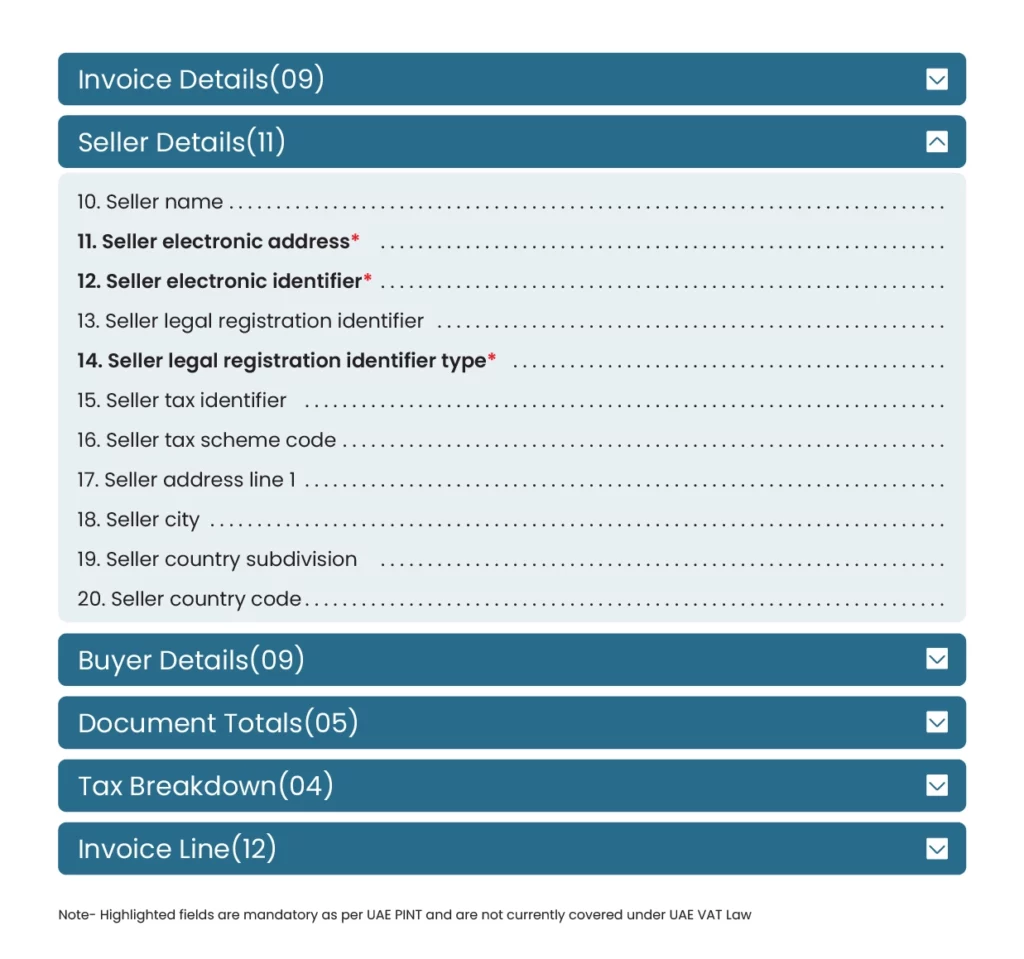
Seller Details

10. Seller Name (IBT-027)

The full legal name of the seller as registered in the national registry or as a taxable entity.

11. Seller Electronic Address (IBT-034)

The seller’s electronic address for invoice delivery. It must include a scheme identifier (e.g., CEF EAS code list).

12. Scheme identifier

The scheme identifier shall be chosen from a list to be maintained by the Connecting Europe Facility. 

13. Seller Legal Registration Identifier (IBT-030)

An official identifier for the seller as a legal entity. It must occur at most once and follow specific formatting rules depending on the scheme.

14. Seller Legal Registration Identifier Type

To identify the nature of commercial registration number issued in UAE.

15. Seller Tax Identifier (IBT-031)

The seller’s tax identification number (TRN). It must be 15 alphanumeric digits, starting with 1 and ending with 03.

16. Seller Tax Scheme Code (IBT-031-1)

The scheme of the tax identifier. Default Value of VAT to be used. Must be coded using one of the ISO 6523 ICD list. 

17. Seller Address Line (IBT-035)

The main address line of the seller’s postal address. Mandatory and part of the seller’s postal address.

18. Seller City

The city, town, or village where the seller is located. Mandatory and part of the seller’s postal address.

19. Seller Country Subdivision (IBT-039)

The region, state, or province of the seller’s address. For UAE, it must be one of the emirates (e.g., DXB, AUH).

20. Seller Country Code

A code identifying the seller’s country, using ISO 3166-1. 

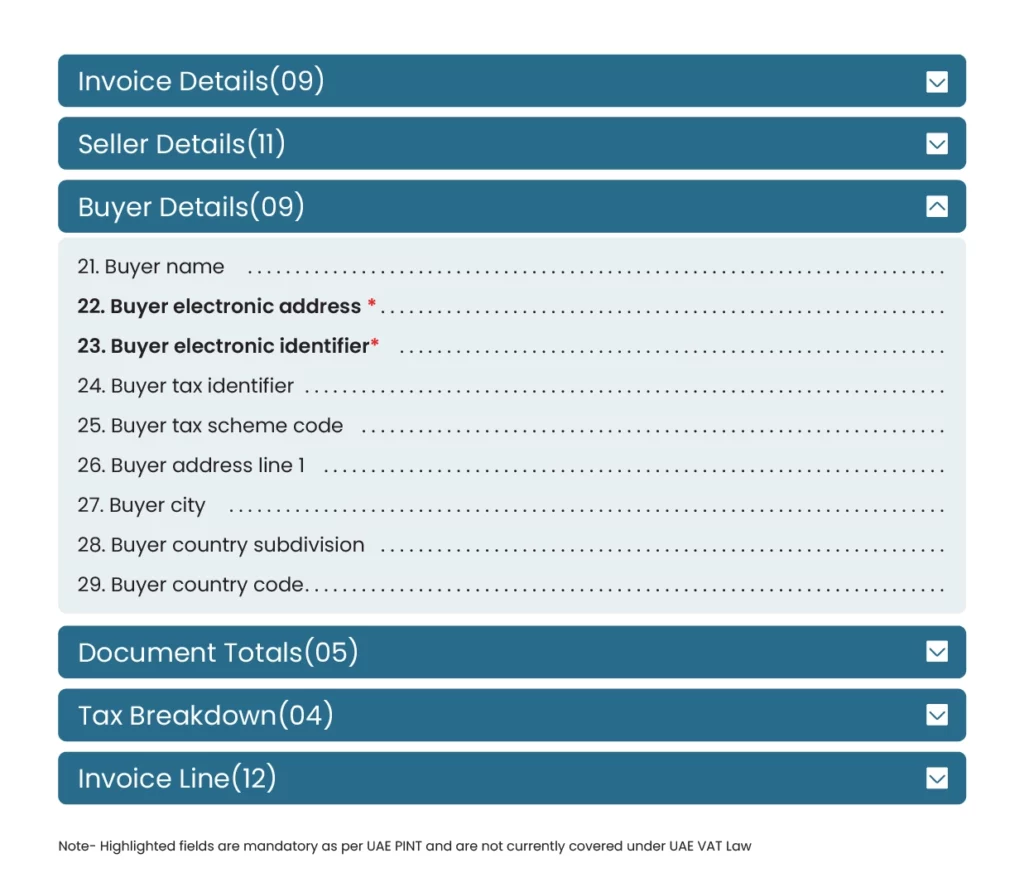
Buyer Details

21. Buyer Name (IBT-044)

The full name of the buyer. Mandatory and must occur at most once.

22. Buyer Electronic Address (IBT-049)

The buyer’s electronic address for invoice delivery. Must include a scheme identifier (e.g., CEF EAS code list).

23. Scheme identifier (IBT-049-1)

The scheme identifier shall be chosen from a list to be maintained by the Connecting Europe Facility. 

24. Buyer Tax Identifier (IBT-048)

The buyer’s tax identification number (e.g., TRN). Must be 15 alphanumeric digits, starting with 1 and ending with 03.

25. Buyer Tax Scheme Code

The scheme of the tax identifier. Default Value of VAT to be used. 

26. Buyer Address Line (IBT-050)

The main address line of the buyer’s postal address. Mandatory and part of the buyer’s postal address.

27. Buyer City (IBT-052)

The city, town, or village where the buyer is located. Mandatory and part of the buyer’s postal address.

28. Buyer Country Subdivision (IBT-054)

The region, state, or province of the buyer’s address. For UAE, it must be one of the emirates (e.g., SHJ, RAK).

29. Buyer Country Code (IBT-055)

A code identifying the buyer’s country, using ISO 3166-1. 

Document Totals

30. Sum of Invoice Net Amount (IBT-106)

The total of all invoice line net amounts before tax. Mandatory and must match the sum of individual line amounts.

31. Invoice Total Amount Without Tax (IBT-109)

The total invoice amount excluding tax. Must have no more than 2 decimals.

32. Invoice Total Tax Amount (IBT-110)

The total tax amount for the invoice. Must equal the sum of tax category amounts and have no more than 2 decimals.

33. Invoice Total Amount with Tax (IBT-112)

The total invoice amount including tax. Must equal the sum of the net amount and total tax amount.

34. Amount Due for Payment (IBT-115)

The outstanding amount requested for payment. Must account for paid amounts and rounding adjustments.

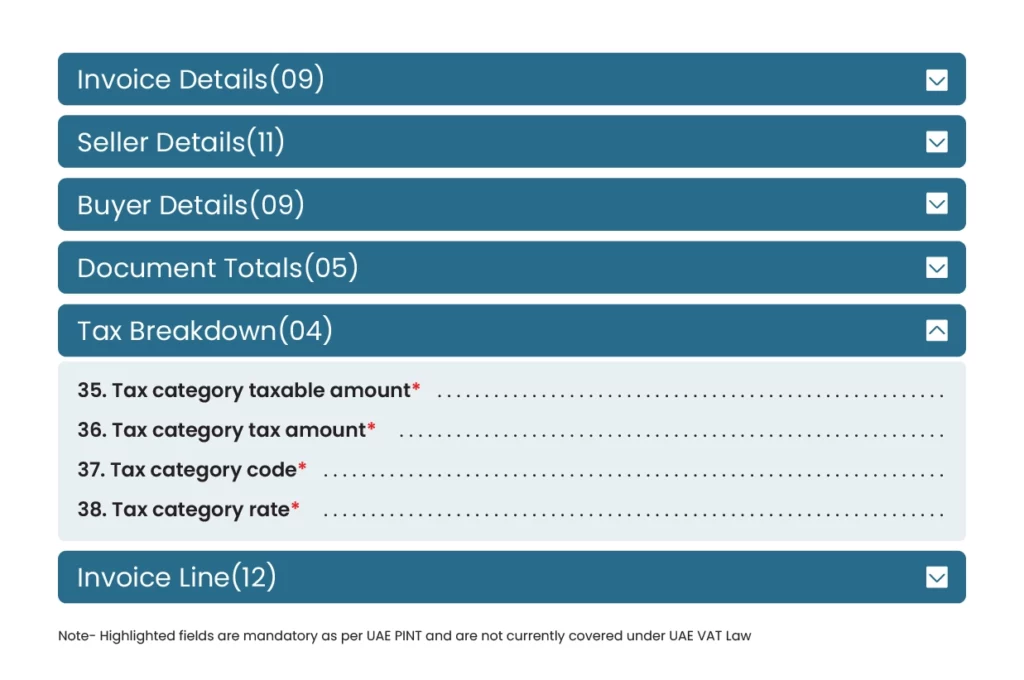
Tax Breakdown

35. Tax Category Taxable Amount (IBT-116)

The sum of taxable amounts subject to a specific tax category. Must align with the applicable tax rate.

36. Tax Category Tax Amount (IBT-117)

The total tax amount for a given tax category. In tax category code (IBT-118) is “Standard Rate”, Tax category tax amount (IBT-117) shall equal to Tax category taxable amount (IBT-116) multiplied by the Tax category rate (IBT-119) / 100

37. Tax Category Code (IBT-118)

A code identifying the tax category (e.g., “Standard Rate”). Must align with the invoiced item tax category.

38. Tax Category Rate (IBT-119)

The tax rate percentage for a specific category.

Invoice Line

39. Invoice Line Identifier (IBT-126)

A unique identifier for each invoice line. Mandatory for all lines.

40. Invoiced Quantity (IBT-129)

The quantity of goods or services charged in the invoice line.

41. Unit of Measure Code (IBT-130)

The unit of measure for the invoiced quantity. Must use UN/ECE Recommendation 20 codes.

42. Invoice Line Net Amount (IBT-131)

The total amount of the invoice line before tax. Must equal the invoiced quantity multiplied by the net price.

43. Item Net Price (IBT-146)

The unit price after discounts, excluding tax. Must equal the gross price minus any discounts.

44. Item Gross Price (IBT-148)

The unit price before discounts and tax. Must not be negative.

45. Item Price Base Quantity (IBT-149)

The number of item units to which the price applies. Must be a positive number above zero.

46. Invoiced Item Tax Category Code (IBT-151)

The tax category code for the invoiced item (e.g., “Standard Rate”). Must align with the tax breakdown.

47. Invoiced Item Tax Rate (IBT-152)

The tax rate percentage for the invoiced item. Must not be zero for standard rates.

48. VAT Line Amount (BT UAE-08)

The tax amount for each line item. For standard rates, it equals the net amount multiplied by the tax rate.

49. Item Name (IBT-153)

The name of the invoiced item. Mandatory for all invoice lines.

50. Item Description (IBT-154)

A description of the invoiced item. Mandatory and must occur at most once per line.

Bridging the Gap: Traditional VAT Invoice vs. Structured e-Invoice in the UAE

Tax Invoice (Current)

E-Invoice

Format

PDF/paper accepted

Structured (XML/UBL)

Mandatory Fields

  • Supplier’s name, address, and TRN (Tax Registration Number).
  • Buyer’s name, address, and TRN (if registered).
  • Invoice number and issue date.
  • The date of supply if different from the date the Tax Invoice was issued
  • Description of goods/services.
  • For each Good or Service, the unit price, the quantity or volume supplied, the rate of Tax and the amount payable expressed in AED
  • The amount of any discount offered
  • The gross amount payable expressed in AED.
  • The Tax amount charged under the provisions of the Decree-Law expressed in AED, together with the rate of exchange applied where the currency is converted from a currency other than the UAE dirham
  • Where the invoice relates to a supply under which the Recipient of Goods or Recipient of Services is required to account for Tax, a statement that the Recipient is required to account for Tax, and a reference to the relevant provision of the Decree-Law

Structured (XML/UBL)

Real-Time Reporting

No

Yes

A Program for e-Invoicing in UAE by the Ministry of Finance

e-invoicing in UAE

Insights
e-invoicing in UAE

Objectives of the Public Consultation Document on e-Invoicing in UAE

To help businesses adapt to digital transformation, the UAE Ministry of Finance (MoF) released a Public Consultation Document on February 7, 2025, which outlines the standard data requirements for e-invoices. The main goals of this effort are: 

1. Create a common understanding of E-Invoicing rules  

This means making sure everyone understands the requirements for using E-Invoicing 

2. Help businesses get ready for E-Invoicing

This will assist businesses in preparing to use E-Invoicing when they are required. 

3. Make sure invoice data is consistent and standardized

This will ensure that the information on invoices is the same across all types of documents, making it easier for everyone to use and understand. 

What is e-Invoicing in UAE

E-invoicing is the digital version of paper or PDF invoices, using a format that can be read by machines and checked in real-time. In the UAE, a system called Decentralized Continuous Transaction Control (DCTCE) is used, where invoices are first checked by approved service providers (ASPs) before being sent to buyers and tax authorities. This helps ensure that invoices are accurate, clear, and follow tax rules. 

The e-Invoicing Data Dictionary (PINT AE)

The E-Invoicing Data Dictionary (PINT AE) outlines the key data fields and their characteristics for the most common types of invoices used by businesses in the UAE. It highlights the need for standardization to make sure that different invoice types are consistent. This standardization is important for smooth integration, efficient processing, and ensuring that E-Invoicing works well across the UAE’s business system. 

Excluded Transaction: A business transaction that doesn’t require E-Invoicing exchange or reporting. 

It is important to note that E-Invoicing will be rolled out in a phased manner. 

The E-invoicing framework encompasses all Business-to-Business (B2B) and Business-to-Government (B2G) transactions, regardless of the VAT registration status of the entities involved. 

Is your business prepared for the UAE’s e-Invoicing implementation? FAME ensures seamless compliance with expert advisory.

Background: UAE e-Invoicing Program

The UAE E-Invoicing program aligns with global trends in Digital Reporting Requirements (DRR) and Continuous Transaction Controls (CTC), reflecting the increasing adoption of digital tax compliance measures worldwide. 

We the UAE 2031 vision, are as follows:

  1. VAT Compliances: – Maximize VAT compliance, tackle the shadow economy, and shrink the tax gap.  
  2. Effectiveness: Increase transparency and improve audits with a view to encouraging a long-term culture of compliance. 
  3. Taxpayer experience: Enhance taxpayer and user experiences, potentially offering new and innovative engagements.  
  4. Digitalization: Reduce human intervention in certain business and tax reporting processes with a view to making the UAE and its fiscal ecosystem more digitally enabled. 
  5. Efficiency: Optimize cost and core operations, reduce processing time and encourage a reduction in paper wastage with a view to helping meet sustainability objectives.  
  6. Economic contribution: Contribute to the growth and competitiveness of the economy and utilize big data.  
  7. Contribute for policy making and government interventions: By adopting E-Invoicing, UAE government will have access to the relevant data in near real-time which will help in providing deep insights to policy makers for identifying areas and sectors that need government support and assistance. 

Framework for e-Invoicing in UAE

The UAE e-Invoicing requirements apply to all businesses operating in the UAE, regardless of their VAT registration status, ensuring comprehensive adoption across the business ecosystem. 

The UAE has implemented a Decentralized Continuous Transaction Control and Exchange (DCTCE) model, a modern approach to electronic invoicing that leverages decentralized technologies to enhance: 

Efficiency – Streamlining transaction processing and reducing administrative burdens. 

Security – Strengthening data protection and fraud prevention. 

Transparency – Ensuring real-time visibility and compliance with regulatory requirements. 

The UAE E-Invoicing process follows a structured approach involving multiple stakeholders to ensure compliance, validation, and seamless transaction processing. Below is a step-by-step breakdown of the E-Invoicing exchange and reporting mechanism: 

Let’s break this process down with a simple example to explain it step by step: 

Example Scenario: 

  • Supplier (C1) is a business that sells products. 
  • Buyer (C4) is the business that purchases these products. 
  • Corner 2 (C2) is the service provider that helps the Supplier send the eInvoice. 
  • Corner 3 (C3) is the service provider that helps the Buyer receive the eInvoice. 
  • Corner 5 (C5) is a system that handles and validates tax-related data. 

UAE e-Invoicing Process: A Step-by-Step Overview

Step 1: Supplier sends the eInvoice 

  • Supplier (C1) creates an eInvoice in the agreed format (PINT AE format) and submits it to their service provider, Corner 2 (C2). 
  • Example: Supplier C1 is sending an invoice for 100 products sold to Buyer C4. 

Step 2: Corner 2 validates and converts the invoice 

  • Corner 2 (C2) receives the eInvoice data from C1, checks if it’s correct, and if needed, converts it into the standard UAE eInvoice XML format. 
  • Example: C2 receives the eInvoice in the PINT AE format and converts it into the XML format used in the UAE. 

Step 3: Corner 2 sends the eInvoice to the Buyer’s service provider 

  • C2 then sends the eInvoice (now in XML format) to Corner 3 (C3), the Buyer’s service provider and buyer will be able to see and approve. 
  • Example: C2 sends the invoice data to C3 so that Buyer C4 can see it. 

Step 4: Corner 2 reports Tax Data to Corner 5 

  • Corner 2 (C2) also reports the Tax Data Document (TDD) to Corner 5 (C5), which handles tax data validation. 
  • Example: C2 reports the tax details related to the eInvoice to C5. 

Step 5: Corner 3 validates the eInvoice 

  • Corner 3 (C3) checks the eInvoice received from C2 and confirms if it’s valid.  
  • If everything is correct, C3 sends a Message Level Status (MLS) back to C2, confirming the eInvoice has been successfully processed. 
  • If there’s an issue with the invoice, C3 sends a negative MLS to C2 and C5. 
  • Example: C3 checks the eInvoice and if it’s valid, it sends a message saying “Invoice approved” to C2. 

Step 6: Corner 3 sends the eInvoice to the Buyer 

  • C3 sends the eInvoice to Buyer (C4) in the agreed format. 
  • Example: C3 delivers the approved invoice to Buyer C4. 

Step 7: Corner 3 reports Tax Data to Corner 5 

  • If the eInvoice is validated successfully, C3 also reports the Tax Data Document (TDD) to C5. 
  • Example: After confirming the eInvoice is correct, C3 sends the tax details to C5 for final validation. 

Step 8: Corner 5 confirms TDD reporting to Corner 2 

  • Corner 5 (C5) sends a confirmation MLS to C2, letting them know the TDD has been successfully reported and validated. 
  • Example: C5 tells C2, “The tax data has been successfully validated.” 

Step 9: Corner 5 confirms TDD reporting to Corner 3 

  • C5 also sends a confirmation MLS to C3, letting them know that the TDD has been validated. 
  • Example: C5 tells C3, “The tax data has been successfully validated.” 

Step 10: Corner 2 sends the MLS to Supplier 

  • C2 sends both the Message Level Status (MLS) from C3 (for processing the invoice) and C5 (for reporting the TDD) to the Supplier (C1). 
  • Example: C2 tells Supplier C1, “The invoice has been processed and tax data reported successfully.” 

Step 11: Corner 3 sends the MLS to Buyer 

  • C3 sends the MLS received from C5 (confirming TDD reporting) to the Buyer (C4). 
  • Example: C3 informs Buyer C4, “The tax data for your invoice has been successfully validated.” 

Summary: 

In this process, the eInvoice is created by the Supplier, validated by the Service Providers (C2 and C3), and passed between them. Tax-related data is also reported to Corner 5 (C5) for validation. Once everything is confirmed, status messages (MLS) are sent back to everyone involved, ensuring that all parties are informed about the success or failure of the invoice processing. 

Overview of Data Dictionary (PINT AE) in the UAE e-Invoicing Framework

Data Dictionary (PINT AE) is a fundamental component of the UAE E-Invoicing framework, providing a structured and standardized catalog of all data elements involved in generating, exchanging, processing, and reporting E-Invoicing  

This includes the following: 

As a foundational reference, the Data Dictionary ensures the following: 

  1. Consistency – Standardized data fields across all E-Invoicing processes. 
  2. Interoperability – Seamless integration between businesses, software providers, and regulatory systems. 
  3. Compliance – Alignment with UAE tax regulations and reporting requirements. 

By serving as a universal guide for businesses, software developers, and regulatory bodies, the Data Dictionary plays a crucial role in ensuring a transparent, efficient, and compliant E-Invoicing system. 

While we await further guidance, the Ministry of Finance (MoF) will continue to provide updates on the types of transactions and businesses that will be included in the upcoming phases of e-invoicing implementation. 


Need help with your e-Invoicing compliance? Our expert advisors make the process straightforward and stress-free.

VAT Treatment of Crypto Mining in the UAE 

Insights

Public Clarification on VAT Treatment of Crypto Mining in the UAE (VATP039)

A public clarification (VATP039) has been issued by FTA to provide detailed guidance on VAT applicability of crypto mining activities. 

Crypto Currency  

“Crypto currencies” are a form of virtual assets, which means digital representation of value that can be digitally traded or converted and can be used for investment purposes, and does not include digital representations of fiat currencies or financial securities.  

Examples – Bitcoin, Ethereum (Classic), and other currencies that are based on proof of work. 

Cryptocurrency Mining 

Cryptocurrency mining is the process of validating transactions on a blockchain network using specialised computers, also known as mining rigs. Miners contribute computational power to solve cryptographic equations, and in return, they may receive cryptocurrency rewards. The FTA categorizes mining into two primary types: 

  • Mining for Personal Use – Individuals mine cryptocurrencies for their own accounts. 
  • Mining as a Service – Individuals or businesses mine on behalf of others in exchange for a fee. 

VAT Treatment of Crypto Mining in the UAE

Mining for Personal Use 

  • When an individual mines cryptocurrency for personal purposes (without providing mining services to others), it is not considered a taxable supply under UAE VAT law. 
  • The reward received from the blockchain network is not regarded as consideration for a taxable supply. 
  • Since mining is not a business transaction in this case, input VAT on mining-related expenses (such as electricity and equipment) is not recoverable. 

Mining as a Service (Providing Computational Power to Others) 

  • If a person or business provides mining services to another entity for a fee, this is classified as a taxable supply of services under UAE VAT law. 
  • The supplier of the mining services must charge VAT at the standard rate of 5%, provided the recipient is in the UAE. 
  • If the services are provided to a non-resident entity, the supply may qualify for zero-rating, subject to specific conditions in UAE VAT legislation. 
  • Businesses offering mining services can recover input VAT on expenses related to the taxable supply, such as the purchase of mining equipment and electricity costs. 

VAT Implications for Businesses Receiving Mining Services 

  • If a VAT-Registered business receives mining services from a non-resident provider, it must apply the reverse charge mechanism and account for VAT accordingly. 
  • If the recipient is a non-registered entity, the foreign service provider must register for VAT in the UAE and charge VAT on its supplies. 

Summary

VAT Treatment of Crypto Mining in the UAE
  • Mining for personal purposes falls outside the scope of VAT, and associated input VAT costs are not recoverable. 
  • Mining as a service is a taxable supply, subject to 5% VAT (or potentially zero-rated if the recipient is outside the UAE). 
  • Input VAT recovery is allowed for businesses conducting taxable mining services but not for individuals mining for personal use. 
  • Businesses receiving mining services from abroad may need to apply the reverse charge mechanism. 
Don’t Let VAT Regulations Derail Your Crypto Profits Secure Your Compliance Strategy

Litigation Overview Under UAE VAT Federal Decree-Law No. (28) of 2022 on Tax Procedures

UAE VAT Decree Law (28) 2022 Tax Procedures

Insights

UAE VAT Decree Law (28) 2022 Tax Procedures

Tax Assessment Review Request ( New Optional Mechanism) (TAXP008)

Intention

A Person may submit a request to the Authority to review a Tax Assessment review if the person has reasonable grounds to believe that there were technical errors relating to the incorrect application of the relevant tax legislation or tax treaties, calculations errors or errors in audit procedures that led to an incorrect determination of tax differences and administrative penalties by the FTA.

Time frame

The request is to be made within (40) forty Business Days from the date the Person is notified of the Tax Assessment and the related Administrative Penalties with the specific the reason.

Response

The FTA team has been providing responses to the clarification requests within 40 business days from the date of receiving such requests.

Decision

Mostly, decisions made by the FTA in a Tax Assessment Review request are based on the facts of the case and the applicant is informed of the decision within (5) five Business Days from the date of issuance of the decision

Conclusion

If the clarification decision is not favorable to a taxpayer, he can apply for filing Reconsideration.

*If the person wishes to introduce new information or additional documentary evidence/facts that were not presented to the FTA auditors during the audit process, the tax assessment review mechanism is not the appropriate dispute channel. In such instances, the person may apply for reconsideration

Reconsideration Request

Intention

A Person may submit a request to the Authority to reconsider any decision, or part thereof, issued by the Authority.

Time frame

  • The request is to be made within (40) forty Business Days from the date from the date he was notified of decision.
  • If an application for review of a Tax Assessment has been submitted to the Federal Tax Authority (FTA), a reconsideration request can only be filed after the FTA issues a decision or after the expiry of the time limit within which the FTA is required to issue a decision and notify the applicant.

Response

The FTA team has been providing responses to the clarification requests within 40 business days from the date of receiving such requests.

Decision

FTA inform the applicant of the decision within (5) five business Days from the date of issuance of the decision.

Conclusion

If the Reconsideration request is not favorable to a taxpayer, he can apply for “TDRC”.

TDRC Mechanism

Time Frame

If the reconsideration decision is not favorable to a tax payer, he can object the same within 40 business days from the date of reconsideration order.

Working mechanism

Taxpayer should file an appeal when he disagrees with FTA’s reconsideration and has good arguments to support his position. TDRC works independently from the FTA, i.e. it falls under the Ministry of Justice.

Payment

Payment of taxes should be made before submission (not penalties anymore)

Response

The Committee shall review the objection submitted  and make a decision within (20) twenty Business Days from the receipt of the objection.

Decision

FTA informs the applicant of the decision within (5) five business days from the date of issuance of the decision.

Conclusion

TDRC has the power to cancel FTA’s decision if it is found out that decision passed earlier was not correct.

Appeal Process

Time Frame

If the outcome of TDRC is not favorable to taxpayer he can file an appeal with the Court within 40 business days from the date of TDRC order.

Prerequisites

An appeal can be filed with the Court only when combined tax and penalty amount exceeds AED 100,000.

Who can appeal?

Both taxpayer and FTA can file an appeal with the Court to challenge against decisions laid out by TDRC.

Payment

Payment of taxes and at least 50 % of the prescribed administrative penalty (either through cash payment or bank guarantee in favor of the authority) should be made.

Conclusion

Decision to the appeal can be either ruled out against taxpayer or the FTA after considering all the facts, information available and presented before it.

Timeline Mechanism

Tax Assessment Review Request

It has to be submitted to the FTA within 40 business days from the date the person is notified of the tax assessment and related administrative penalties

Reconsideration

It has to be filed within 40 business days from being notified of the FTA decision.

TDRC

It has to be submitted within 40 business days from the date of reconsideration order.

Appeal

It has to be filed within 40 days from the date of TDRC order.

Need clarity on UAE VAT Federal Decree-Law No. (28) of 2022? Our team of experts can guide you through tax assessments, reviews, and appeals.

UAE Introduces Domestic Minimum Top-up Tax for MNEs

UAE Introduces Domestic Minimum Top-up Tax for MNEs

Insights

UAE Introduces Domestic Minimum Top-up Tax for MNEs

On the 6th of February 2025, the UAE Ministry of Finance released the legislation introducing a Domestic Minimum Top-up Tax (“DMTT”) for multinational enterprises (“MNEs”), through the publication of Cabinet Decision No. 142 of 2024 introducing a 15% Global Minimum Tax effective January 1, 2025. This follows the announcement made by the Ministry on December 9, 2024. The legislation is broadly aligned with the Organisation for Economic Co-operation and Development (OECD) Inclusive Framework.

The key provisions of the decisions have been outlined below: 

Applicability

  1. The decision applies to MNEs with annual consolidated revenue of at least EUR 750 million in two of the four preceding fiscal years. 
  2. Constituent entities, Joint Ventures (JV), and JV subsidiaries in the UAE will be subject to top-up tax if their effective tax rate falls below the global minimum tax rate of 15%. 
  1. To boost the UAE’s competitiveness as a leading investment hub, the rules have been structured to exclude certain entities, such as governmental entity, International Organisation, Non-Profits, organizations, Pension Funds, Investment Funds, and Real Estate Investment Vehicles that is an Ultimate Parent Entity.  
  2. Sovereign Wealth Funds that qualify as Government Entities are not the Ultimate Parent Entity (UPE) of any group shall also be excluded. 
  3. An excluded entity is also an Entity: 
    • where at least 95% of the value of an Entity is owned (directly or through a chain of Excluded Entities) by one or more Excluded Entities mentioned above (other than a Pension Services Entity) and where that Entity: (i) operates exclusively or almost exclusively to hold assets or invest funds for the benefit of the Excluded Entity or Entities; and/or (ii) only carries out activities that are ancillary to those carried out by the Excluded Entity or Entities. 
    • where at least 85% of the value of an Entity is owned (directly or through a chain of Excluded Entities), by one or more Excluded Entities mentioned above (other than a Pension Services Entity) provided that substantially all of the Entity’s income is Excluded Dividends or Excluded Equity Gain or Loss that is excluded from the computation of Pillar 2 Income or Loss. 
    • Entities owned 100% by Non-profit Organizations can be classified as Excluded Entities under certain revenue conditions, especially when the revenue of Non-profits and Excluded Entities is disregarded. 
  1. For an MNE Group that has International Shipping Income, each Constituent Entity’s International Shipping Income and Qualified Ancillary International Shipping Income shall be excluded from the computation of its Pillar Two Income or Loss for the Jurisdiction in which it is located. Where the computation of a Constituent Entity’s International Shipping Income or Qualified Ancillary International Shipping Income results in a loss, the loss shall be excluded from the computation of its Pillar Two Income or Loss.  
  2. In order for a Constituent Entity’s International Shipping Income and Qualified Ancillary International Shipping Income to qualify for the exclusion from its Pillar Two Income or Loss under this Article, the Constituent Entity must demonstrate that the strategic or commercial management of all ships concerned is effectively carried on from within the Jurisdiction where the Constituent Entity is located.  
  1. In order to compute Top-up Tax, the Net Pillar 2 Income for the UAE shall be reduced by the SBIE to determine the Excess Profits. 
  2. The SBIE amount is the sum of the payroll carve-out and the tangible asset carve-out for each Constituent Entity, except for Constituent Entities that are Investment Entities, located in the UAE. 
  3. The payroll carve-out for a Constituent Entity located in the UAE is equal to 5% of its Eligible Payroll Costs of Eligible Employees that perform activities for the MNE Group in the UAE. 
  4. The tangible asset carve-out for a Constituent Entity located in the UAE is equal to 5% of the carrying value of Eligible Tangible Assets located in the UAE. 
  5. To provide transitional relief, the 5% value will be replaced by the higher exclusion rate for the first 8 fiscal years as specified in the law. 

The application of the De Minimis Exclusion allows the Filing Constituent Entity in the UAE to elect for Top-up Tax to be deemed zero if specific conditions are satisfied. These include: 

Eligibility for De Minimis Exclusion: 

  • The Top-up Tax for UAE-based Constituent Entities can be reduced to zero for a FY if: 
    • The Average Pillar 2 Revenue is less than EUR 10 million. 
    • The Average Pillar 2 Income or Loss is either a loss or less than EUR 1 million. 
    • This is an annual election, meaning it must be made each FY. 

Are there any exceptions to the rule? 

  • The election does not apply to Stateless Constituent Entities (entities with no jurisdictional residence) with their financials excluded from the calculation for the de minimis exclusion. 

Transitional CBCR Safe Harbour

For FYs that begin before 1 January 2027 and end before 1 July 2028, an MNE Group can elect for the Jurisdictional Top-up Tax of the UAE to be deemed as zero if: 

  1. De minimis test: The MNE Group reports Total Revenue of less than EUR 10 million and Profit (loss) before Income Tax of less than EUR 1 million in the UAE on its Qualified Country-by-Country Report (“CBCR”) for the FY. 
  2. Simplified ETR test: The MNE Group has a Simplified ETR that is equal to or greater than 16% (for FYs that begin in 2025) and 17% (for FYs that begin in 2026) in the UAE. The Simplified ETR is calculated by dividing the Jurisdiction’s Simplified Covered Taxes by its Profit (Loss) Before Income Tax as reported on the MNE Group’s Qualified CBCR; or 
  3. Routine Profits test: the MNE Group’s Profit (loss) before Income Tax in the UAE is equal to or less than the SBIE amount, for entities reported in the UAE in the CBCR. 

Initial Phase of MNE Group’s International Activity

  1. As part of a transitional measure and to create a tax environment conducive to economic growth, during the initial phase of an MNE Group’s international activity, the Top-up Tax shall be reduced to zero, provided that none of the ownership interests of the Entities located in the UAE are held by a parent entity subject to a Qualified Income Inclusion Rule in another Jurisdiction.  

  2. An MNE Group is in the initial phase of its international activity if, for a FY: (a) it has Constituent Entities in no more than six Jurisdictions; (b) the sum of the Net Book Values of Tangible Assets of all Constituent Entities located in all jurisdictions other than the reference Jurisdiction does not exceed EUR 50 million. 

Top-ups Tax Registration, Return Filing, and Payment

  1. A UAE Entity that is subject to Top-up Tax under these rules and any Designated Filing Entity will be required to register with the Federal Tax Authority. The manner and timeline of this registration is still to be confirmed. 
  2. Each Constituent Entity and JV (including JV subsidiaries) located in the UAE shall file the Top-up Tax Return to the Federal Tax Authority within 15 months after the end of the Reporting financial year. 
  3. However, for the first financial year, the Top-up Tax return shall be filed within 18 months after the end of the first applicable FY. 
  4. The relevant UAE constituent entity must pay any Top-up Tax due in UAE Dirhams. This payment shall be made at the time of filing the Top-up Tax return (i.e. 15 months after the FY or 18 months after the transitional year). 

In light of recent developments, it is essential for MNEs with operations in the UAE to start preparing for the upcoming regulations, as these could have a substantial impact on taxes and compliance requirements. To assist MNEs in navigating the Pillar 2 readiness journey, we at FAME Advisory FZCO have crafted a phased approach that includes: 

  • Conduct high-level initial impact assessments of how the new rules could affect the MNE’s operations. 
  • Review the shareholding structure, identify jurisdictions with the greatest and least impact, and plan accordingly. 
  • Critically assess existing and alternative supply chains, analyzing how the new rules could impact tax costs, cash flow, profitability, and financial statements. 
  • Provide training to in-house teams on these changes and address any required adjustments to IT systems for effective data collection. 

Best of 2024: FAME’s Year in Review

Best of 2024: Fame's insights on Corporate Tax, VAT, & More

Insights

Best of 2024: Fame's insights on Corporate Tax, VAT, & More

As 2024 comes to an end, it’s not just another year we are celebrating – it’s a decade of Taxcellence. Over the last 10 years, FAME Advisory has been on a journey of growth, innovation, and unwavering commitment to excellence. This year has been particularly significant, with new regulations shaping the landscape of corporate taxation in the UAE.

From VAT amendments to tax groups and wealth planning, we have covered a wide array of topics to support businesses in staying ahead. Out of all our contributions, these seven articles have stood out as the most impactful in 2024:

1. Corporate Tax Registration on EmaraTax: The Complete Guide

  • This article is a onestop guide for everything about Corporate Tax Registration. In this piece, we have covered everything from the foundational basics, steps and procedures, and common mistakes, to the expected timeline of registration on the EmaraTax portal.

2. VAT Penalties and Fines in UAE: Cabinet Decision No. (49) of 2021 Impact

  • A vital read for UAE businesses, that discusses the VAT amendments which came in effect after Cabinet Decision no. (49) of 2021. Here, the changes that led to reduction in VAT penalties and fines compared to previous legislation, since these amendments, are highlighted. A comparative Analysis of the penalties that were applicable previously and the new penalties, helping businesses in the UAE understand the regulatory shifts and its potential impact on their operations. 

3. UAE Corporate Tax Group: Pros, Cons, and Considerations

  • FAME delved into one of the most deliberated subjects, a Tax Group in the UAE. This article outlined a careful analysis of UAE CT treatment to a Tax Group. A thorough analysis of the consideration’s businesses must keep in mind when deciding whether or not to form a tax group, along with its benefits and limitations. 

4. Determining a Non-Resident Person’s Nexus in UAE for Corporate Tax Purposes

  • This article dealt with determining a non-resident person’s nexus in UAE. It focused on the treatment of non-resident persons under the UAE Corporate Tax Law. A crucial read for international businesses and foreign investors, the article clarified the special treatment these individuals may receive under UAE Corporate Tax Regulations.
Does lack of information hinder your business's growth? Stay vigilant with knowledge that helps you comply.

5. Navigating Estate Succession in the UAE: Options for Non-Muslim Expatriates

  • This article provided non-Muslim expatriates in UAE with the requisite clarity on estate succession in the UAE. It detailed on the available platforms for their Will registration, particularly essential owing to the fact that the absence of a Will leaves the distribution of their estate to be done under Shariah law, which may not align with their preferred means of distribution. This article highlighted various registration options and their benefits for expatriates seeking flexibility in estate planning. 

6. Qualifying Public Benefit Entity: Registration and Exemption under UAE Corporate Tax

  • This article provided non-Muslim expatriates in UAE with the requisite clarity on estate succession in the UAE. It detailed on the available platforms for their Will registration, particularly essential owing to the fact that the absence of a Will leaves the distribution of their estate to be done under Shariah law, which may not align with their preferred means of distribution. This article highlighted various registration options and their benefits for expatriates seeking flexibility in estate planning. 

7. Tax Loss Relief under UAE’s Corporate Tax Law: Key Factors

  • Startups and businesses may experience temporary losses in their tenures. During these phases, they can benefit from Tax Loss relief under the UAE Corporate Tax Law. In this article we have explored the key factors businesses need to consider and understand to take full benefit of tax loss relief, ensuring optimal financial strategy during challenging periods. 

A Look Ahead with Gratitude 

Taxation in the UAE continues to evolve, and staying informed has never been more important. These articles reflect just a fraction of the guidance we have been proud to provide to help businesses and professionals navigate these changes with confidence. 

As we celebrate 10 incredible years, we want to take a moment to thank you for being a part of this journey. Your trust and support have been instrumental in helping us reach this milestone. Stay tuned for more insights, updates, and highlights from our anniversary celebrations. Here is to the next decades of Taxcellence together! 

Want to grow your business in the UAE? Take the next steps in your journey with us.