
Dubai Cassation Court Rules on VAT for Pre-2018 Construction Contracts: A Landmark Judgment for Long-Term Contracts

Insights

The Dubai Cassation Court has issued a landmark ruling in Case No. 685/2024, providing critical clarification on the application of Value Added Tax (VAT) to construction supplies and services performed prior to the implementation of VAT in the UAE on 1 January 2018. This decision has significant implications for contractors, developers, and other stakeholders involved in long-term construction projects that span the VAT implementation date.

The ruling confirms a fundamental principle of taxation: VAT cannot be applied retroactively to supplies delivered before the law came into effect, regardless of when the associated invoice was issued or payment received.

Legal and Regulatory Background

VAT in the UAE was introduced under Federal Decree-Law No. 8 of 2017, which came into force on 1st January 2018, along with the Executive Regulations (Cabinet Decision No. 52 of 2017). This legislative framework set out the mechanisms for identifying taxable supplies, VAT treatments and determining the date of supply.

There was considerable uncertainty in the construction sector regarding multi-phase, multi-year contracts during the transitional period following the introduction of VAT. Key questions arose about how VAT should be applied in the following scenarios:

  • Goods and services supplied before 2018, but invoiced after;
  • Contracts signed before the introduction of VAT that continued into 2018 and beyond;
  • Projects with lump-sum or milestone-based payments that overlapped the VAT threshold.

The Facts of the Case

The case before the Dubai Cassation Court involved a contractor who had entered into a construction agreement prior to 1 January 2018. Although portions of the work were completed and delivered before VAT was introduced, invoices for some of these supplies were issued only after the VAT law came into force.

The Federal Tax Authority (FTA) and the primary court initially held the position that VAT was payable on invoices issued after the implementation of VAT, regardless of when the actual supply occurred. As a result, contractors were held liable for VAT even though the goods or services had been supplied before the law came into effect.

The Ruling: Key Takeaways

The Dubai Cassation Court reversed the lower court’s decision, stating:

VAT is not applicable to supplies of goods and services that were completed before 1 January 2018, irrespective of when the invoices were issued or payments received.”

The court cited the following critical provisions:

1. Article 25 –Date of Supply

This article outlines that the “date of supply” is generally the earliest of:

  • The date on which goods were transferred or services completed.
  • The date of invoice issuance.
  • The date of payment.

The court affirmed that, in cases where supply was demonstrably completed prior to 1 January 2018, that supply is deemed to fall outside the VAT regime.

2. Article 80 – Transitional Provisions

Article 80 emphasizes that VAT is only chargeable on the portion of supplies delivered after the implementation date, unless otherwise agreed contractually.

Substance Over Form: Legal Reasoning

The court adopted a “substance over form” interpretation, focusing on the actual performance and delivery of obligations, rather than the formal act of invoicing or payments.

This interpretation ensures that parties to long-term contracts are not unjustly penalized for administrative or procedural delays in invoicing or payment processing.

Implications for the Construction Sector

This decision carries significant implications for businesses in the UAE construction industry, as many continue to face unresolved transitional VAT assessments.

Pre-2018 Supplies are non-vatable

Any component of a project—whether labour, materials, or services—that was completed or delivered prior to 1 January 2018 is not subject to VAT, even if invoice issued or payment recei

Accurate Documentation Is Crucial

To rely on the VAT applicability, contractors must retain clear, dated documentation proving when supplies were completed. This includes:

  • Delivery notes
  • Site inspection reports
  • Work completion certificates
  • Progress reports

Impact on VAT Compliance and Refunds

Businesses that may have erroneously charged or paid VAT on pre-2018 supplies due to ambiguous billing practices or FTA assessments may now have grounds to:

  • File for VAT refunds with supporting documentation;
  • Challenge prior FTA audits or tax penalties;
  • Renegotiate or review historical contracts that span the VAT introduction date.

Conclusion

The Dubai Cassation Court’s ruling in Case No. 685/2024 sets an important precedent in the interpretation and application of VAT in the UAE, particularly during transitional periods. It provides a fair and pragmatic solution for the construction industry—a sector heavily impacted by long-term contractual obligations.

Furthermore, it is essential for contractors, developers, and legal advisors to align their contractual, accounting, and compliance practices with this interpretation. Maintaining proper documentation, ensuring clear communication with clients, and engaging in proactive tax planning are key to avoiding disputes and ensuring VAT compliance in the post-2018 UAE tax environment.

Summary of the Dubai Cassation Court VAT Ruling (Case No. 685/2024) 

  • Background:

    • UAE implemented 5% VAT on 1st January 2018.
    • Many construction contracts started before VAT but continued after.
  • Issue:

    • Should VAT apply to supplies completed before 1st Jan 2018, but invoiced or paid for after?
  •  Court’s Ruling:

    • NO VAT on goods/services supplied before 1st Jan 2018, even if:
      Invoices were issued later, or
      Payments were made after2018.
    • The “date of supply” is based on actual delivery or performance, not invoice/payment date.
  • Legal Basis:

    • NO VAT on goods/services supplied before 1st Jan 2018, even if:
      Invoices were issued later, or
      Payments were made after2018.
    • The “date of supply” is based on actual delivery or performance, not invoice/payment date.

VAT Refund for UAE Nationals Building New Residences

VAT Refund for UAE Nationals Building New Residences

Insights

VAT Refund for UAE Nationals Building New Residences

The UAE Federal Tax Authority (FTA) offers a VAT refund scheme to UAE nationals constructing new residences. This initiative aims to alleviate the financial burden of VAT on construction costs, promoting homeownership among Emiratis.

Meaning of ‘residence’ for VAT purposes

A ‘residence’ refers to any building—such as a townhouse or villa—mainly used as a private home by an individual. It must include basic living features like a kitchen, bathroom, sleeping areas, along with any fixtures or fittings that come with it.

Additions or separate buildings built later on the same plot are not considered part of the original residence for the New Residences Refund Scheme, unless they independently meet the definition of a residence (i.e., have their own kitchen, bathroom, and sleeping areas).

Examples

  • If a children play area is added later, the VAT on its construction cannot be reclaimed.
  • If a separate second house with full living facilities is built later, the VAT can be reclaimed—if all other conditions are met.
  • If a second floor with full living facilities is added to the existing home, the VAT on this cannot be reclaimed, even if all other conditions are met.

Exclusion for New Residences Refund Scheme

Properties registered for commercial use, like hotel apartments, do not qualify as ‘residences’ under this scheme.

Eligibility Criteria

  • The applicant must be a natural person who is a UAE national.
  • The applicant must hold a valid UAE Family Book.
  • The claim must relate to a newly constructed building.
  • The building must be intended for use solely as the residence of the applicant or the applicant’s family.
  • The building must not be used for any commercial or non-residential purposes (e.g. hotel, guest house, hospital, clinic).
  • Only one refund claim is permitted per new residence, except in cases involving retention payments.
  • Any additions or separate structures built on the same plot must independently qualify as a residence.

Eligible Expenses

Expenses must relate to a newly constructed building which is to be used solely as a residence of the applicant and / or his or her family. VAT on transport and clearing agent fees can be refunded if they are directly linked to building materials used to construct a private home for a UAE national or their family. The materials must be fixed to the building in a way that they can’t be removed easily without tools or causing damage. No refund is allowed for costs related to extra or separate structures unless they qualify as a full residence on their own.

A list of what expenses are covered and not covered is provided below:

Expense items eligible for refund

  • Services of builders
  • Services of architects
  • Services of engineers
  • Supervisory services
  • Other similar services necessary for the successful construction of the residence
  • Building materials that make up the fabric of the property (e.g. bricks, cements, tiles, timber)
  • Central air conditioning and split units Doors
  • Fencing permanently erected around the boundary of the dwelling
  • Fire alarms and smoke detectors
  • Flooring (excluding carpets)
  • Built-in kitchen, kitchen sinks, work surfaces and fitted cupboards
  • Sanitary units
  • Shower units
  • Window frames and glazing
  • Wiring when embedded inside the structure of the building

Expense items NOT eligible for refund

  • Furniture which is not affixed to the building such as sofas, tables, chairs, bedroom furniture, curtains, blinds, carpets
  • Electrical and gas appliances, including cookers
  • Landscaping, such as trees, grass and plants
  • Free-standing and integrated appliances such as fridges, freezers, dishwashers, microwaves, washing machines, dryers, coffee machines
  • Audio equipment (including remote controls), built-in speakers, intelligent lighting systems, satellite boxes, Freeview boxes, CCTV, telephones
  • Electrical components for garage doors and gates (including remote controls)
  • Garden furniture and ornaments and sheds
  • Swimming pools
  • Children play structures

Timeline for submitting the application

The refund application must be submitted to the FTA within 12 months from the date the newly built residence is completed which is the earlier of the date:

  • The residence is occupied, or
  • The residence is certified as completed by a competent authority (Building Completion Certificate).

The applicant must provide proof of the date the residence was occupied. In certain situations, like illness, military service, legal disputes, or pending construction work, the 12-month deadline can be extended. These events must be supported by official documents, and the FTA will decide if the reasons are acceptable. It should be noted that refurbishments or changes to previously completed work are not considered in this context.

Procedures, steps & required documents

To apply for the New Residence VAT Refund, applicant must submit their application through the FTA E-Services Portal. If they don’t have an account, they need to register first then proceed for refund application by following below mentioned steps:

Step 1

Where the FTA checks the application and may ask for original or extra documents. Only one refund request can be made per residence, unless it includes a retention payment, which allows for a second claim.

Step 2

If the application meets the basic conditions, it moves to next step, where it’s sent to a Verification authority within five working days. Applicant will be given a reference number and may need to submit more documents. The Verification authority will carefully review the expenses and VAT claims.

Request for Tax Refund for Building a New Residence

Procedures & steps:

  • Sign-up for an Emara tax account through the FTA’s website
  • Click on the “User Profile” screen
  • Select “Special Refunds”
  • Click on “New Residence VAT Refunds”
  • Click on “New Refund Request”
  • Fill in the form and submit the request.

Documents required

  • Copy of the applicant’s Emirates ID.
  • Copy of the applicant’s Family Book.
  • Copy of the property completion/occupancy certificate.
  • Copy of applicant’s property site plan
  • Documentary proof to support the ownership of the plot
  • Copy of the IBAN letter.
  • Any other documents requested at a later stage.

If the request is preliminarily approved by the FTA, the authority will e-mail the applicant requesting additional documents.

Additional Documents which may be requested by FTA

  • Copy of the construction contract (including addendums).
  • Copy of the consultancy contract (including addendums).
  • All tax invoices and proofs of payment (e.g. payment receipts or payment stamps) provided by the contractor & the consultant to the owner.
  • Any other documents requested at a later stage.

The Verification authority may request additional documentations, or original of documents, to complete verification procedures. Reviewing the documents and making payment might take up to 20 business days from the date all required documents have been submitted.

Retention payments

If a UAE national needs to make retention payments to contractors after the new residence is completed, this should be mentioned in the initial VAT refund application. Once the payment is made, a separate VAT refund claim can be submitted within 6 months of the payment date, along with proof of payment (e.g. a receipt).

Procedures & steps to request for Tax Refund for Retention Payments:

  • Login to Emara tax account through FTA website
  • Click on “New Residence VAT Refunds”
  • Click on “Request Retention”

Note: A claim may not be made in connection with a building that will not be used solely as a residence, for example as a hotel, guest house, hospital or for other similar purposes. Should the building be used for any purpose other than being the residence of a UAE National after receiving the special refund, the FTA will require the applicant to repay any VAT refunded to him as a result of breaching the above condition.

The FTA has launched the “Maskan” application in 2024 to simplify the VAT refund process for UAE nationals building new residences. This digital platform allows users to upload and link invoices, track refund status, and manage claims directly through the app. It reduces paperwork and speeds up the process. The app is available on iOS and Android and requires login via UAE Pass.

UAE MOF: Depreciation on Investment Properties held at Fair Value

UAE MOF Depreciation on Investment Propertie sheld at Fair Value

Insights

UAE MOF Depreciation on Investment Propertie sheld at Fair Value

UAE Ministry of Finance: Ministerial Decision on Depreciation Adjustments for Investment Properties Held at Fair Value

A welcome clarification for Taxpayers holding Investment Properties (‘IP’) at fair value under IFRS. Businesses opting for the realization basis must now carefully compute depreciation deductions in line with the new rules.

Earlier, Taxpayers were not allowed to deduct depreciation on Investment Properties (‘IP’) if realisation basis is chosen. However, with the issuance of this new Ministerial Decision, Taxpayers who elect the realization basis can now deduct depreciation on such IP from their taxable income. The deduction will be lower of the tax written down value of:

  • The investment property or 4% of original cost of IP, for each 12-month tax period,

    OR

  • A prorated amount if the tax period is shorter/ longer than 12 months, or if the property was held only for part of the tax period.

Note: Taxpayers must maintain separate working with respect to depreciation for Corporate Tax purposes.

Clarity on Tax Teatment Starts with the Right Advice Ensure your depreciation strategy aligns with the latest MOF decision

Oman Personal Income Tax – Key Highlights

Insights

Waiver of Administrative Penalty for failing to submit a Corporate Tax registration application within the deadline

Important definitions

  • Tax Resident: A person present in Oman for 183 days or more in a tax year
  • Tax Year: Calendar year from January 1 to December 31
  • Gross Income: All executory amounts and benefits received by the person during the tax year according to the provisions of this Law
  • Net Income: The amount exceeding 42,000 Omani Rials from the Gross Income
  • Taxable Income: The Net Income minus the value of exemptions, costs, and losses deductible under this Law, as well as exemptions granted under international agreements

Scope of law

An annual tax shall be imposed on the Net Income of the Person as follows:

  • Residents are taxed on global income
  • Non-residents are taxed on income sourced in Oman

Applicability

The law will come into effect on 01 January 2028

Taxable sources of income

The Gross Income of the Person consists of all or some of the following sources:

  • Salaries and wages
  • Self-employment
  • Leasing
  • Royalties
  • Interest
  • Profits from shares, quotas, and sukuk, and proceeds from their disposal
  • Proceeds from the disposal of real estate assets
  • Retirement pensions and end-of-service benefits
  • Prizes
  • Grants and gifts
  • Membership remunerations

Tax Rate

The tax is due at a rate of 5% of the Taxable Income

Which income is Exempted

Exemptions include:

  • Income of foreign diplomats (with reciprocity)
  • Additional allowances for Omani diplomats abroad
  • Income of a resident earned outside Oman for 18 months after return
  • Overseas income of Omani residents
  • Certain pension contributions
  • Education and healthcare expenses
  • Capital gains from sale of primary residence (after 2 years of registration)
  • Donations (up to 5% of gross income)
  • Income realized from industrial property rights related to patents, designs and drawings, models, trademarks, and secret methods or formulas. (exempt for first 5 years from the date of registration)

Carry forward of losses

Losses can be carried forward up to 5 years, but only from:

  • Self-employment
  • Leasing
  • Disposal of real estate assets
  • Disposal of shares, quotas, sukuk, and bonds
  •  

Tax Returns

  • A tax return is required if gross income exceeds OMR 42,000
  • Filing deadline: Within 6 months from the end of tax year
  • If the Person has no other source of income other than salaries and wages, membership remunerations, or retirement pensions paid from a single employer, the employer is obligated to submit the return on his behalf upon his request on the forms prepared for this purpose, as specified by the Regulations

Amendment of Return

If the Person discovers, within 3 years following the end of the period specified for submitting the tax return, that the return he submitted contained an error or omission, he must submit an amended return to the Authority within 30 from the date of discovering the error or omission which shall be considered as an original return.

Payment of Tax

  • Normally due when the return is filed
  • The Employer is obligated to pay the amounts required to be withheld for the account of the tax on salaries and wages, retirement pensions and end-of-service benefits, and membership remunerations

Control and Audit

  • The person obligated to pay the tax must keep the records, documents, data, information, invoices, and others for a period of 5 years from the date of submitting the return
  • The Authority may annually audit the tax returns of individuals

Penalties

A fine of not less than 1,000 Omani Rials and not more than 5,000 Omani Rials shall be imposed on anyone who commits any of the following acts in violation of the provisions of this Law:

  • Intentionally refraining from submitting the tax return within the prescribed deadlines
  • Intentionally refraining from complying with the Authority’s request to submit records, documents, data, information, invoices, or others, related to the tax
  • Intentionally refraining from withholding the amounts required to be deducted for the account of the tax
  • Intentionally refraining from paying the amounts he has withheld for the account of the tax

Imprisonment for a period of not less than 1 year and not more than 3 years, and a fine of not less than 10,000 Omani Rials and not more than 20,000 Omani Rials, or one of these two penalties, shall be imposed on anyone who commits any of the following acts in violation of the provisions of this Law:

  • Stating incorrect data in the tax return with knowledge thereof.
  • Attaching forged records, documents, information, data, invoices, or others to the tax return with knowledge thereof.
  • Intentionally destroying, concealing, or disposing of records, documents, information, data, invoices, or others, before the end of the period specified for their retention.

Corporate Tax Public Clarification on Waiver of Late Registration Penalty (CTP006)

Corporate Tax Public Clarification

Insights

Corporate Tax Public Clarification

Waiver of Administrative Penalty for failing to submit a Corporate Tax registration application within the deadline

Issue under consideration

  • In case of failure of the Taxable Person to submit a Corporate Tax (‘CT’) Registration application within the timeframe specified by the Federal Tax Authority (‘FTA’) in accordance with the CT Law, an Administrative Penalty of AED 10,000 is levied.
  • However, recently, the Cabinet approved that the FTA may waive and refund (where paid) the late registration administrative penalty applicable to Taxable Persons and certain categories of Exempt Persons, subject to meeting specific conditions.

Conditions to waive off or avail refund of Late Registration Penalty

The FTA has launched an initiative to waive this late registration penalty provided that a Taxable Person submits its Tax Return within seven months from the end of its first Tax Period, instead of nine months.

Cases covered under the Corporate Tax Public Clarification on Waiver of Late Registration Penalty

  • Persons that were subject to a late registration penalty and subsequently became exempt from CT following an application approved by the FTA, may also benefit from this waiver, if they submit their annual declaration within seven months from the end of their first Financial Year, instead of nine months.
  • Persons within the scope of this initiative are eligible for this waiver even if the Late Registration Penalty has already been settled. In such case, a refund shall be made by crediting the amount to the person’s EmaraTax account.
  • Where the Person has submitted a request to the FTA for reconsideration in respect of the Late Registration Penalty, such request shall be considered null and void, as the late registration penalty will be waived under this initiative.
  • Where the Person has submitted a request to the FTA for reconsideration of the late registration penalty, and the reconsideration request has already been approved, i.e. the penalty has already been waived, the Person will not be eligible for a further waiver under this initiative.
  • Where a Tax Group files its Tax Return within seven months from the end of the Tax Period, the late registration penalty imposed on any member of the Tax Group shall be waived under this initiative and the amount credited, if applicable, provided that it is the first Tax Period of the member of such Tax Group.

What happens with amount lying in the EmaraTax account

Where the amount of the late registration penalty is credited to the Person’s EmaraTax CT account, the Person may either leave the amount in the account towards settling CT Payable or request a refund of such amount via EmaraTax.

Note: This initiative only applies to the first Tax Period, whether in the past or in the future. This initiative does not affect the deadline of when a Taxable Person must settle the CT Payable to the FTA, which remains payable within nine months from the end of the first Tax Period.

Mutual Agreement Procedure – Key Highlights

Mutual Agreement Procedure – Key Highlights

Insights

Mutual Agreement Procedure – Key Highlights

Mutual Agreement Procedure

The Mutual Agreement Procedure (‘MAP’) is a formal process under Double Taxation Agreements (‘DTA’) that enables taxpayers to resolve international tax disputes arising due to differing tax treatments between two jurisdictions, which could result in double taxation. The primary objective of MAP is to provide taxpayers with relief from such double taxation by facilitating discussions and negotiations between the Competent Authorities (‘CA’) of the concerned countries.

Legal Basis of the Mutual Agreement Procedure

The legal foundation for MAP (Mutual Agreement Procedure​) is established under:

  • Article 25 of the OECD Model Tax Convention, which provides the framework for MAP between contracting states
  • In the United Arab Emirates (‘UAE’), MAP is implemented through:
    • The DTA signed by the UAE with various countries.
    • The Multilateral Instrument (‘MLI’), which amends existing DTAs to incorporate BEPS-related minimum standards, including dispute resolution mechanisms
  • The UAE CA responsible for handling MAP cases is the Ministry of Finance (‘MoF’), acting independently of the Federal Tax Authority (‘FTA’).

Where multiple and distinct services are provided and the cost of each can be separately identified (even if charged as a single inclusive price) it is treated as multiple supplies. If the components have different VAT rates, the value of each must be determined separately to calculate the total VAT due.

When is MAP (Mutual Agreement Procedure) Available?

A taxpayer may initiate a MAP request under any of the following circumstances:

Double Taxation on Same Income: 

When income is taxed in two jurisdictions due to differences in the application of treaty provisions.

Transfer Pricing Adjustments:

If the FTA or a foreign tax authority makes a transfer pricing adjustment that results in the same income being taxed in both jurisdictions.

Tax Residency Disputes:

Where there is a conflict in determining the tax residency of the taxpayer under different jurisdictions.

Permanent Establishment Reassessments:

If a tax authority reclassifies a taxpayer’s activities as creating a permanent establishment (‘PE’), leading to additional tax liability.

Multilateral Disputes:

Involving tax issues across multiple countries where coordinated resolution is required.

Need for MAP in UAE

  • MAP provides relief in cases of economic double taxation.
  • MAP also provides relief in cases where automatic relief, such as tax credits, tax exemption etc. are not available.
  • The interest Article of a tax treaty may permit interest arising in one Contracting State and paid to, and beneficially owned by, a resident of the other Contracting State to be taxed in both these States, with the tax charged in the source State limited to an agreed-upon rate.
  • Double taxation is then eliminated by the relief from double taxation Article, under which the residence State would generally allow a deduction or credit against its tax

How to File a MAP Claim

Requirements for Filing a MAP Request:

  • Full taxpayer details, including entity name, tax registration number (TRN), and contact information.
  • Information about related foreign entities involved in the dispute.
  • A clear description of the tax issue, including:
    • Nature of the adjustment or dispute
    • Background facts and transaction details
    • Financial years affected
  • References to specific articles of the applicable DTA that the taxpayer believes have not been correctly implemented.
  • Submission of all relevant documentation, such as:
    • Transfer Pricing reports and analysis.
    • Notices of tax assessments or adjustments.
    • Rulings, correspondences with tax authorities, and any other supporting evidence.
 

MAP Process Steps

The process for handling MAP cases involves the following sequential steps:

Eligibility Assessment:

The UAE CA conducts an initial assessment to determine whether the MAP request is admissible under the applicable DTA.

Submission of MAP Request:

The taxpayer formally submits the MAP request to the UAE CA, including all required details and supporting documents.

Review by the UAE Competent Authority:

The CA reviews the merits of the case, may request additional information, and prepares for discussions with the foreign CA.

Unilateral or Bilateral Resolution:

Negotiations take place between the UAE CA and the foreign CA to arrive at a mutually acceptable solution. Resolution can be:

  • Unilateral, where the UAE resolves the issue without involving the foreign CA; or
  • Bilateral, involving agreement between both CAs.

Outcome of MAP

  • If an agreement is reached, the resolution is implemented via the FTA to provide relief to the taxpayer.
  • If no agreement is reached, the taxpayer retains the right to pursue domestic remedies, such as administrative appeals or court proceedings.

Drawbacks of the Mutual Agreement Procedure

  • MAP may take too long to complete
  • Taxpayer participation may be limited
  • Time limit under domestic law may make corresponding adjustments unavailable if those limits are not waived in the relevant tax treaty.

Time Limit for Mutual Agreement Procedure​

  • The MAP request must generally be filed within three (3) years from the date of first notification of the action resulting in taxation not in accordance with the DTA.
  • This time limit aligns with the OECD BEPS Action Plan recommendations to ensure timely resolution of disputes.
  • The UAE CA retains the discretion to accept late claims under reasonable circumstances, considering the merits of each case.

Interaction with Domestic Remedies

  • Taxpayers cannot pursue MAP and court proceedings simultaneously. Filing a MAP request usually requires that domestic litigation be suspended or withdrawn.
  • Acceptance of the resolution reached under MAP requires the taxpayer to withdraw any ongoing domestic legal actions pertaining to the same issue.

Penalties related to MAP

  • Penalties directly related to the issue covered under MAP may be adjusted if the resolution alters the tax position.
  • Penalties for domestic compliance violations (e.g., failure to maintain Transfer Pricing documentation) are not covered under MAP and remain enforceable.
  • Taxpayers are generally required to pay the assessed tax during the MAP process. Refunds or adjustments are made only if the MAP results in a reduction in tax liability.

Multi-year periods

To avoid duplicate MAP requests and permit a more efficient use of the UAE CA’s resources, a taxpayer will be allowed to request a multi-year resolution via MAP for a recurring issue, provided that for each relevant year, the facts and circumstances of the issue are the same and the MAP request is submitted within the time limit specified in the DTA. Where a taxpayer submits more than one MAP request for the same issue over several years, the UAE CA will aim to deal with all such requests in a coordinated manner.

Arbitration

Some of the UAE’s DTAs provide access to arbitration for an issue that is unresolved via MAP. In circumstances where:

  • Arbitration is provided for under the relevant DTA; and
  • UAE CA is unable to reach an agreement with the CA of the other contracting state to resolve the issue via MAP within the time limit specified in the MAP article of the relevant DTA; and
  • No decision has been issued by a court or tribunal of the UAE or the other contracting state,the taxpayer may request the UAE CA to refer the unresolved issues to arbitration. Depending on the DTA, this may be a voluntary or mandatory provision and may be requested by either the CA of either contracting state or by the relevant person that submitted the MAP claim.

Mutual Agreement Procedure​: Key Takeaways for Taxpayers

  • Ensure timely filing of MAP requests within the stipulated time limits.
  • Refer to relevant DTAs and treaty articles before filing.
  • Avoid pursuing MAP and court litigation simultaneously.
  • Maintain robust supporting documentation for all cross-border transactions.
  • Respond promptly to requests for additional information from the CA to avoid delays in resolution.

A Guide on VAT Treatment for Insurance and related services

Insights

FTA Guide on Insurance and Related Services

The Federal Tax Authority (FTA) has issued a VAT Guide (VATGIN1) which outline the VAT treatment of various Insurance Services, the eligibility to recover input VAT on certain expenses and the apportionment of costs used for both taxable and exempt services.

VAT Treatment of Some of the Insurance charges and its Related Services

VAT Treatment of some of Insurance charges and its related services

Multiple Supplies vs. Single Composite Supplies

In cases where insurance products offered in “package” or “bundle”, the taxability of each type of service must be taken into consideration.

Multiple supplies

Where multiple and distinct services are provided and the cost of each can be separately identified (even if charged as a single inclusive price) it is treated as multiple supplies. If the components have different VAT rates, the value of each must be determined separately to calculate the total VAT due.

Example

The insurer provides theft insurance and life insurance; each charged with separate premiums on a single invoice. The life insurance premium is exempt from VAT, while the theft insurance premium is subject to a 5% VAT.

Single composite supplies

A single composite supply occurs when one element is the principal component and the others are ancillary, forming a single, inseparable supply. It is subject to VAT at a single rate applied to the total value of the supply, typically when: a) the price of the components is not separately identified or charged, and b) all components are provided by a single supplier.

Example

An insurer may offer life insurance that includes an element of health insurance to enhance the product’s appeal. Since the prices are not separately identified, the premium would be exempt, as the principal component is the life insurance, not the health insurance.

Insurance Intermediaries (Agents)

Where an insurance intermediary (i.e. an agent or broker) acts as disclosed agent for a taxable insurance transaction, the following supplies generally occur:

  • The insurer supplies (re)insurance to the insured and charges the premium, which is subject to VAT at the applicable rate.
  • The intermediary collects for the premium on behalf of the (re)insurer, which is not considered a supply for VAT purposes.
  • The intermediary may charge the (re)insurer a fee or commission for the collection service which is subject to VAT at the applicable rate.
  • Finally, the intermediary remits the premium to the insurer, which is not considered a supply for VAT purposes.

Where the intermediary acts in its own name (undisclosed agent), the above sequence becomes a series of supplies liable to VAT.

Real Estate Insurance

It is stated that insurance related to real estate is not considered a “service related to real estate” for the purpose of determining the place of supply.

According to the general rule, the place of supply for services is where the supplier is resident. However, for services related to real estate, the place of supply is determined by the location of the real estate itself, which is an exception to the general rule.

The place of supply for insurance related to real estate follows the general place of supply rules. However, when the insurance is part of a single composite supply, where the principal element is a service related to real estate and the insurance is ancillary, the place of supply for the insurance is determined by the location of the real estate.

Employee health insurance

The Federal Tax Authority (FTA) has introduced an amendment to the Executive Regulations of the UAE VAT Law through Cabinet Decision No. 100 of 2024, which amends Cabinet Decision No. 52 of 2017. According to the amended Article 53, from 15th November 2024 when an employer provides health insurance to its employees and their family members—limited to a spouse (either a husband or one wife) and up to three children under the age of eighteen—the input tax on such expenses can be recovered.

Islamic Insurance products

Any supply made under an Islamic financial arrangement, which is certified as Shariah compliant, shall be treated similarly for VAT as traditional financial products.

This is to ensure the “equality” of VAT treatment between Islamic and non-Islamic finance products.

Example

Family takaful is a type of insurance that combines long-term savings with protection for the participant and their family, usually in cases like death, disability, or survival. Normally, family takaful and family retakaful products don’t have to pay VAT because their similar non-Islamic life insurance products are also exempt.

However, if the savings part involves investing in a fund and the provider charges a separate fee for managing this fund, then that fee would be taxable under VAT rules.

Input tax apportionment for insurance providers

The standard input VAT apportionment rules apply to insurance providers:

  • VAT incurred on costs wholly attributable to the standard rated and zero-rated supplies can be recovered in full.
  • VAT on costs incurred wholly attributable to exempt supplies cannot be recovered at all.
  • When VAT incurred is partly attributable to taxable supplies and partly to exempt supplies, the VAT is considered residual and must be apportioned. The standard method for attributing residual input tax is based on the recovery ratio percentage, which is calculated as follows:

(Input tax directly attributable to taxable supplies) ÷ (Input tax directly attributable to taxable supplies + Input tax that cannot be recovered)

If the standard apportionment method is not considered fair and reasonable, an insurance provider may apply to use a special method, subject to FTA approval. This method can only be applied from the second tax year of registration.

Insurance companies – recovery of claims costs

Where an insurer makes a payment in respect of the provision of some goods or services under the contract of insurance – e.g. for a replacement product or a repair of an asset – the question arises who may recover the VAT incurred.

The following principles should be applied in respect of determining which party may recover the VAT incurred:

  • If the insurer provides a payment to the insured which is in the nature of compensation for costs incurred by the insured (e.g. in repairing a car), the input tax in respect of the costs will be recoverable by the insured (subject to the normal recovery rules).
  • If the insurer incurs the cost of acquiring goods or services itself, then the input tax in respect of the costs will be recoverable by the insurer

UAE VAT Clarification on Concerned Services (VATP044)

UAE VAT Clarification on Concerned Services (VATP044) in detail

Insights

UAE VAT Clarification on Concerned Services (VATP044) in detail

Purpose of the UAE VAT Clarification on Concerned Services

This Public Clarification, issued by the UAE Federal Tax Authority (FTA), provides clarification on the VAT treatment of Concerned Services. It clarifies the circumstances under which VAT must be accounted for, the requirement for issuing tax invoices, and the documentation needed to recover input tax.

1. What are Concerned Services?

Concerned Services are services received by a VAT-registered business in the UAE from a supplier outside the UAE, where the place of supply is considered to be within the UAE. These services are subject to VAT unless they would have been exempt if provided within UAE.

Example

A Dubai company hires a UK-based consultant. The UAE company must treat this as imports of services.

2. VAT Treatment – Reverse Charge Mechanism

When a UAE-registered person imports Concerned Services, the law treats this as imports of services.

Therefore, the recipient is required to:

  • Account for the output VAT using the reverse charge mechanism;
  • Report this VAT in Box 3 of the VAT return for the relevant tax period.

Example

If a UAE company pays AED 10,000 to a foreign service provider, it must account for 5% VAT (AED 500) under RCM on its VAT return in Box 3 and Box 10.

3. Requirement to Issue Tax Invoices

Generally, a tax invoice must be issued within 14 days of the date of supply. Since the recipient is treated as both the supplier and recipient, they are required to issue a tax invoice to themselves.

However, the FTA allows an exception to this requirement in the following case:

  • If the recipient retains the original invoice issued by the foreign supplier, which contains sufficient details (e.g., service description, amount paid etc), than recipient is not required to issue an additional tax invoice to themselves.

In exceptional cases where the supplier does not issue an invoice (e.g., in reinsurance), the recipient must keep alternative documentation that includes key details like:

  • Name and address of the supplier and recipient
  • Date of supply and service completion
  • Description of the service
  • Consideration including relevant currency and payment terms

If no proper invoice or acceptable documentation is available, the recipient may apply to the FTA for an administrative exception.

Example

if UAE entity receives an invoice from a US software provider showing date, service details, and amount. Then UAE entity doesn’t need to issue the TAX invoice.

4. Input Tax Recovery

A VAT-registered recipient may recover the VAT paid (input tax) under the reverse charge mechanism if the Concerned Services are used to make taxable supplies.

To recover input tax:

  • The recipient must have valid supporting documentation (e.g., a supplier’s invoice);
  • The recipient must have paid or intend to pay the consideration within six months of the agreed due date.

Input tax can be recovered in the tax period in which:

  • The tax invoice or supporting document is received and retained; and
  • The consideration has been paid (or is intended to be paid within the allowed timeframe).

Notes: 

  • This clarification reflects the FTA’s interpretation of Federal Decree-Law No. 8 of 2017 and Cabinet Decision No. 52 of 2017 and its amendments.
  • VATP044 constitutes an official clarification of the law.

UAE VAT Clarification on Concerned Services (VATP044): In Summary

Issued: 27 May 2025 by UAE Federal Tax Authority

UAE VAT Clarification on Concerned Services (VATP044)
Topic
Details
Concerned Services
Services received by a UAE VAT-registered business from a foreign supplier where supply is deemed within UAE.
Reverse Charge Mechanism
Output VAT must be self-accounted for – Declare in Box 3 and Box 10 of VAT return
Tax Invoice Requirement
-Normally, the recipient must issue a self-invoice within 14 days – Exception: Not needed if foreign invoice has all key details.
Documentation Alternative
If no invoice (e.g., reinsurance), retain: name, address, date of supply, service details, consideration, currency, terms.
Administrative Exception
May be requested if invoice or required documentation is missing.
Input Tax Recovery allowed if:
-Service used for taxable supplies -Valid Documentation is Kept – Payment made/intended within 6 months
Relevant Laws
Federal Decree-Law No. 8 of 2017 & Cabinet Decision No. 52 of 2017 (with amendments)

VAT Applicability on the Real Estate Sector in the UAE

VAT Applicability on the Real Estate Sector in the UAE

Insights

VAT Applicability on the Real Estate Sector in the UAE

The introduction of Value Added Tax (VAT) in the UAE on January 1, 2018, represented a significant shift in the country’s taxation framework. The real estate sector, a key contributor to the UAE’s economy, was directly impacted by this change. VAT, at 5%, applies to goods and services, including real estate. However, the VAT treatment of real estate transactions in the UAE is distinct, with specific rules that depend on the type of property involved and the nature of the transaction. 

VAT Applicability on Real Estate Supplies in the UAE

In the UAE, the VAT treatment of real estate is categorized into two main types: commercial and residential properties. The VAT liability differs significantly depending on whether the transaction involves the supply of residential or commercial real estate. 

1. Residential Properties  

The supply of residential properties is typically exempt from VAT under UAE tax laws. This exemption applies to: 

  • The sale or lease of residential properties (houses, apartments, villas). 
  • The granting of long-term leases for residential purposes. 

This exemption aims to make residential properties more affordable and accessible for individuals and families. However, it is important to note that while the sale of residential properties is exempt from VAT, developers and property owners may still incur VAT on expenses related to the development, construction, and maintenance of residential properties. These VAT costs may be recoverable if the property is subsequently used for taxable supplies. 

2. Zero-Rating of Residential Properties 

In addition to the exemption, there are specific circumstances in which residential properties are subject to zero-rated VAT. Zero-rating means that VAT is charged at 0%, and the seller or developer can recover VAT incurred on related costs. 

  • First Supply of a Newly Constructed Residential Property: The first sale of a newly constructed residential property is subject to zero-rated VAT but it must be made within 3 years of the building’s completion date. This allows developers to recover VAT on construction and development costs, which can reduce the overall cost of building new homes. 
  • Leasing of New Residential Properties: The leasing of newly built residential properties (those never leased before) can be zero-rated, provided the lease is long-term (more than six months). Short-term leases of residential properties remain exempt from VAT. 

Exception of Zero rating the export of services 

According to Article 31 of the VAT Public Clarification on Amendments to the Executive Regulation of Federal Decree-Law No. 8 of 2017 on Value Added Tax – Cabinet Decision No. 100 of 2024 (VATP040), services directly related to real estate located in the UAE that are supplied to a non-resident do not qualify for the zero-rated export of services. 

3. Commercial Properties 

Unlike residential properties, the supply of commercial real estate is subject to VAT at the standard rate of 5%. This includes: 

  • The sale or lease of office buildings, retail spaces, and industrial properties. 
  • The supply of vacant land intended for commercial use. 

Commercial property transactions, including both the sale and leasing of such properties, attract VAT at the standard rate 5%, and the buyer or tenant is required to pay VAT on the transaction. Businesses that engage in such transactions can recover VAT paid on expenses incurred during the purchase, construction, or development of these properties, provided they are using the property for taxable business purposes. 

4. Mixed-Use Properties 

Properties that are used for both residential and commercial purposes, such as mixed-use developments, present a more complex VAT treatment. The VAT liability depends on the proportion of the property’s use that is residential versus commercial. The commercial portion will generally be subject to VAT 5%, while the residential portion will be exempt. Developers and property owners must carefully assess and allocate the VAT treatment based on the intended use of each part of the property. 

Place of Supply of Real Estate 

For real estate-related services, the place of supply is where the property is located. This includes services such as construction, leasing, and maintenance. If the property is in the UAE, the supply is considered made within the UAE, and UAE VAT applies (subject to the usual rules).  

Additional Key Points from the UAE VAT Real Estate Guide

To ensure comprehensive compliance, real estate professionals must also consider the following nuanced areas from the UAE VAT Real Estate Guide: 

1. VAT on Property-Related Services 

In addition to the sale and lease of properties, the VAT Real Estate Guide also covers property-related services that may be subject to VAT: 

  • Property Management Services: Services such as maintenance, cleaning, and security for properties, which are subject to VAT at the standard rate of 5%. However, for residential properties where the lease is exempt, related services may still attract VAT. 
  • Real Estate Agency Fees: Commissions and fees charged by real estate agents or brokers for selling or renting properties are subject to VAT at 5%. 
  • Ancillary Services: Additional services that are provided in connection with the supply of real estate, such as leasing services, parking, and utilities, may also be subject to VAT 5% depending on the nature of the service and the type of property. 

2. Sale of Land 

Sale of land is generally exempt from VAT unless the land is being developed or used for a commercial purpose. The VAT treatment on land sales depends on whether the land is sold for development or commercial use. 

  • Sale of Vacant Land: The sale of vacant land is typically exempt from VAT, but VAT may apply if the land is being used for taxable supplies or is part of a commercial development. 
  • Development of Land: If a developer constructs or improves property on the land, the resulting sale of the developed property (whether residential or commercial) may be subject to VAT 5%. The VAT Real Estate Guide encourages developers to assess the VAT implications of land sales carefully, particularly in relation to the potential for future taxable developments. 

3. Mixed-Use Developments 

For mixed-use developments (e.g., developments with both residential and commercial spaces), the VAT treatment depends on the use of the property. The residential portion is generally exempt from VAT, but the commercial portion is subject to VAT at the standard rate of 5%. 

  • Proportional Allocation: Developers and owners must properly allocate VAT treatment between the residential and commercial parts of the development. The VAT Real Estate Guide emphasizes the importance of maintaining accurate records and ensuring the correct allocation for VAT purposes. The treatment of common areas in mixed-use developments should also be assessed to determine if VAT applies to services or common property. 

Conclusion

In summary, the VAT liability for real estate in the UAE varies based on the type of property and the nature of the transaction: 

  • Residential properties: Typically exempt from VAT, but subject to zero-rated VAT for the first sale of new homes and leases of new residential properties. 
  • Commercial properties: Subject to VAT at 5% for both sales and leases. 
  • Mixed-use properties: VAT applies to the commercial portion of the property; the residential portion is exempt. 
VAT Applicability on the Real Estate Sector in the UAE
Transactions
VAT Liability
Input VAT Recoverability
First supply of residential buildings within completion of 3 years
0%
Input Tax Credit can recover
Second supply of residential buildings within completion of 3 years
Exempt
Input Tax Credit cannot recover
Supply residential buildings after completion of 3 years
Exempt
Input Tax Credit cannot recover
Supply residential buildings after completion of 3 years However, when lease is for less than 6 six months or the tenant does not possess an ID card issued by Federal Authority for Identity and Citizenship
5%
Input Tax Credit can recover
Supply of Commercial Buildings
5%
Input Tax Credit can recover
Mixed used of Supply
Input Tax Credit can recover
1. First supply of Residential building (within completion within 3 Years)
0%
2. Commercial building
5%
Mixed used of Supply
Input Tax Apportionment required
1. Supply of Residential building (After Completion of 3 Years)
Exempt
2. Commercial building
5%

These guidelines ensure that the real estate sector operates within the VAT framework while balancing the need for affordable housing with the commercial viability of development projects. Real estate professionals must remain mindful of the specific VAT treatments applicable to their transactions to ensure compliance with UAE tax laws. 

Understanding these provisions, as outlined in the UAE VAT Real Estate Guide, is crucial for developers, investors, and property owners navigating the real estate market in the UAE. 

FTA Clarifies UAE VAT Amendments in VATP040

Insights

The Federal Tax Authority (FTA) in the United Arab Emirates (UAE) has released its Value Added Tax (VAT) on Amendments to the VAT Executive Regulation which were effective from 15 November 2024. To provide further clarity, the FTA published Public Clarification VATP040 regarding these amendments on March 14, 2025.

FTA Clarifies UAE VAT Amendments in VATP040

Clarifications on changes in documentary requirements for export of goods (Article 30)

The recent Public Clarification has provided clarity on the amendments to Article 30 of the Executive Regulation, which aim to streamline the proof requirements for suppliers applying the zero-rate for exporting goods, whether directly or indirectly. 

The updated regulations allow taxable persons exporting goods to retain any of the following documentation: 

  • Customs declarations and commercial evidence verifying export. 
  • Shipping certificates and official proof of export. 
  • For goods under customs suspension as per the GCC Common Customs Law, customs declarations confirming the suspension status. 

Starting from 15 November 2024, additional official evidence forms will be accepted, including: 

  • Export certificates issued by local customs authorities, confirming the goods have departed the UAE. 
  • Clearance certificates from local customs or relevant UAE authorities. 
  • Certified documents from authorities in the destination country confirming the goods’ entry. These documents must clearly display official stamps or seals and be either in Arabic or English, or include a certified translation should be retained in one of these languages. 

It is important to note that exports made before 15th November 2024 will still be subject to the previous documentary evidence requirements under Article 30. Before this date, both a customs declaration and an exit certificate will continue to be required as proof of export 

Zero-rated services (Article 31)

Recent changes to Article 31 of the Executive Regulation clarify when services provided to non-residents do not qualify for zero-rating under UAE VAT law. The term “personal” has been removed from “personal moveable assets,” meaning any moveable assets located in the UAE at the time of service now disqualify the supply from zero-rating.

The following services supplied to a non-resident do not qualify for zero rating under this Article: 

  • Installation Services related to goods supplied by others; the place where the service is performed.  
  • Transport Services Provided to lessees who are not taxable persons; the place where the means of transport were placed at the disposal of the lessee.  
  • Hospitality Services: Restaurant, hotel, and catering services; at the location of service performance.  
  • Cultural and Educational Services; place where the services are performed.  
  • The supply of services that are directly connected with real estate located in the UAE.  
  • Transportation Services; place where the transportation begins.  
  • Telecommunications and Electronic Services; where the services are enjoyed 

Zero-rating international transportation services (Article 33)

The Public Clarification outlines the VAT treatment of international transportation services under Article 33, emphasizing conditions for applying the zero-rate. 

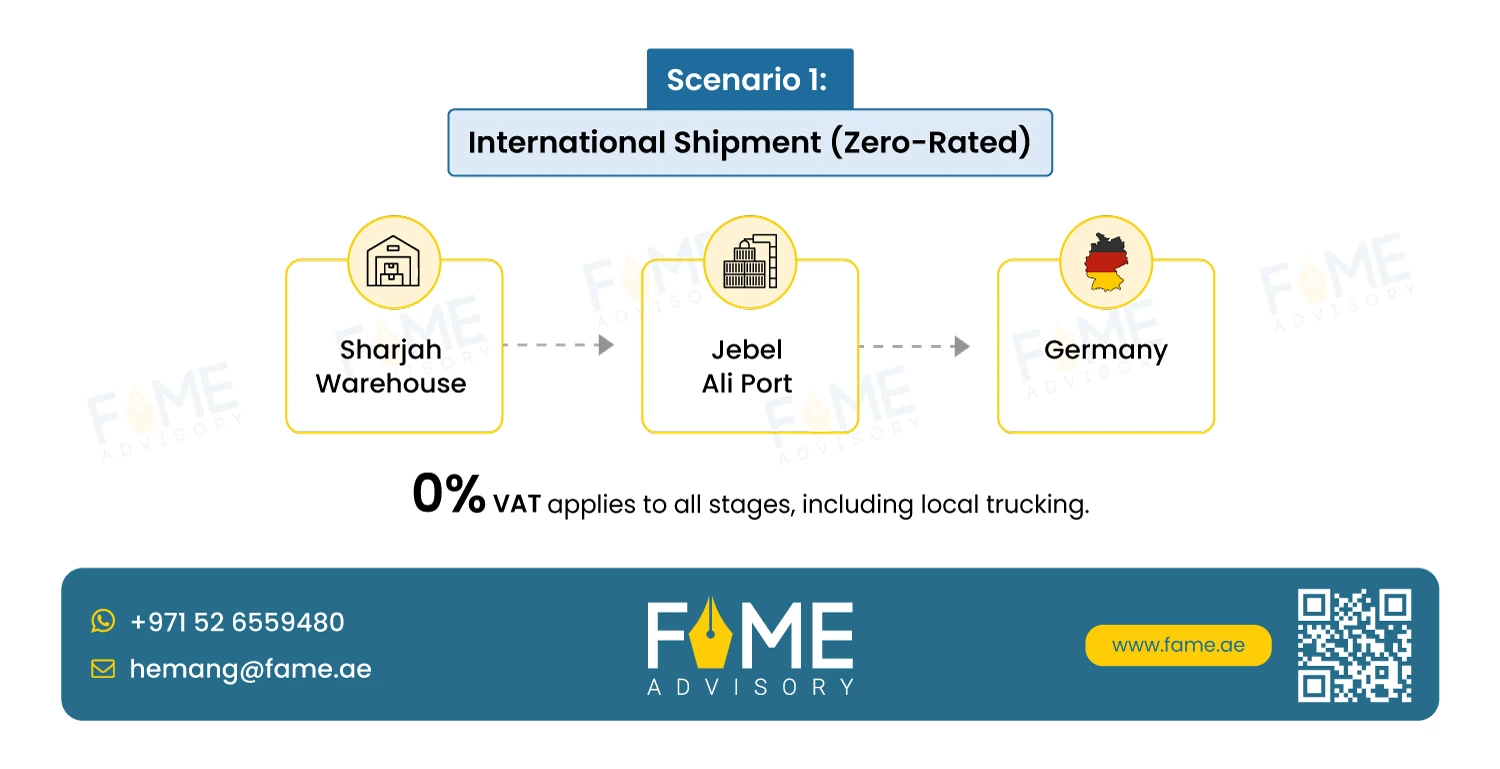
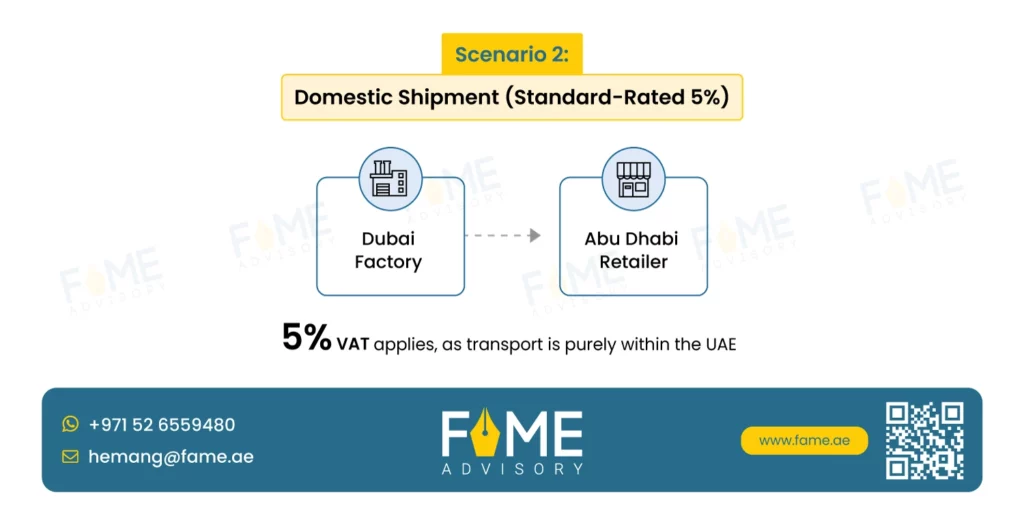
  • Domestic transportation of goods can be zero-rated only when it is supplied by the same entity that provides the international leg of the transport. If different parties handle each segment, the domestic portion does not qualify for zero-rating. 
  • Zero-rating applies only to services provided directly to the recipient of the international transport. Any supporting services offered to third parties (e.g., warehousing or handling provided to someone other than the transport recipient) are subject to the standard VAT rate. 

Zero-rating goods and services in connection with means of transport (Article 35)

Article 35 is hereby amended to specify that only the following services, when supplied directly in connection with a qualifying means of transport, shall be eligible for zero-rating: 

  • Repair Services: when the repair services are carried out onboard. 
  • Maintenance Services: Includes inspection, testing, cleaning, and similar services if carried out onboard. 
  • Conversion Services: Should maintain compliance with conditions of Article 34 on post-conversion. 

Tax Treatment for financial service (Article 42)

The recent amendment to Article 42(2) introduces additional categories of financial services. However, it is important to emphasize that inclusion under Article 42(2) does not automatically qualify a service for VAT exemption. 

The actual application of the exemption is determined under Article 42(3), which sets out the specific conditions that must be met. Only services that satisfy these criteria are eligible for VAT exemption, regardless of their listing in Article 42(2). 

The following newly added categories in definition of financial services has been clarified through this public clarification –  

  • Management of investment funds – Services provided by an independent fund manager to funds licensed by the UAE authority, including the management of the fund’s operations, the management of investment for or on behalf of the fund, monitoring and improvement of the fund’s performance, are exempt from VAT. 
  • Transferring ownership of virtual assets and conversion of Virtual Assets – This includes virtual currencies like bitcoin and conversion of virtual assets. These services are exempt from VAT retroactively from 1 January 2018. 
  • Keeping and managing Virtual assets – Services related to keeping and managing virtual assets (e.g., managing crypto wallets) are taxable if supplied in the UAE for an explicit fee, commission, or similar charge. Crypto currencies are a subset of virtual currencies and from a VAT perspective are not regarded nor treated as money. 

It clarifies that Investment fund management services, transfer of virtual assets/currencies and conversion of virtual assets are considered as exempt financial services from VAT. Therefore, taxable person only engaged in these supplies has to assess the recoverability of input VAT and necessity of VAT-Deregistration. 

Input VAT Recovery on Health Insurance for dependent (Article 53 - Non-Recoverable Input tax)

This article is amended to allow recovery of input VAT for health insurance, including enhanced health insurance for employees and their dependents within the limit of one spouse and three children under the age of 18. 

The public clarification has clarified that this amendment is only effective from 15 November 2024 and shall not be applied retrospectively. 

For example, if the employer paid health insurance premiums in January 2024 in respect of the full calendar year, only the VAT incurred on the portion relating to the period 15 November to 31 December 2024 may be recovered to the extent the employer incurs these costs to make taxable supplies, and provided the relevant supporting documents are retained. 

Input Tax Apportionment (Article 55)

Article 55 now clarifies that standard input tax apportionment also applies to government entities and charities. Notwithstanding the amendments introduced under Article 55(7)(a)—which clarify the “sum of input tax for the tax period”, the simplified input tax apportionment method as outlined in “VATGIT1” still be used. 

Other Key Changes

Further clarifications have been issued regarding the updated VAT Executive Regulation. Below is a illustrative list of the topics that have been addressed: 

  • Tax registration cancellation and deregistration – The authority has the right to cancel a VAT registration of a taxpayer under certain circumstances (e.g., registration requirements not met) and also now deregister entities that have applied but not completed deregistration or no longer meet VAT registration conditions. 
  • Profit margin scheme – The definition of “purchase price” has been clarified to includes all costs and fees incurred in addition to the price of the goods. 
  • Tax invoice requirements – New timelines have been introduced to issue summary tax invoices (in case of multiple supply to same person). Now, business has 14 days from the end of calendar month to issue summary tax invoices. 
  • Tax Credit Note – FTA clarify the treatment of multiple tax credit notes issued for the same tax invoice. In such cases, the “value of supply shown on the tax invoice” in any subsequent credit note should reflect the adjusted value after accounting for the previous credit note(s). 
  • Zero-rating healthcare services- Article 41(4) of the Executive Regulation was amended to clarify that not only a supply, but also an import of the goods referred to in that Clause may qualify for zero-rating 

It is important for all taxpayers to familiarize themselves with the published changes and clarifications, and assess their impact on their business. Businesses should conduct an internal review to determine whether they are in compliance with the updated Executive Regulation and Public Clarification.