
UAE VAT Applicability on Precious Metals & Stones

UAE VAT on Precious Metals and Stones

Insights
UAE VAT on Precious Metals and Stones

The UAE’s VAT framework treats precious metals and precious stones differently depending on the nature of the transaction, by assessing who is buying, who is selling, and for what purpose. Whether you are a jewellery manufacturer, a bullion trader, a gemstone wholesaler, or a retailer, understanding which VAT treatment applies to your transactions is essential to staying compliant and avoiding unnecessary costs.

This article breaks down the three key VAT treatments i.e. Zero Rating, Reverse Charge Mechanism (RCM), and Standard Rating.

What are included in Precious Metals and Precious Stones?

Precious metals include the following: Gold, silver, palladium, and platinum

Precious stones include Natural and synthetic diamonds, pearls, rubies, sapphires, and emeralds.

1. Zero Rating of Investment Grade Precious Metals

Certain precious metals are treated as financial instruments rather than ordinary goods. Accordingly, their supply and import attract VAT at 0%, yet the supplier retains the right to recover input tax on related costs. 

Key conditions for zero-rating: 

  • The metal must be gold, silver, palladium, or platinum.
  • It must have a purity of 99% or more.
  • It must be in a form tradeable in global bullion markets (e.g., bars, ingots, or coins that meet international trading standards). 

Jewellery or other manufactured articles of these metals generally do not qualify for zero-rating under this provision. 

Example: A UAE-based bullion dealer sells 1 kg gold bars (99.9% purity) to a registered jewellery manufacturer. The dealer issues a tax invoice at 0% VAT as the gold is a precious metal and the is traded in bullion form with a purity of 99.9%.  

Applicability of Reverse Charge Mechanism (RCM)

For most business-to-business (B2B) transactions involving precious metals, precious stones, and jewellery within the UAE, the Reverse Charge Mechanism applies, provided certain conditions are satisfied.

For jewellery manufacturer and retailers, the key point to note that the RCM can be applied for jewellery made from these materials but only where the value of the precious component exceeds the value of all other elements such as clasps, settings, and packaging. If it does not, the RCM under CD 127/2024 does not apply.

Key conditions that must be met for RCM to be applied

For the RCM to apply, three conditions must be satisfied simultaneously:

  1. The recipient must be VAT-registered in the UAE at the time of supply.
  2. The recipient must intend to resell the goods or use them in the production or manufacture of precious goods.
  3. The recipient must provide a written declaration to the supplier, before the date of supply, confirming both their VAT registration and their commercial intent.

The recipient must obtain and retain the declaration received from the supplier and verify the supplier’s Tax Registration Number (TRN) through the FTA’s online verification tool, while retaining evidence of such verification. Although no VAT is charged by the seller, a compliant Tax Invoice must still be issued, clearly stating that the Reverse Charge Mechanism (RCM) applies to the transaction.

How the Reverse Charge Works

Under the RCM, the VAT obligation shifts from the supplier to the recipient. The supplier does not charge or report VAT on the supply. Instead, the VAT-registered recipient self-accounts for VAT, reports it in their VAT return, and may recover it as input tax subject to standard recovery rules.

This mechanism applies to B2B transactions only. Supplies to unregistered end consumers fall outside the RCM and standard 5% VAT is applied for B2C unregistered consumers.

Example:

  • A diamond trader supplies lab-grown diamonds worth AED 500,000 to a VAT-registered jewellery company that intends to resell them. The jeweller provides the required written declaration. The trader issues a tax invoice with no VAT charged. The jeweller self-accounts for AED 25,000 (5%) under RCM by disclosing output VAT in its VAT return and simultaneously claim this as input tax, resulting in a net nil effect.

Standard Rating (5% VAT) — Retail and Non-Qualifying Transactions

When the conditions for zero-rating and RCM are not met, the supply of precious metals, precious stones, and jewellery is subject to standard VAT at 5%, which the supplier charges and remits to the FTA.

Common scenarios where standard rating applies:

  • Sales to unregistered individuals (retail / B2C transactions).
  • Sales to VAT-registered businesses that do not provide the required written declarations.
  • Sales where the recipient has no intention to resell or manufacture precious goods.

Example:

  • A jewellery retailer sells gold bangles to a walk-in customer (an unregistered individual). The retailer charges 5% VAT on the sale price and pays this to the FTA.
  • A VAT-registered company purchases sapphires to use as corporate awards or gifts — not for resale or manufacture. Since the company does not intend to resell or use the stones in production, the RCM does not apply. The supplier charges 5% VAT.
  • A diamond dealer fails to receive a written declaration from the recipient before the supply. Even if the recipient is VAT-registered, the RCM cannot apply, and the dealer must charge standard 5% VAT.

Making Charges — A Nuance to Watch

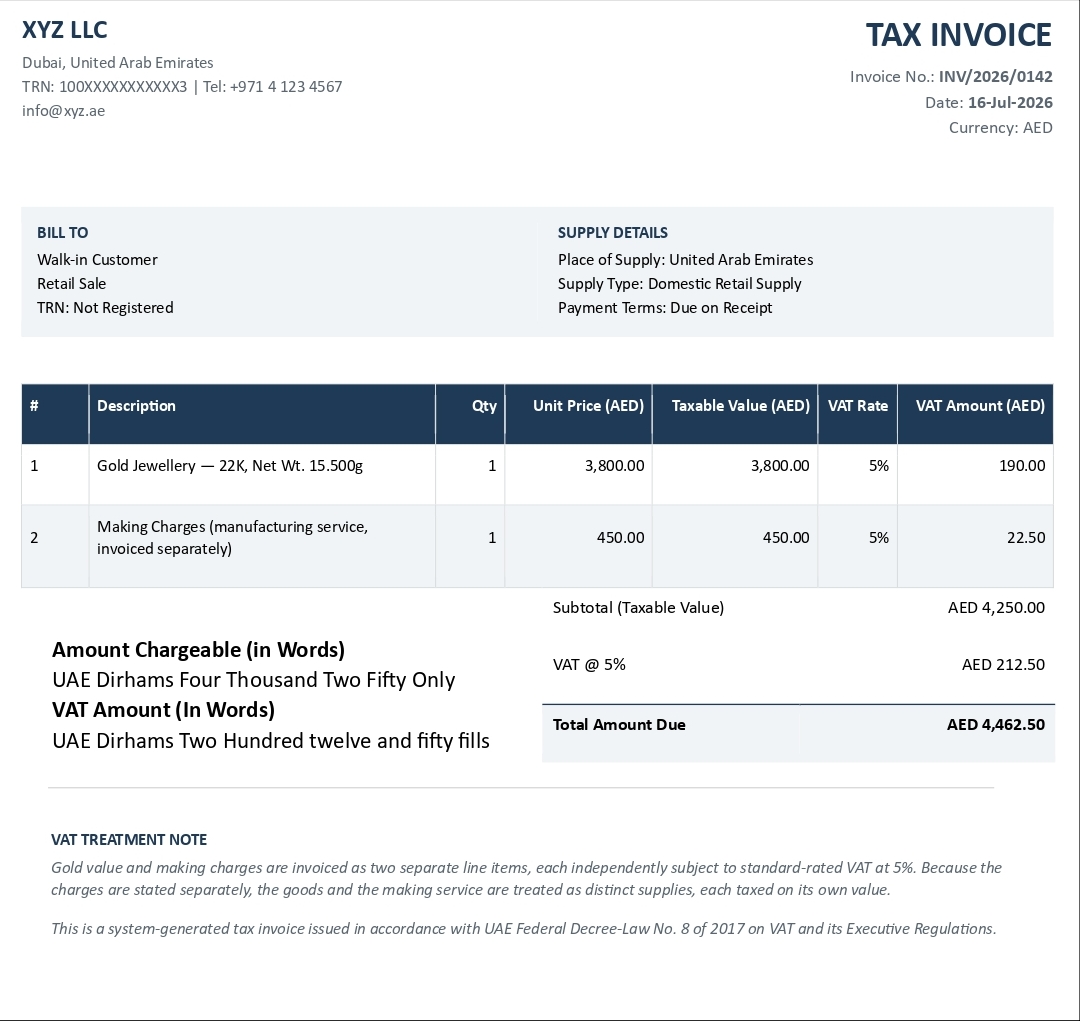
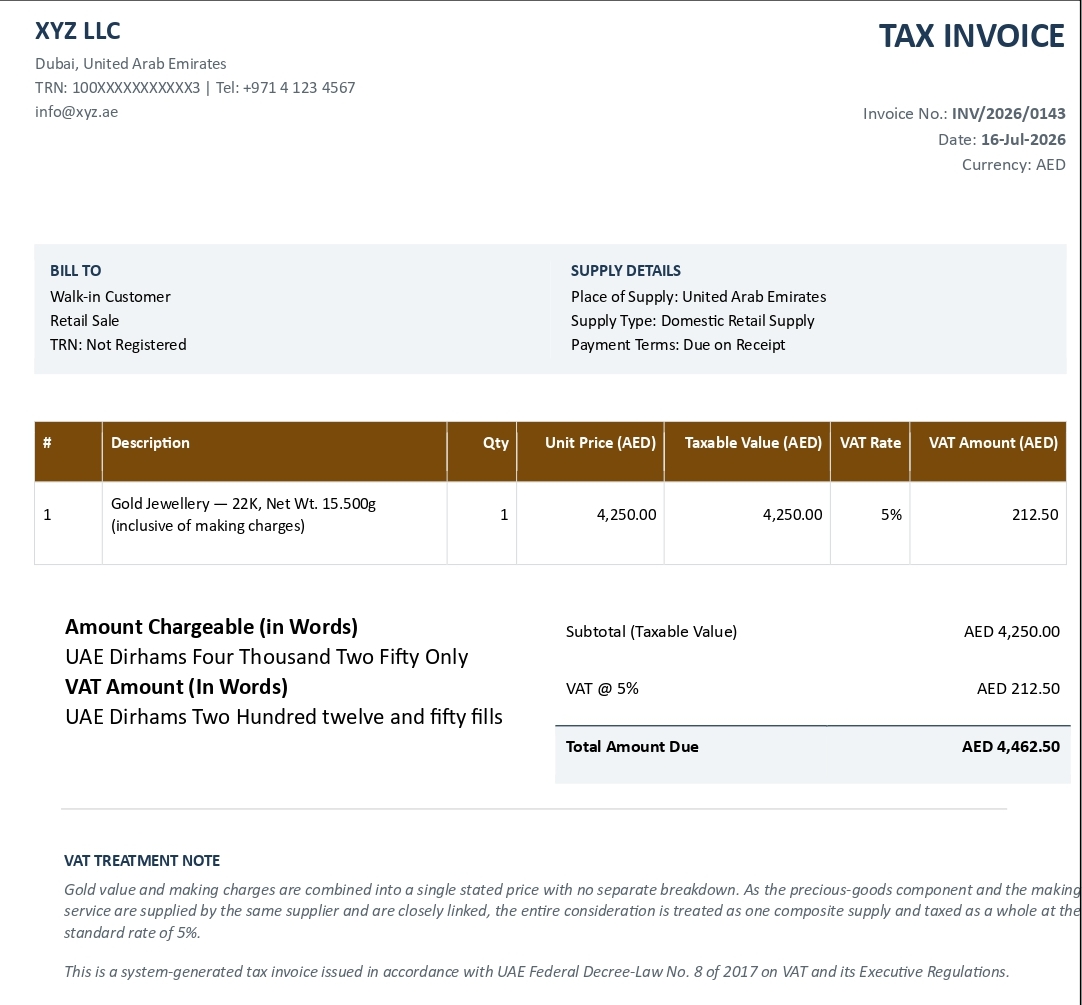
Where a jeweller charges separately for manufacturing services (“making charges”), those services remain subject to standard 5% VAT. The RCM applies only to the precious goods component. If a single composite price is charged for both goods and services by the supplier to VAT registered customer the entire supply fall under the RCM provided all conditions are met.

Composite Supply

Following conditions shall be met for the supply to be treated as a composite supply.

  • The supply consists of a principal component (Precious Goods) and ancillary / incidental elements (including Making Services), closely linked that splitting them would be impossible or unnatural.
  • The price for the Precious Goods and related services is not charged separately. One combined price is stated.
  • The Precious Goods and all related services are supplied by the same supplier.

Sample Tax Invoice for Taxable Supply

Sample Tax Invoice for Composite Supply

Record-Keeping Requirements

Given the interplay between zero-rating, RCM, and standard rating, robust documentation is essential to support the VAT position taken on each transaction. The specific records to maintain vary depending on which treatment applies.

Zero-Rated Supply

  • Evidence that the metal is in a recognised tradeable bullion form (bars, ingots, or coins meeting international trading standards)
  • Compliant tax invoice reflecting 0% VAT.
  • Records supporting input tax recovery claimed against the zero-rated supply

Reverse Charge Mechanism (RCM)

  • The recipient’s written declaration confirming VAT registration and intent to resell or use the goods in production/manufacture, obtained before the date of supply
  • Evidence of TRN verification carried out via the FTA’s online tool, retained by the supplier
  • A compliant tax invoice issued despite no VAT being charged, clearly mentioning VAT will be accounted by customer on behalf of supplier under RCM
  • Records distinguishing separately-invoiced making charges (standard-rated) from composite pricing (fully under RCM), where applicable

Standard Rated Supply

  • Compliant tax invoice showing VAT charged at 5% on the full consideration
  • Records of the customer’s registration status (or confirmation of non-registration for B2C sales)
  • Where a declaration was requested but not obtained, records evidencing that RCM could not be applied, justifying standard rating
  • Records of VAT collected and remitted to the FTA in the relevant tax period

All of the above should be retained for the statutory five-year period (or longer where applicable) and be readily available for FTA audit, as the burden of proof for zero-rating, RCM, or input tax recovery rests with the taxpayer.

Conclusion

The VAT treatment of precious metals, precious stones, and jewellery in the UAE depends on the nature of each transaction and who is buying, for what purpose, and how the supply is structured, rather than the product alone. Zero-rating applies to qualifying investment-grade bullion, RCM shifts the VAT burden to registered recipients where all conditions and declarations are met, and standard 5% rating is the default otherwise. The making charges distinction is particularly important: whether these are invoiced separately or bundled into a single price can determine whether RCM extends to the whole supply or only its precious component. Businesses should review their invoicing practices and documentation carefully to apply the correct treatment and safeguard their input tax position.

Private Clarifications – UAE CT Alert

UAE Corporate Tax Private Clarifications

Insights
UAE Corporate Tax Private Clarifications

Background

The FTA published a consolidated set of UAE Corporate Tax Private Clarifications on 9 July 2026, covering rulings issued up to May 2026. The compilation touches a wide sweep of the Corporate Tax Law, from exempt persons, Permanent Establishment and Unincorporated Partnerships, through to Free Zone Qualifying Activities, Participation Exemption, Tax Groups, registration, financial statements and transitional relief.

Private Clarifications are issued by the FTA in response to a specific taxpayer’s request and are binding only on that taxpayer in relation to the facts submitted, unlike Public Clarifications, which apply more broadly. That said, the compilation offers a useful window into the FTA’s thinking on points the legislation itself does not spell out and can guide taxpayers facing similar fact patterns.

This alert provides our selection of the more practically significant clarifications from that compilation, with a short note on what each means. We are also pleased to mention that Fame Advisory has assisted clients in preparing and filing Private Clarification requests with the FTA, and certain favourable outcomes obtained in those cases have been included in the FTA’s compilation and are discussed in this alert.

Permanent Establishment

1. Absence of a trade licence or use of a third party does not rule out a UAE PE. Presence exceeding 6 months (aggregate) in a rolling 12-month period may indicate permanence, if premises are at the enterprise’s disposal and core (non-auxiliary) activities occur there.

What This Means: Not holding a UAE trade licence for the activity is not a defence — the FTA looks past licensing status to substance.

Unincorporated Partnership

2. A landowner-developer arrangement (written or oral) can be an Unincorporated Partnership where parties jointly conduct a development business and share profits.

What This Means: A development agreement dressed up as a simple service arrangement can still be reclassified as a partnership.

3. Failure to submit the annual declaration confirming Foreign Partnership conditions causes loss of tax-transparent treatment.

What This Means: A substantive condition, not routine paperwork.

Family Foundation

4. An LLC/private company investing for individuals is not a Family Foundation merely by purpose. A qualifying “similar entity” needs legal characteristics comparable to a foundation or trust.

What This Means: Purpose alone is insufficient — legal form and governance matter; ordinary corporate vehicles can’t access foundation transparency.

Qualifying Free Zone Persons

5. A QFZP must be a juridical person – a discretionary trust, natural person, Unincorporated Partnership or other non-juridical arrangement cannot qualify.

What This Means: Entity classification must precede the QFZP analysis; Free Zone licensing alone is not enough.

6. A branch has no separate legal identity, so head office and Free Zone branches are one Taxable Person for QFZP assessment — but each activity and its substance must still be tested individually.

What This Means: No standalone QFZP test per location, but every activity and its substance must be mapped and tested separately.

7. A Free Zone Person is not automatically disqualified where a related-party transaction was not recorded at arm’s length, provided an appropriate transfer-pricing adjustment is made in the Corporate Tax Return.

What This Means: A corrective mechanism at filing, not a safe harbour — the adjustment must be supportable and can affect Qualifying Income and de minimis.

Adequate Substance

8. No automatic substance exception for passive/asset-based leasing. A property-leasing Free Zone Person with no employees may fail where no one performs lease administration, compliance, renewals or enforcement.

What This Means: Owning an asset isn’t enough — the FTA looks for people, expenditure and decision-making behind the income.

9. Employees sponsored by Related Parties may count as the Free Zone Person’s qualified full-time employees if it bears their economic cost and controls/supervises the employment relationship.

What This Means: Visa sponsorship isn’t decisive — economic responsibility and day-to-day control matter more.

Adequate Substance (Contd.)

10. A shared workspace can satisfy adequate substance where sufficient and commensurate with the scale of core income-generating activities, alongside adequate people, assets and expenditure.

What This Means: A dedicated office isn’t mandatory, but a nominal flexi-desk may be inadequate for a business with real operations or staff.

11. Overseas warehousing/shipping doesn’t automatically disqualify high-seas or third-port distribution, provided core income-generating activities and substance remain in a Designated Zone.

What This Means: Physical movement of goods isn’t the sole test — what matters is where distribution decisions and CIGA actually happen.

12. A distributor’s customer is the Beneficial Recipient where legal ownership passes and goods are at the customer’s free disposal, including an unrestricted right to resell, with no obligation to do so.

What This Means: Legal title alone isn’t enough — genuine, unrestricted control confirms Beneficial Recipient status and Qualifying Income.

Processing of Goods and Materials

13. Processing is broader than manufacturing — the product doesn’t need to be physically transformed into something new. Simple packaging or re-packaging of goods can itself qualify as “processing,” provided the activity is genuinely carried out in the Free Zone.

What This Means: Don’t assume packaging-type activities fall outside Qualifying Income just because the product itself isn’t changed. But the actual packaging work must physically happen in the Free Zone.

Trading of Qualifying Commodities

14. Buying and selling physical Qualifying Commodities is a Qualifying Activity, but speculative derivative trading (futures, options, swaps) is not, unless the derivatives are used to hedge price risk from the trader’s own physical commodity business, or from related structured commodity financing.

What This Means: A standalone derivatives/proprietary trading desk cannot claim Qualifying Activity status just because the underlying reference is a commodity. The derivatives must be genuinely tied to hedging real physical trading risk — not speculative positions on their own.

Holding of Shares and Securities

15. Selling shares within 12 months of buying them doesn’t automatically disqualify the holding from being treated as an investment. What matters is the original intention, if the shares were genuinely acquired to be held for 12 months or more, an early exit doesn’t break qualification. For discretionary investment portfolios, that intention can be assessed at the level of the overall investment mandate, rather than each individual holding.

What This Means: Actual holding period is evidence, not the sole test — a well-governed mandate can support early disposals driven by risk/market decisions.

Ownership, Management & Operation of Ships

16. Time chartering can qualify without direct ship ownership. Ownership, management and operation are independent limbs, provided functions are substantively carried out by the Free Zone Person.

What This Means: A Free Zone Person can qualify by genuinely operating ships taken on time charter, even if it does not own or manage those ships. Ownership, management and operation are separate qualifying activities.

17. Purchase and sale of ships is not, by itself, the Qualifying Activity of ownership/management/operation — it may be ancillary only where the main qualifying shipping activity is also conducted.

What This Means: A business that only trades ships — buying and selling vessels without a real shipping operation behind it — cannot claim the shipping Qualifying Activity category.

Reinsurance

18. Reinsurance requires the Free Zone Person to assume all or part of the insurance risk undertaken by another insurer or reinsurer.

What This Means: Arrangements without genuine risk transfer do not qualify as reinsurance services.

Wealth and Investment Management Services

19. Commission/referral fees from genuine holistic advisory qualify as wealth-management income; pure execution/brokering doesn’t qualify alone but can be ancillary if genuine wealth management is also carried on.

What This Means: The fee payer need not be the client — what matters is whether the service is strategic management or mere execution.

Headquarter Services to Related Parties

20. Headquarter services include oversight/management of Related Parties — senior management, procurement, planning, risk management, coordination, admin support. One category may suffice, but the company must assume responsibility for the group’s overall success/governance; routine IT or marketing for one entity is generally insufficient.

What This Means: The FTA is looking for real ownership of group performance and governance behind it. A company merely providing routine IT support or marketing to one group entity, without broader strategic responsibility, risks falling outside this Qualifying Activity altogether.

21. Headquarter services may be supplied to only one Related Party where they are nevertheless provided for the wider benefit of the group.

What This Means: The number of recipients isn’t decisive — purpose, scope and group-wide impact matter more than multi-entity invoicing.

22. A Free Zone branch may provide headquarter services to its head office — although the same legal entity, branch and head office are treated as Related Parties for this purpose.

What This Means: A branch providing real HQ functions to its own head office can generate Qualifying Income of headquarter services.

Treasury and Financing Services

23. Loans, payment processing and loan guarantees for Related Parties fall within treasury and financing services, aligning with liquidity, financing, debt, risk and centralised payment functions.

What This Means: Broader than interest-bearing lending — covers central payment and guarantee arrangements, subject to substance and TP requirements.

Distribution in or From a Designated Zone

24. Distribution can qualify where the customer incorporates goods into products later sold to third parties, regardless of processing degree. If the customer retains the product/machine to provide services, it is the end-user and the sale doesn’t qualify.

What This Means: The decisive point is downstream resale versus retained use, not whether goods are transformed.

25. Where raw materials go to a foreign Related Party for manufacture and finished goods are sold outside the UAE without entering the UAE, this is foreign manufacturing, not Designated Zone distribution.

What This Means: Buying raw materials and outsourcing their manufacture abroad is treated as foreign manufacturing, not distribution. Therefore, the income will not qualify merely because the buying and selling are done by a Designated Zone company.

Logistics Services

26. A taxpayer needn’t perform every listed logistics function — it may qualify without directly storing/transporting goods if it performs other qualifying logistics activities.

What This Means: Logistics can cover coordinators, freight forwarders and agency models, not only asset-heavy operators.

27. Using third-party transport/storage providers doesn’t prevent qualification, provided the outsourced activities aren’t the taxpayer’s own core income-generating activities.

What This Means: Outsourcing is fine as long as the taxpayer still performs its CIGA in Free Zone.

Taxable Income

28. Transfer, sale or liquidation of a nominal 1% shareholding is a taxable event, but arm’s-length value may be nominal/book value where the holder has no dividend, liquidation, control or other economic benefit.

What This Means: Legal ownership alone does not necessarily create taxable income. The actual economic rights and benefits attached to the shares must be considered; i.e., substance takes priority over form.

Participation Exemption

29. The FTA treats the Participation Exemption subject-to-tax condition as satisfied for dividends from a Saudi company subject to Zakat, based on Saudi’s corporate-tax framework and 20% rate.

What This Means: Welcome clarity for Saudi investments — but ownership, holding period and asset tests still apply.

30. Dividends from a foreign holding company taxed below 9% may still qualify for participation exemption where its principal activity is holding qualifying interests and prescribed conditions are met.

What This Means: This is a conditional look-through, not a blanket pass — the holding company’s activity, substance, management and income mix all need to be tested and documented before relying on it.

31. For the 5% ownership threshold, interests held by members of a Qualifying Group must be aggregated — aggregation is compulsory.

What This Means: Taxpayers can’t choose stand-alone testing where group aggregation changes the result.

32. Dividends paid from retained earnings generated before the taxpayer acquired the Participation may still qualify, provided all other exemption conditions are met.

What This Means: No need to trace dividends only to post-acquisition profits — removes a common conservative restriction.

33. Beneficial ownership can support a Participating Interest without strict legal title, where the taxpayer controls the interest, has rights to its economic benefits, and it’s treated as equity under applicable accounting standards.

What This Means: The FTA will look through to who genuinely controls the interest and receives its economic benefits.

Registration for Corporate Tax

34. A natural-person Business ceases on the owner’s death and must deregister. If heirs continue the activity as an Unincorporated Partnership, they must appoint an authorised partner and register the partnership.

What This Means: Heirs continuing the business need to actively register a new taxpayer (typically an Unincorporated Partnership) and appoint an authorised partner.

Transitional Relief

35. Transitional relief is capped at the accounting profit attributable to the same property in the relevant Tax Period and cannot create or increase a Tax Loss.

What This Means: Transitional relief can only reduce the profit recognised on that property. It cannot turn the result into a loss or increase an existing loss.

Tax Group

36. A newly incorporated subsidiary may join an existing Tax Group from incorporation, even though its own Tax Period starts later, provided all group conditions are met from incorporation and its financial year aligns with other members.

What This Means: A short first period doesn’t prevent immediate grouping — year-end alignment and day one ownership are what counts.

FTA Decision No. 6 of 2026 – Designated Zone

FTA Decision No. 6 of 2026

Insights

FTA Decision No. 6 of 2026

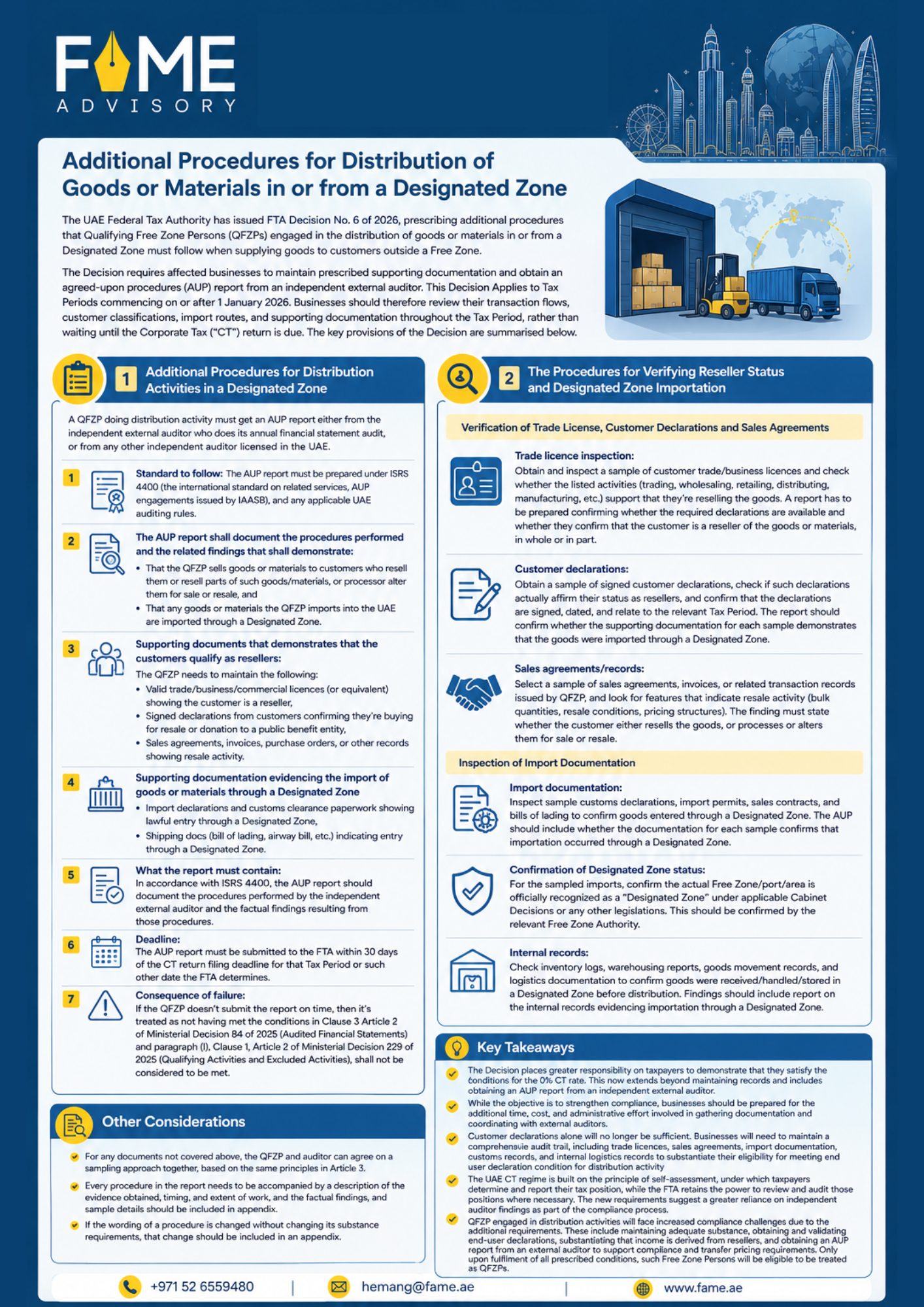
Additional Procedures for Distribution of Goods or Materials in or from a Designated Zone

The UAE Federal Tax Authority has issued FTA Decision No. 6 of 2026, prescribing additional procedures that Qualifying Free Zone Persons (QFZPs) engaged in the distribution of goods or materials in or from a Designated Zone must follow when supplying goods to customers outside a Free Zone.

The Decision requires affected businesses to maintain prescribed supporting documentation and obtain an agreed-upon procedures (AUP) report from an independent external auditor. This Decision Applies to Tax Periods commencing on or after 1 January 2026. Businesses should therefore review their transaction flows, customer classifications, import routes, and supporting documentation throughout the Tax Period, rather than waiting until the Corporate Tax (“CT”) return is due. The key provisions of the Decision are summarised below.

Additional Procedures for Distribution Activities in a Designated Zone

A QFZP doing distribution activity must get an AUP report either from the independent external auditor who does its annual financial statement audit, or from any other independent auditor licensed in the UAE.

  1. Standard to follow: The AUP report must be prepared under ISRS 4400 (the international standard on related services, AUP engagements issued by IAASB), and any applicable UAE auditing rules.
  2. The AUP report shall document the procedures performed and the related findings that shall demonstrate:
    • That the QFZP sells goods or materials to customers who resell them or resell parts of such goods/materials, or processor alter them for sale or resale, and
    • That any goods or materials the QFZP imports into the UAE are imported through a Designated Zone.
  3. Supporting documents that demonstrates that the customers qualify as resellers:
    The QFZP needs to maintain the following:
    • Valid trade/business/commercial licences (or equivalent) showing the customer is a reseller,
    • Signed declarations from customers confirming they’re buying for resale or donation to a public benefit entity,
    • Sales agreements, invoices, purchase orders, or other records showing resale activity.
  4. Supporting documentation evidencing the import of goods or materials through a Designated Zone
    • Import declarations and customs clearance paperwork showing lawful entry through a Designated Zone,
    • Shipping docs (bill of lading, airway bill, etc.) indicating entry through a Designated Zone.
  5. What the report must contain: In accordance with ISRS 4400, the AUP report should document the procedures performed by the independent external auditor and the factual findings resulting from those procedures.
  6. Deadline: The AUP report must be submitted to the FTA within 30 days of the CT return filing deadline for that Tax Period or such other date the FTA determines.
  7. Consequence of failure: If the QFZP doesn’t submit the report on time, then it’s treated as not having met the conditions in Clause 3 Article 2 of Ministerial Decision 84 of 2025 (Audited Financial Statements) and paragraph (l), Clause 1, Article 2 of Ministerial Decision 229 of 2025 (Qualifying Activities and Excluded Activities), shall not be considered to be met.

The Procedures for Verifying Reseller Status and Designated Zone Importation

Verification of Trade License, Customer Declarations and Sales Agreements

  • Trade licence inspection: Obtain and inspect a sample of customer trade/business licences and check whether the listed activities (trading, wholesaling, retailing, distributing, manufacturing, etc.) support that they’re reselling the goods. A report has to be prepared confirming whether the required declarations are available and whether they confirm that the customer is a reseller of the goods or materials, in whole or in part.
  • Customer declarations: Obtain a sample of signed customer declarations, check if such declarations actually affirm their status as resellers, and confirm that the declarations are signed, dated, and relate to the relevant Tax Period. The report should confirm whether the supporting documentation for each sample demonstrates that the goods were imported through a Designated Zone.
  • Sales agreements/records: Select a sample of sales agreements, invoices, or related transaction records issued by QFZP, and look for features that indicate resale activity (bulk quantities, resale conditions, pricing structures). The finding must state whether the customer either resells the goods, or processes or alters them for sale or resale.

Inspection of Import Documentation

  • Import documentation: Inspect sample customs declarations, import permits, sales contracts, and bills of lading to confirm goods entered through a Designated Zone. The AUP should include whether the documentation for each sample confirms that importation occurred through a Designated Zone.
  • Confirmation of Designated Zone status: For the sampled imports, confirm the actual Free Zone/port/area is officially recognized as a “Designated Zone” under applicable Cabinet Decisions or any other legislations. This should be confirmed by the relevant Free Zone Authority.
  • Internal records: Check inventory logs, warehousing reports, goods movement records, and logistics documentation to confirm goods were received/handled/stored in a Designated Zone before distribution. Findings should include report on the internal records evidencing importation through a Designated Zone.

Other Considerations:

  • For any documents not covered above, the QFZP and auditor can agree on a sampling approach together, based on the same principles in Article 3.
  • Every procedure in the report needs to be accompanied by a description of the evidence obtained, timing, and extent of work, and the factual findings, and sample details should be included in appendix.
  • If the wording of a procedure is changed without changing its substance requirements, that change should be included in an appendix.

Key Takeaway

  • The Decision places greater responsibility on taxpayers to demonstrate that they satisfy the conditions for the 0% CT rate. This now extends beyond maintaining records and includes obtaining an AUP report from an independent external auditor.
  • While the objective is to strengthen compliance, businesses should be prepared for the additional time, cost, and administrative effort involved in gathering documentation and coordinating with external auditors.
  • Customer declarations alone will no longer be sufficient. Businesses will need to maintain a comprehensive audit trail, including trade licences, sales agreements, import documentation, customs records, and internal logistics records to substantiate their eligibility for meeting end user declaration condition for distribution activity
  • The UAE CT regime is built on the principle of self-assessment, under which taxpayers determine and report their tax position, while the FTA retains the power to review and audit those positions where necessary. The new requirements suggest a greater reliance on independent auditor findings as part of the compliance process.
  • QFZP engaged in distribution activities will face increased compliance challenges due to the additional requirements. These include maintaining adequate substance, obtaining and validating end-user declarations, substantiating that income is derived from resellers, and obtaining an AUP report from an external auditor to support compliance and transfer pricing requirements. Only upon fulfilment of all prescribed conditions, such Free Zone Persons will be eligible to be treated as QFZPs.

Family Foundation Guide

Family Foundation Tax Guide - UAE

Insights

Family Foundation Tax Guide - UAE

Background

The UAE Federal Tax Authority (FTA) has issued an updated Corporate Tax (CT) Guide on the Taxation of Family Foundations in June 2026, replacing the earlier version issued in May 2025.

Family Foundations are commonly used by families for succession planning, asset protection, wealth preservation and inter-generational transfer of assets. Under the UAE CT, a foundation, trust or similar entity may apply to the FTA to be treated as an Unincorporated Partnership (UIP), provided the relevant conditions under Article 17 of the UAE CT Law are satisfied.

Where such application is approved, the Family Foundation is treated as fiscally transparent for UAE CT purposes. In simple terms, this means that the Family Foundation itself is not taxed separately. Instead, the income, expenditure, assets and liabilities are treated as arising directly to the beneficiaries in accordance with their respective shares.

The updated guide does not fundamentally change the overall tax framework for Family Foundations. However, it provides important clarifications on practical matters such as multi-tier structures, asset transfers into Family Foundations, acquisition or sale of entities by Family Foundations, and the Corporate Tax treatment of family offices.

Key Updates in June 2026 Guide

The June 2026 guide updates Sections 2.5, 3.3, 3.4, 6 of the earlier guide and adds Sections 7.8, 7.9 and 7.10.

1. Legislative References Updated

The updated guide includes additional legislative references, including Free Zone-related decisions. These references are particularly relevant where Family Foundation structures involve Free Zone entities or family offices carrying out wealth management, investment management or fund management activities.

2. Trust-related Wording Clarified

The updated guide refines the description of trusts and clarifies the role of the settlor, trustee and beneficiaries. This is largely a legal drafting clarification and does not appear to change the underlying Corporate Tax treatment.

3. Clarification on LLCs and Similar Entities

The updated guide expressly clarifies that an LLC is not considered a ‘similar entity’ to a foundation or trust.

Therefore, an LLC cannot itself apply to be treated as fiscally transparent on the basis that it is a Family Foundation.

However, an LLC may still be eligible to apply for fiscally transparent treatment where it is wholly owned and controlled by a qualifying Family Foundation and satisfies the applicable conditions.

4. Multi-tier Structures Expanded

The updated guide provides more detailed guidance on the treatment of multi-tier Family Foundation structures, particularly where a Family Foundation holds assets through one or more underlying companies, SPVs or holding entities.

Where the Family Foundation owns one or more underlying juridical persons, the eligibility of each entity in the ownership chain must be assessed separately. In other words, an underlying SPV or holding company will not automatically be treated as fiscally transparent merely because it is owned by a qualifying Family Foundation.

For a juridical person in a multi-tier structure to apply for fiscally transparent treatment, it must be wholly owned and controlled by a Family Foundation that is treated as an Unincorporated Partnership. This ownership and control may be direct or indirect. However, where the ownership is indirect, it must be through an uninterrupted chain of entities that are themselves fiscally transparent for UAE Corporate Tax purposes. The updated guide specifically confirms that each juridical person in the structure must meet the relevant conditions separately.

The guide further clarifies that the relevant conditions should be met continuously throughout the Tax Period of the juridical person. If the conditions are not met continuously during the relevant Tax Period, the concerned juridical person, and any juridical persons wholly owned and controlled by it, will no longer be treated as an Unincorporated Partnership from the beginning of that Tax Period. The guide also clarifies that entities within the uninterrupted ownership chain are not required to have the same Financial Year.

A key clarification in the June 2026 guide relates to structures where an underlying entity is held by more than one Family Foundation. The earlier May 2025 guide had taken the position that where an SPV was owned partially by two Family Foundations, SPV was not considered wholly owned and controlled by one Family Foundation. Accordingly, SPV was not eligible to apply under Article 17(1) of the CT Law to be treated as fiscally transparent, and the income derived by SPV would have been subject to Corporate Tax.

The June 2026 guide now revises this position. In the updated example, Family Foundation 1 and Family Foundation 2 are both juridical persons that have been approved by the FTA to be treated as Unincorporated Partnerships. They jointly incorporate a real estate investment SPV, with Family Foundation 1 holding 80% and Family Foundation 2 holding 20%. The updated guide clarifies that a juridical person can be ‘wholly owned’ by more than one Family Foundation. Accordingly, SPV is considered wholly owned, jointly, by two Family Foundations, and the ownership condition is met where both Family Foundations are treated as Unincorporated Partnerships.

This is a significant practical clarification. It means that the ownership condition is not restricted to cases where a single Family Foundation owns 100% of the underlying entity. A jointly held SPV may also qualify, provided it is wholly owned by one or more qualifying Family Foundations and the control condition is satisfied.

5. New Guidance on Transfers to Family Foundations

The updated guide introduces a new section on transfers of assets to a Family Foundation.

Where a founder or settlor transfers assets to a Family Foundation, the CT implications will depend on the status of the transferor and the nature of the assets transferred.

Where the transferor is a Taxable Person, the transfer may give rise to CT implications. Further, where the transfer is between Related Parties, the arm’s length principle need to be adhered to.

However, where a natural person transfers assets that qualify as Personal Investments or Real Estate Investments, such transfer should generally remain outside the scope of UAE Corporate Tax.

This clarification is particularly relevant for families planning to transfer shares, investment portfolios, real estate or other assets into a Family Foundation structure.

6. New Guidance on Acquisition or Sale of Entities by Family Foundations

The updated guide also includes new guidance on the treatment of juridical persons acquired or sold by a Family Foundation.

Where a juridical person becomes wholly owned and controlled by a qualifying Family Foundation, it may be eligible to apply for fiscally transparent treatment, provided the relevant conditions are met.

Conversely, where such entity ceases to be wholly owned and controlled by the Family Foundation, it may lose its fiscally transparent status and become subject to Corporate Tax in its own right.

Importantly, the guide clarifies that a change in tax status from fiscally opaque to fiscally transparent, or vice versa, does not result in any adjustment to the base cost of assets held by that entity. Therefore, a Family Foundation structure should not be viewed as creating a tax-free uplift or reset in the tax base cost of assets.

7. New Guidance on Family Offices

The updated guide introduces a new section on Single Family Offices and Multi Family Offices.

The FTA clarifies that family offices are generally expected to carry on Business or Business Activities, particularly where they provide management, administrative, investment or support services. As a result, family offices are unlikely to meet the conditions for fiscally transparent treatment as a Family Foundation.

Accordingly, a family office would generally be subject to UAE CT on its income, including management fees or other service income. Where services are provided to Related Parties or Connected Persons, transfer pricing and arm’s length considerations should also be assessed.

Where a family office is established in a Free Zone, it may potentially benefit from the 0% Corporate Tax rate on Qualifying Income, provided all relevant Free Zone conditions are satisfied. However, the updated guide indicates that merely holding a licence should not be considered sufficient; the activity and regulatory oversight requirements should also be reviewed.

Key Takeaway

The June 2026 update is particularly relevant for families, founders, trustees, family offices, wealth managers and advisors using Family Foundations, trusts, SPVs or holding companies for succession planning, asset protection and wealth management.

Existing and proposed structures should be reviewed to assess:

  • whether the Family Foundation continues to meet the conditions for fiscally transparent treatment;
  • whether each underlying SPV or holding company independently satisfies the relevant conditions;
  • whether jointly held entities meet the ownership and control requirements;
  • whether transfers of assets into the Family Foundation could trigger Corporate Tax or transfer pricing implications;
  • whether the acquisition or sale of underlying entities affects the tax status of the structure;
  • whether there is any expectation of base cost uplift, which the updated guide clarifies should not arise merely due to a change in tax status; and
  • whether a family office should be treated as a taxable service entity rather than a fiscally transparent Family Foundation.

The updated guide does not overhaul the UAE Corporate Tax treatment of Family Foundations. However, it provides important practical guidance on areas that are commonly encountered in private wealth and succession planning structures.

UAE E-Invoicing: Practical Business Challenges

UAE E-Invoicing Practical Business Challenges

Insights

UAE E-Invoicing Practical Business Challenges

The Ministry of Finance (MoF) has announced targeted amendments to the regulations governing the UAE’s e-invoicing framework, including an extension of the deadline for appointing an Accredited Service Provider (ASP).

Under the amended Ministerial Decision No. 244 of 2025, the deadline has been extended from 31 July 2026 to 30 October 2026. The revised timeline applies to entities with annual revenues exceeding AED 50 million.

The extension provides businesses with additional time to evaluate and select suitable Accredited Service Providers while ensuring adequate preparation for compliance ahead of the mandatory go-live deadline on 1 January 2027.

E-Invoicing: Beyond Compliance - Managing Real Business Challenges

E-invoicing in the UAE is no longer something businesses can consider as a future requirement. It is rapidly becoming a critical transformation that will directly impact invoicing practices, operational workflows, VAT compliance, ERP systems, and data management across organizations.

As the UAE moves toward a structured Peppol-based e-invoicing framework, businesses are beginning to realize that implementation is not simply about generating electronic invoices. It requires businesses to reassess existing processes, identify operational and technical gaps, improve data accuracy, and redesign internal workflows.

This is why conducting a detailed e-invoicing gap analysis has become one of the most important preparation steps for businesses operating in the UAE.

Why E-Invoicing Gap Analysis is Critical?

In simple terms, a gap analysis helps businesses understand:

  • Where they stand today?
  • What changes are required?
  • Whether current systems are compliant?
  • Which operational processes need modification?
  • How prepared they are for implementation?

Many organizations assume their current ERP or accounting system is already sufficient because invoices are generated digitally. However, once detailed reviews begin, businesses often identify gaps in:

  • Invoice structure
  • Invoice and Credit note formats
  • Data fields
  • Approval workflows
  • Customer master data
  • Tax treatments etc

Identifying these issues early helps to avoid operational disruption and last-minute implementation pressure.

Major E-Invoicing Challenges Businesses Are Facing in UAE

1. Data Mapping and ERP Integration Challenges

One of the biggest practical issues during implementation is data mapping.

In many businesses, data is spread across:

  • ERP systems
  • Warehouse management systems
  • CRM platforms
  • Excel workings

Bringing all this information into a single structured e-invoice format becomes highly complex.

Common issues include:

  • Missing customer and Supplier TRNs
  • Incorrect VAT mapping
  • Different product descriptions across systems
  • Inconsistent unit measurements
  • Duplicate customer records
  • Manual invoices

Without proper mapping and standardization, invoices may fail validation or create reconciliation issues later.

2. Warehouse and Delivery Note Timing Issues

A major operational challenge arises where warehouses and finance teams operate separately.

In many trading and logistics businesses:

  • Warehouse teams issue delivery notes immediately once goods move
  • Finance teams issue invoices later after approvals or pricing confirmation

This creates delays between:

  • Physical movement of goods
  • Delivery note generation
  • Invoice issuance

Under UAE e-invoicing requirements, real time invoice issuance becomes extremely important.

Practical Example

Goods may leave the warehouse today, but the finance team may issue the invoice only after:

  • Customer confirmation
  • Management approval
  • Final pricing review
  • Freight confirmation

Such delays can create VAT compliance issue. Businesses will need to redesign operational workflows to ensure invoices are generated on real time basis as per E-invoicing requirement’s.

3. High Sea Sales and Price Difference Challenges

Businesses involved in High Sea Sales or international trading often face pricing complexities.

In many cases:

  • Goods are shipped directly from supplier to customer
  • Freight cost is finalized later
  • Exchange rate fluctuations impact final value
  • Supplier invoices arrive after shipment
  • Landed cost changes after dispatch

As a result, the initial invoice amount may differ from the final commercial value.

Under e-invoicing, businesses must establish proper mechanisms for:

  • Commercial invoices
  • Credit notes
  • Price amendments

Without proper system configuration, businesses may face reconciliation issue between:

  • Accounting records
  • VAT returns
  • Reported e-invoice data

4. The Precious Metals Industry and Unfixed Transaction Complexity

The precious metals industry faces some of the most complicated e-invoicing challenges.

One major issue is unfixed transactions & Common Industry Practice

In many precious metals transactions:

  • Quantity is fixed initially
  • precious metals rate is fixed later
  • Final invoice value depends on future market price

For example:

  • Goods may be delivered today
  • precious metals price may be fixed after 5–7 days
  • Final invoice value changes based on market fluctuations

This creates significant complexity in:

  • Invoice timing
  • VAT determination
  • Reporting accuracy
  • Debit and credit adjustments
  • Final invoice reconciliation

Traditional practices followed within the precious metals industry may therefore require substantial redesign under structured e-invoicing systems.

Under e-invoicing, businesses must establish proper mechanisms for:

  • Tax invoices
  • Tax Credit notes

5. Complex Commercial Arrangements

Businesses also face challenges in handling non-standard transactions such as:

  • Principal-agent arrangements
  • Promotional discounts
  • Free-of-cost supplies
  • Intercompany recharges
  • Composite supplies
  • Consignment stock

Each of these transactions has unique VAT implications and documentation requirements.

If not properly evaluated during implementation, businesses will face difficulties in the following

  • Invoice rejection
  • Incorrect VAT treatment
  • Compliance exposure
  • Audit risk

E-invoicing systems depend heavily on accurate and structured master data.

Businesses will need to ensure:

  • Correct Customer/Supplier names
  • Valid TRNs
  • Accurate VAT classification
  • Proper product coding
  • Consistent invoice descriptions
  • Correct address details

Even small inconsistencies will result in invoice rejection or reporting errors.

E-Invoicing is Not Just a Finance Project

A common misconception is that e-invoicing only concerns finance or tax teams.

In reality, implementation impacts multiple departments:

  • Finance
  • Tax
  • IT
  • Procurement
  • Warehouse operations
  • Sales
  • Logistics
  • Compliance teams

Successful implementation requires:

  • Clear ownership
  • Defined responsibilities
  • Proper coordination
  • Internal process alignment

Without cross-functional collaboration, businesses may struggle during implementation.

The Importance of a Structured Action Plan

The biggest value of a gap analysis is that it provides businesses with a clear implementation roadmap.

A proper assessment helps to identify:

  • System enhancement requirements
  • ERP modification if any
  • Areas to redesign the process
  • ASP onboarding readiness
  • Compliance gaps

This allows businesses to move toward implementation in a controlled and well-planned manner instead of reacting under pressure later.

Practical Recommendations for UAE Businesses

Businesses should begin preparation early rather than waiting for mandatory implementation dates.

Recommended Steps:

  • Conduct detailed e-invoicing gap assessments
  • Review ERP and invoicing capabilities
  • Standardize customer and supplier master data
  • Evaluate industry-specific transaction complexities
  • Engage with Accredited Service Providers (ASPs)
  • Train finance, tax, warehouse, and IT teams
  • Eliminate manual invoicing processes
  • Establish clear invoice issuance timelines

Conclusion

E-Invoicing gap analysis provides management with a clear roadmap for implementation. Instead of making last-minute changes, businesses can plan upgrades, allocate budgets, and prepare employees in a more organized way.

The key value of a gap analysis lies in the actionable roadmap it delivers, as it not only identifies existing gaps but also highlights areas requiring improvement and provides clear recommendations on system upgrades and implementation steps. It further supports effective coordination with ASP providers, ensuring a smoother and more efficient transition when the system goes live.

Overall doing an e-invoicing gap analysis gives businesses control and clarity. Instead of reacting at the last moment, it allows you to prepare in advance, reduce risks, and move into the new system with confidence and proper planning.

UAE Pillar Two Top-up Tax Registration is Now Open on EmaraTax Portal

UAE Pillar Two Top Up Tax Registration is Now Open on EmaraTax Portal

Insights

UAE Pillar Two Top Up Tax Registration is Now Open on EmaraTax Portal

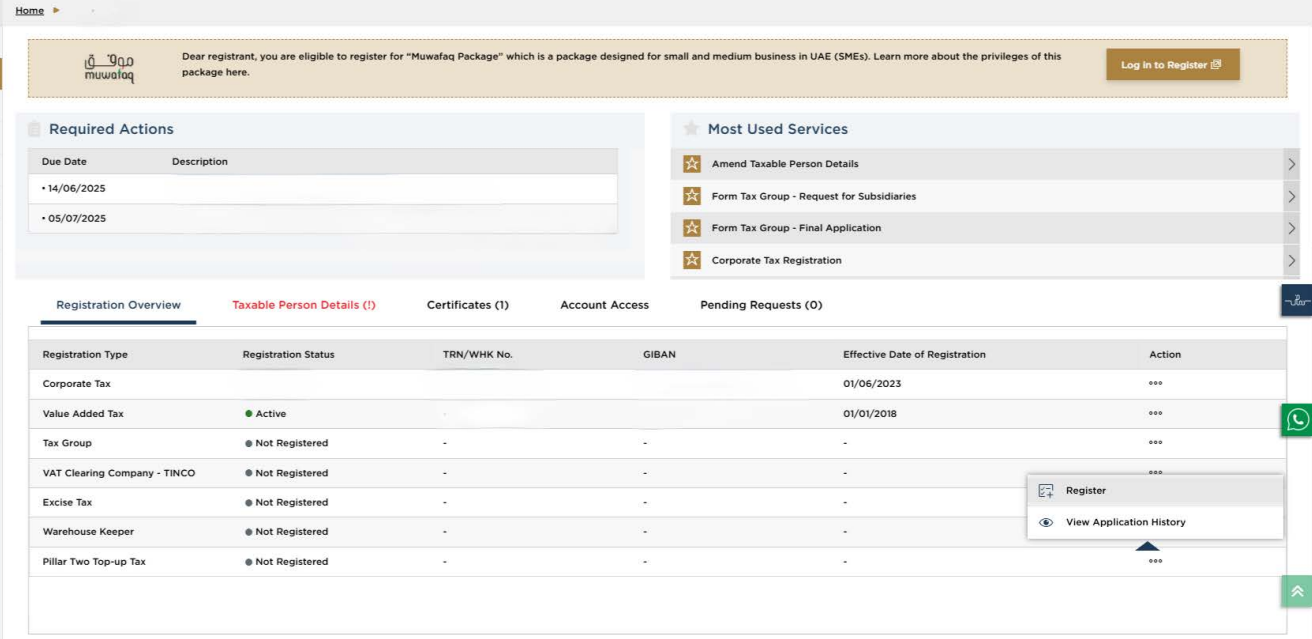
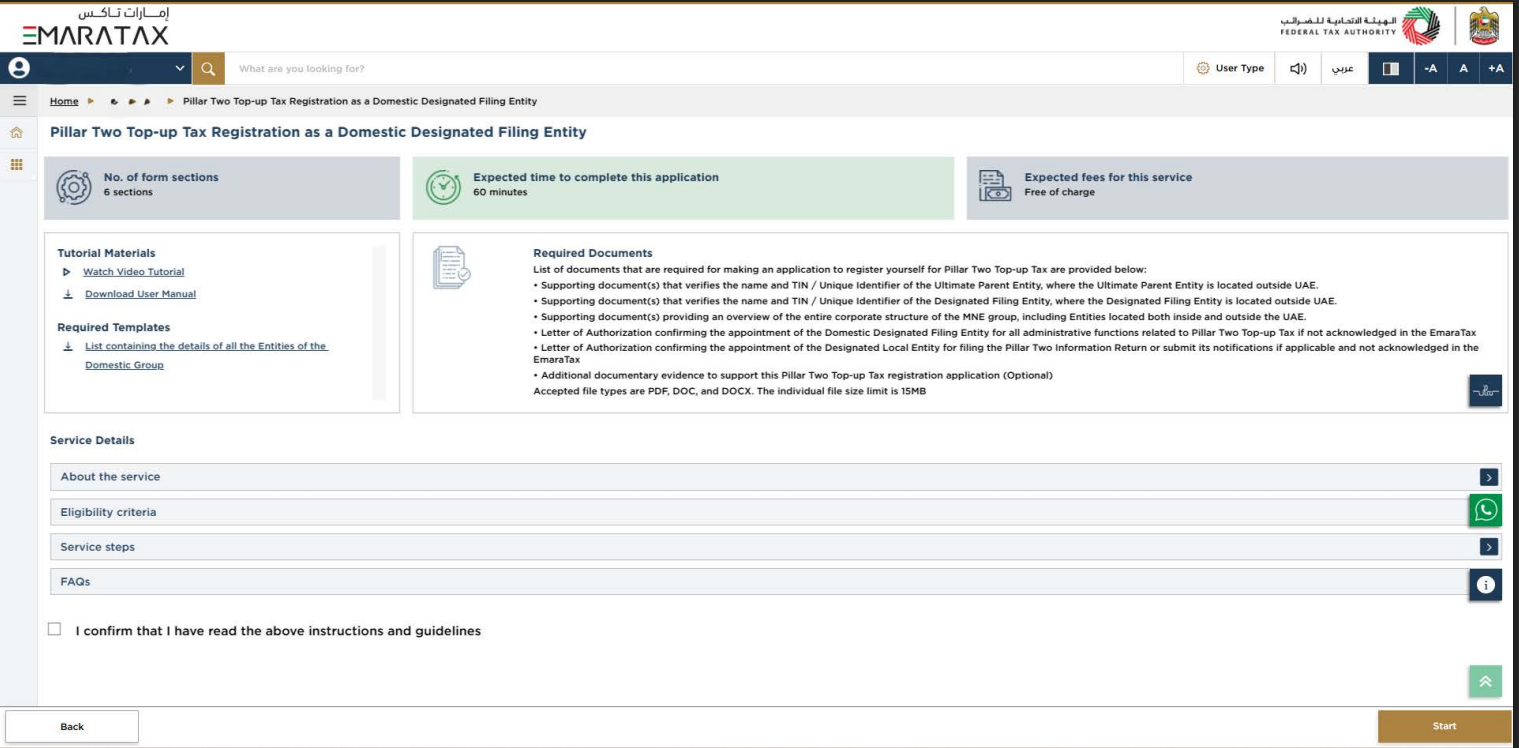
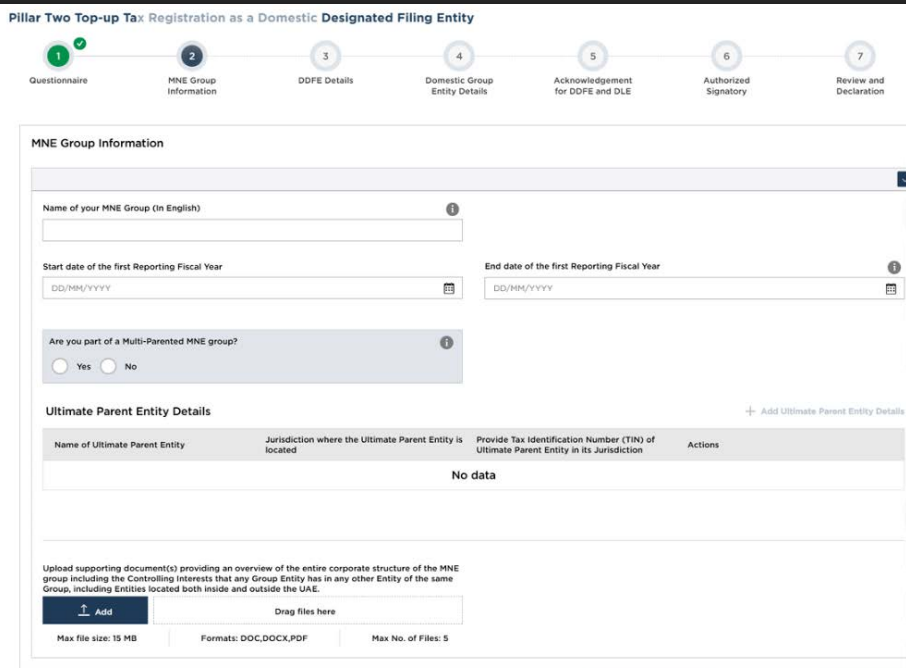
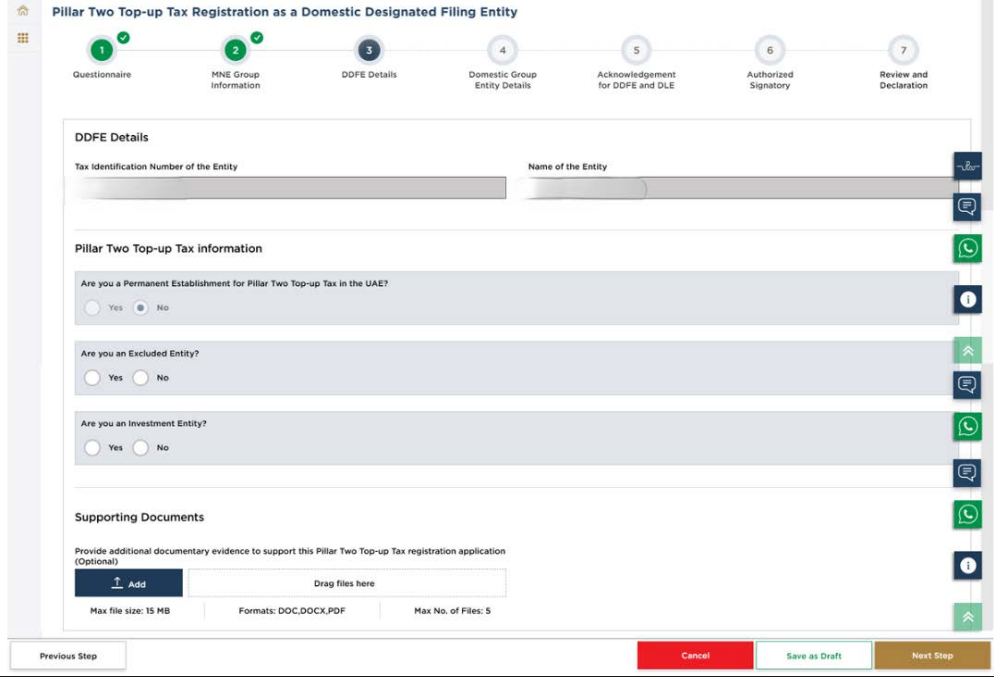
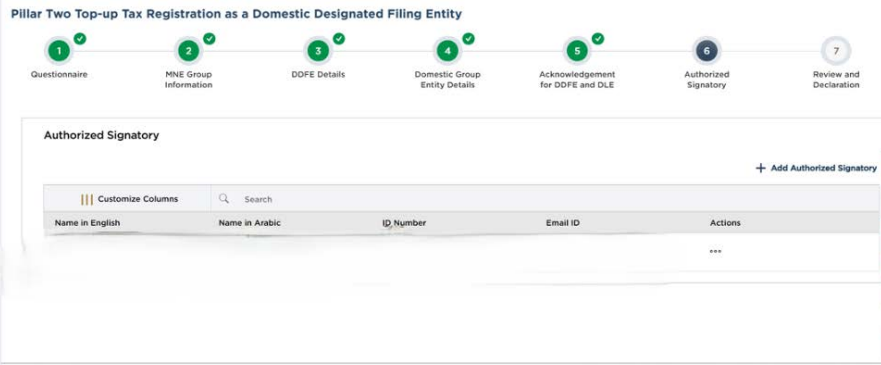
The UAE Federal Tax Authority (FTA) has officially enabled the Pillar Two Top-up Tax Registration on the EmaraTax portal. This represents a significant compliance requirement for Multinational Enterprise (MNE) groups operating in the UAE.

Under the new Domestic Minimum Top-up Tax (DMTT) framework—effective for financial years starting on or after January 1, 2025 in-scope MNEs with global consolidated revenues of €750 million or more are required to maintain a minimum effective tax rate of 15% on their UAE profits.

With the first active reporting cycle taking place in 2026, eligible entities must begin the registration process. The EmaraTax portal currently offers two pathways for registration:

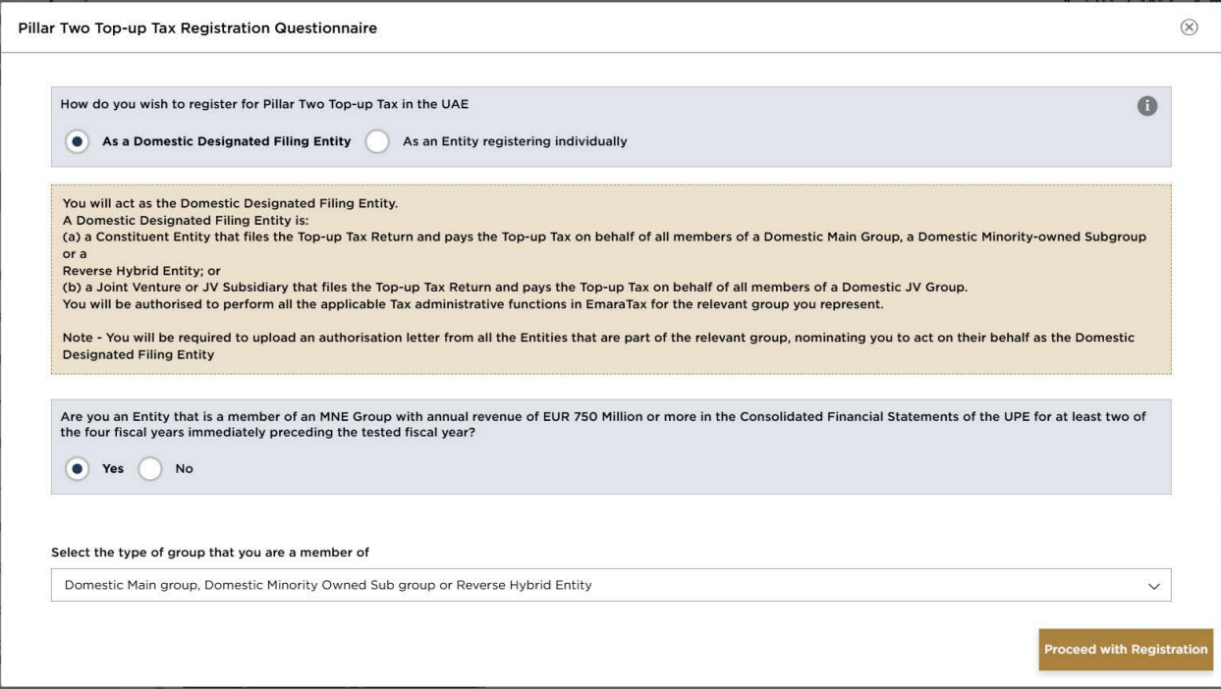
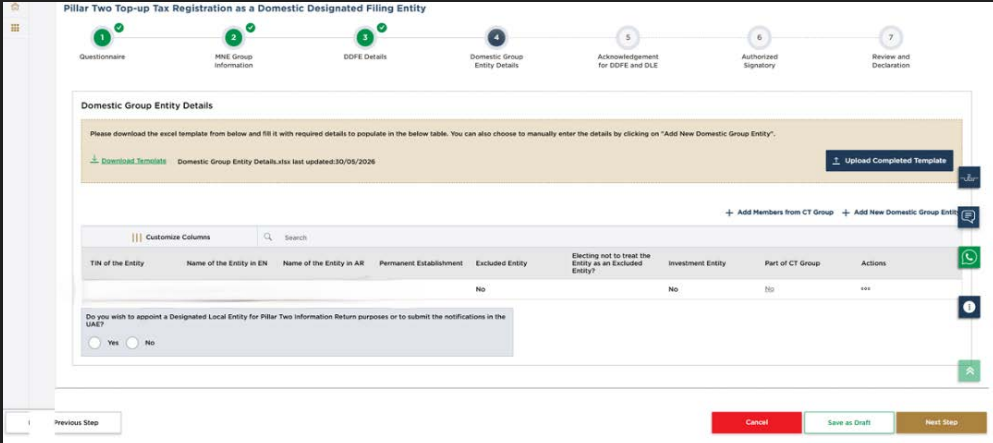
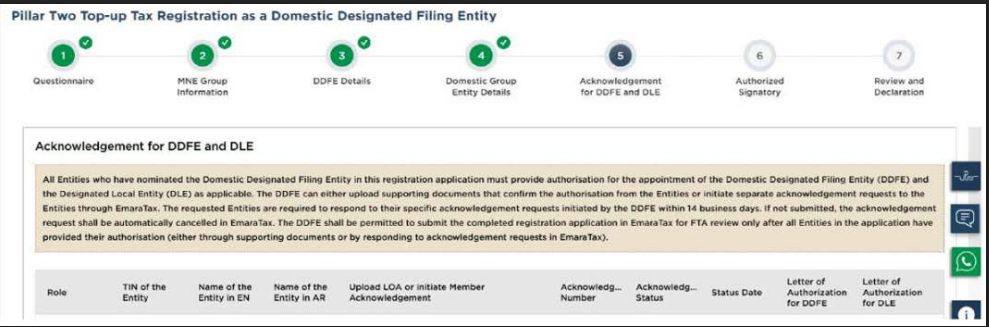
  • Domestic Designated Filing Entity (DDFE) Registration: A single constituent entity is appointed to register and file centrally on behalf of the entire UAE domestic group. While this approach centralizes reporting, it requires preliminary steps, including mapping out domestic group entities and securing the necessary internal authorizations.
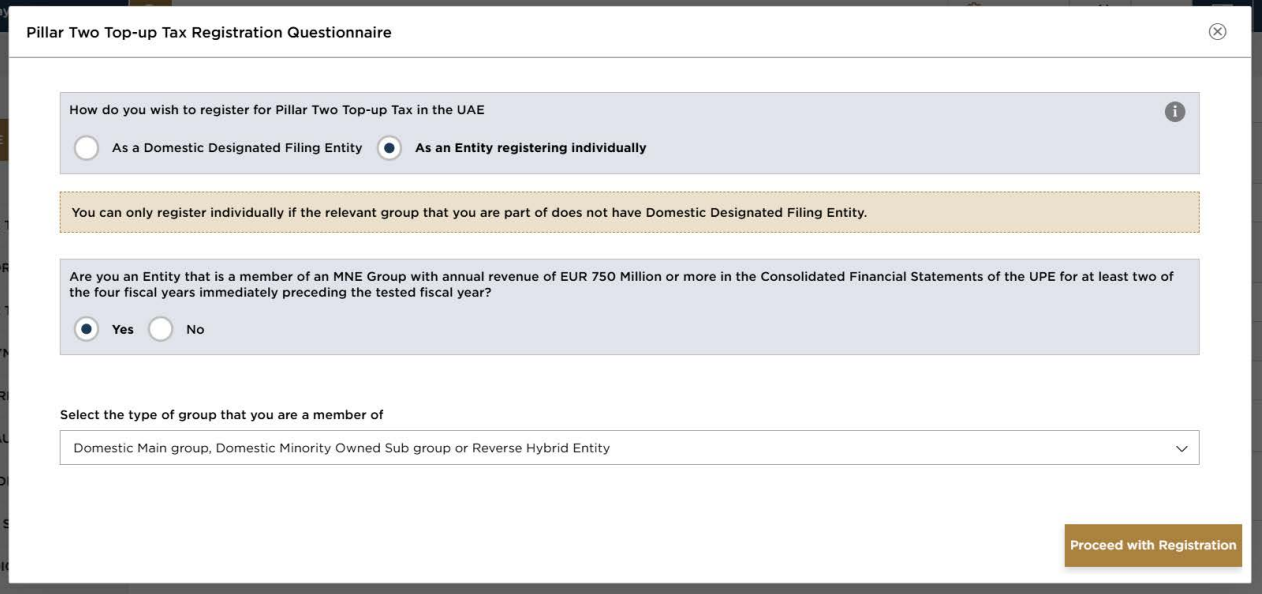
  • Individual Entity Registration: In cases where a central filing body is not appointed, individual constituent entities or joint ventures can register directly to manage their compliance independently

Required Information for Registration

Before proceeding with the formal EmaraTax registration, applicants are required to complete an initial profiling questionnaire. Your organization should have the following information prepared:

  • The selected registration strategy (DDFE versus Individual Entity).
  • Confirmation of group eligibility based on the €750 million global revenue threshold.
  • Details regarding whether the Pillar Two requirements apply due to recent structural changes, such as a merger, acquisition, or demerger.
  • The precise group classification for registration and reporting purposes.

Recommended Next Steps

Multinational groups with operations in the UAE should proactively assess their Pillar Two readiness by determining the most appropriate filing approach, aligning compliance responsibilities across relevant entities, and evaluating the impact on their existing structures.

UAE E-Invoicing Accredited Service Provider (ASP) Deadline Extended To 30 October 2026 

UAE E-Invoicing Accredited Service Provider (ASP) Deadline Extended to 30 October 2026

Insights

UAE E-Invoicing Accredited Service Provider (ASP) Deadline Extended to 30 October 2026

The UAE Ministry of Finance has announced targeted amendments to the UAE E-invoicing framework, including an extension of the deadline for appointing an Accredited Service Provider (ASP).

What Has Changed?

Entities subject to the UAE e-invoicing system with annual revenues exceeding AED 50 million will now have until 30 October 2026 to appoint an Accredited Service Provider (ASP), extending the previous deadline of 31 July 2026. 

Reason for the Extension

According to the Ministry of Finance, the extension was introduced following, 

  • An Assessment of market readiness 
  • Feedback from businesses requesting broader technical options 
  • The Need to encourage more competitive pricing within the ASP ecosystem 

Approved Accredited Service Provider (ASP)

The ministry announced that 32 service providers have been accredited so far, with a large number of service providers in the final stages of the accreditation process, stressing that this step will contribute to building a more integrated and competitive technology system. 

Empowering Local Businesses

To support and empower local businesses, the Ministry amended Ministerial Resolution No. (64) of 2025, allowing service providers to offer technical solutions through partnerships with third-party providers. This enables local companies to collaborate with international providers, enhance technical expertise, and deliver solutions that meet UAE requirements, further accelerating the country’s digital transformation. 

Key Important Clarification

  • While the ASP appointment deadline has been extended, the mandatory implementation timeline remains unchanged.  
  • Businesses with annual revenues exceeding AED 50 million must still fully implement the E-Invoicing system by 1st January 2027 

Key Takeaway

The extension provides businesses with additional time to evaluate and select suitable Accredited Service Providers while ensuring adequate preparation for compliance ahead of the mandatory go-live deadline on 1 January 2027. 

Below is the link to the official announcement issued by the Ministry of Finance.  

https://mof.gov.ae/en/news/ministry-of-finance-announces-targeted-amendments-to-einvoicing-system-decisions/ 

FTA Clarification CTP010: Director vs Officer in UAE Corporate Tax (Article 36 Explained)

FTA Clarification CTP010: Director vs Officer in UAE Corporate Tax

Insights

FTA Clarification CTP010: Director vs Officer in UAE Corporate Tax

The Federal Tax Authority has clarified the meaning of “director” and “officer” for payments to Connected Persons under Article 36 of the Corporate Tax (CT) Law. The interpretation goes beyond job titles and is based on actual authority and decision-making power. The purpose of this clarification is to explain exactly what “director” and “officer” mean beyond the title.

Article 36(1) states that any payment or benefit given by a Taxable Person to a CP is deductible only if:

  • It matches the Market Value of the service, benefit, or anything else provided by the CP, and
  • It is incurred wholly and exclusively for the purposes of the company’s business.

A “Connected Person” (CP) under Article 36(2)(b) includes a director or officer of the company. Additionally, under Article 55(1), of the CT law states that the FTA may require the company to disclosure in its CT Return, covering all transactions and arrangements with CPs. Currently, the FTA requires payments or benefits to CPs to be disclosed in the CT return if they exceed AED 500,000.

These rules ensure that payments to directors or officers are:

  • Deductible only if they do not exceed Market Value, and
  • Properly disclosed.

Who is a Director as per the public clarification (CTP010)?

A “director” is a person who holds a position on the board of directors. This includes:

  • Executive directors
  • Non-executive directors
  • Temporary directors
  • Permanent directors
  • Alternative directors

as long as they are appointed on the board of directors, including any member of a board committee.

If the company does not have a board of directors, then “director” refers to a person holding a position on any equivalent governing body — including but not limited to:

  • Board of trustees
  • Board of governors

as determined under the applicable law governing the company’s incorporation, or the company’s constitutional documents, including but not limited to:

  • Memorandum of association
  • Articles of association
  • Partnership deed
  • Trust deed

Just having the word “director” in a job title does not make someone a director for the purposes of Article 36(2)(b).

If a person’s job title includes “director” but they do not hold a position on the board or equivalent governing body as per the company’s incorporation or constitutional documents, they are not considered a “director”.

However, it is still necessary to check whether that person could be considered an “officer.”

Who is an Officer as per the public clarification (CTP010)?

An “officer” includes any person who meets at least one of the following three criteria:

  1. The person has the authority and responsibility for planning, directing, and controlling the
    activities of the Taxable Person, in accordance with the framework of International Accounting
    Standard 24 on Related Party Disclosures.

  2. The person has the authority to make strategic decisions related to the financial, operational,
    or commercial matters of the Taxable Person.

  3. The person has the authority to enter into agreements or approve actions that legally or
    contractually bind the Taxable Person.

Officer does not include a person who does not have the ultimate strategic decision-making or binding authority. An officer may include, but is not limited to:

  • Chief Executive Officer (CEO)
  • General Manager (GM)
  • Chief Financial Officer (CFO)
  • Chief Operating Officer (COO)
  • Chief Commercial Officer (CCO)
  • An authorised representative with discretionary authority

together referred to as “C-suite.”

A formal appointment or job title may be used as an indicator when assessing whether someone is an officer but it should not be relied upon as the sole criterion.

If a person does not have a formal appointment or C-suite job title, but through their actual conduct effectively has:

  • The authority and responsibility for planning, directing, and controlling, or
  • The authority to make strategic decisions, or
  • The authority to take or approve actions that legally or contractually bind the company

that person is still considered an “officer.”

The concept of “officer” applies to all Taxable Persons, including trusts, foundations, and unincorporated partnerships that are treated as fiscally opaque for Corporate Tax purposes.

  • Only a natural person can be a “director” or “officer” of a Taxable Person.
  • If a person is considered both a Related Party and a CPs of a Taxable Person, that person will be treated only as a Related Party for Corporate Tax purposes.

Examples

Sl No.
Role
Officer Status (✓/✗)
1
GM of an LLC
✓ – if they have authority and responsibility for overall management of the company
2
Head of a division
✓ – if they make ultimate strategic decisions.

✗ – if they only operate within frameworks set by higher authority
3
Head of HR
✓ – if they have ultimate authority over strategic HR decisions.

✗ – if limited to routine HR functions
4
Employee named on trade icence / board resolutions
✓ – if this gives authority to approve actions that legally or contractually bind the company
5
Holder of Power of Attorney
✓ – if PoA grants discretionary and strategic decision-making authority.

✗ – if limited to predefined tasks
6
Third-party secondees/ outsourced personnel
✓ – if they have authority to make strategic decisions or bind the company

✗ – if only executing pre-agreed terms.
7
GM of a Permanent Establishment
✓ – if responsible for planning, directing, and controlling activities of the PE
8
Interim CEO titled “consultant”
✓ – if they perform CEO role with authority to plan, direct, and control activities
9
GM appointed by natural-person Taxable Person
✓ – if they have authority and responsibility for managing the business
10
Trustee of a trust (Taxable Person)
✓ – if they have authority to plan, direct, and control activities of the trust
11
Court-appointed trustee / administrator
✗ – if only carrying out court-assigned duties without discretionary authority

Key Takeaways

The classification of a “director” or “officer” is determined by substance over form. What matters is the actual authority to plan, direct, and control the business, rather than the title held. Accordingly, individuals who may not formally hold the title of director or officer could still fall within this scope if they exercise significant decision-making powers.

Businesses should therefore carefully assess roles and responsibilities in practice to ensure that payments to CPs are correctly evaluated and remain compliant with the CT Law. Companies should also revisit and clearly identify who qualifies as a director or officer based on their functional roles, and ensure that appropriate benchmarking is undertaken for any payments made to such persons.

Amendments to the VAT Guide on Input Tax Apportionment – VATGIT1

Amendments to the VAT guide on Input Tax Apportionment – VATGIT1

Insights

Amendments to the VAT guide on Input Tax Apportionment – VATGIT1

The Federal Tax Authority (FTA) in the United Arab Emirates (UAE) has amended Input tax apportionment guide – VATGIT1 on 30th September, 2025. We have summarised the key highlights below –

Input Tax Apportionment

Input tax apportionment is a process of calculating how much input tax you are allowed to claim back when expenses are partly for taxable supplies and partly for exempt or non-business use.

Specified Recovery Percentage (SRP)

SRP is a new method introduced by FTA, under this method business are allowed to use a fixed recovery rate based on the prior year’s actual recovery rate. A taxable persons can submit an application to the FTA to adopt a fixed recovery percentage this approach helps reduce the effort of recalculating the recovery ratio for every tax period.

Eligibility to apply for SRP:

  • Applicants must have been registered for VAT for a minimum of 12 months.
  • Applicants must be making taxable supplies , exempt supply such as financial services and supplies that are made outside the UAE which would have been considered taxable had they been made in the UAE.
  • Application is made to the FTA by either the authorized signatory, tax agent or by the legal representative.

Requirements for submitting an application for Special Input Tax apportionment to the FTA

Applicants are required to provide the following information as part of the request:

  • A cover letter that contains:
    • Detailed description of the Business activities of the Applicant,
    • The special Input Tax apportionment method to be used, and
    • The reasons for applying for a special Input Tax apportionment method.

  • Historical calculations of Residual Input Tax apportionment in Excel format using the standard method of apportionment. The calculations should be for the period of 12 months preceding the application (as applicable or a shorter period if the business has been conducted for less than 12 months)

  • Calculations of the Residual Input Tax apportionment in Excel format for the same period as above but using the special method requested by the Applicant.

  • Where an application is submitted for a sectoral method, the Applicant is required to provide the special apportionment method calculations separately for each sector included in the request, along with a clear description of the activities and nature of each sector.

  • Applicants must ensure that all figures and details included in the calculations are fully aligned and reconciled with the Tax Returns that have been filed with the FTA for the respective Tax Periods.

Response times highlighted

FTA’s standard response times remain unchanged:

  • 40 business days for non-sectoral method requests
  • 60 business days for sectoral method requests

Applicants are required to reply to any queries raised by the FTA within 40 business days.

Validity of Approved SRP

Approval for special input tax apportionment methods is valid for:

  • 4 years for non-sectoral methods
  • 2 years for sectoral methods

Notifying FTA in case of any variance

Registrants must inform the FTA if the actual recovery percentage for the entire tax year differs by more than 10% from the percentage originally reported. Notification to the FTA must be made within 20 business days from the date the variance is identified.

Additional information to be provided as part of the notification includes:

  • Confirmation of the variance and the date it was detected.
  • An explanation outlining the reason for the difference.
  • Information on any changes in business activities.
  • Details and nature of such changes, if applicable.
  • Full-year recovery rate calculations, including an Excel-based annual washup.

If a Registrant does not inform the FTA of a variance greater than 10% within 20 Business Days, or fails to reply to the FTA’s request within 40 Business Days, the FTA may decide that the approved special method is no longer applicable from the date the variance was first identified.

Conclusion

This update issued by Federal Tax Authority marks a significant step forward by introduction of the Specified Recovery Percentage (SRP) to reduces administrative burden and closely monitor variance and recovery rates. Businesses must adopt a proactive approach in assessing their eligibility, preparing application and complying on going reporting obligations.

Profit Margin Scheme under UAE VAT: A Comprehensive Guide for Businesses 

Profit Margin Scheme under UAE VAT

Insights

Profit Margin Scheme under UAE VAT

The UAE VAT regime generally requires VAT to be charged on the full value of taxable supplies. However, for certain categories of goods, this approach can lead to unfair double taxation, particularly where VAT incurred earlier in the supply chain cannot be recovered. To address this, the Federal Tax Authority (FTA) has introduced a special optional mechanism known as the Profit Margin Scheme.

This article provides a practical and detailed overview of the Profit Margin Scheme under UAE VAT, including eligible goods and transactions, calculation methods, invoicing and record-keeping requirements, and common examples to help businesses apply the scheme correctly. 

What is the Profit Margin Scheme?

The Profit Margin Scheme is an optional VAT accounting method available to resellers of certain goods. Instead of charging VAT on the total selling price, VAT is calculated only on the difference between the selling price and the purchase price. 

When Can the Profit Margin Scheme be Applied?

The Profit Margin Scheme may be applied in the following circumstances: 

  1. Resale of eligible goods acquired from:
    • A non-VAT registered person, or
    • A VAT-registered supplier who already applied the Profit Margin Scheme

  2. Sale of goods where input VAT recovery was blocked under Article 53 of the VAT Executive Regulations, such as motor vehicles available for private use.

The scheme can only be applied if the goods were previously subject to VAT. It does not apply to goods that have never been subject to VAT. 

Importantly, the scheme is optional and can be applied on a supply-by-supply basis, provided all conditions are met. 

Eligible Goods under the Profit Margin Scheme

The scheme applies only to specific categories of goods: 

1. Second-Hand Goods 

Second-hand goods are tangible movable items that are suitable for further use as they are, or after repair, without changing their original function. 

Common examples include: 

  • Used cars 
  • Mobile phones 
  • Furniture 
  • Electronic equipment

2. Antiques 

Antiques are goods that are more than 50 years old, such as antique furniture, artwork, or collectibles. Businesses must retain sufficient evidence to prove: 

  • The age of the goods, and 
  • That VAT was previously imposed on them 

3. Collector’s Items 

Collector’s items include: 

  • Stamps 
  • Coins and currency 
  • Items of scientific, historical, or archaeological interest 

These goods typically derive value from rarity and collectability. Proper documentation is essential to support their eligibility under the scheme. 

Importation of Goods – Key Considerations

As a general rule, the Profit Margin Scheme does not apply to imported goods, because import VAT is usually recoverable under normal VAT rules. 

However, if import VAT recovery is blocked under Article 53, the scheme may be applied on resale. 

Eligible goods & applicability of the Profit Margin Scheme

Example
Scenario
Applicability
Repairs without change in nature
“Company A” a used car dealer purchases a vehicle from a private individual “Mr. B”, carries out servicing and minor repairs, and resells it
Since the car retains its original purpose, it qualifies as a second-hand good under the scheme. “Company A” can apply the scheme.
Goods not previously subject to VAT
“Company A” purchased a used car from a private individual ” Mr. B” who acquired it on 2017.
Since, the car was purchased before the implementation of VAT, the car has never been subject to VAT & hence “Company A” cannot apply the scheme.
Goods previously subject to VAT
“Company A “purchased a used furniture from a non-registrant ” Mr. B” in 2019. Mr. B has bought the furniture by paying VAT with proper Tax invoice.
If Mr. B provide the copy of tax invoice with company A, then Company A has proof that the furniture was previously subject to VAT & can apply the scheme when reselling the furniture, provided all the other conditions are met.
Seller applied scheme
“Company A” purchases second hand goods from a non-registrant & sold some of these goods to “Company B” a registrant by applying the Scheme.
“Company B” can apply the scheme if he is reselling the goods provided all the other conditions are met.
Resale of imported good
“Company A” a taxable antique dealer imports antiques into UAE and pays import VAT.
“Company A” cannot apply the scheme when reselling the antiques as the import VAT is recoverable by company A in accordance with the normal Input Tax recovery rules.

Calculating VAT under the Profit Margin Scheme

Step 1: Determine the Profit Margin 


Profit Margin = Selling Price – Purchase Price 

  • The purchase price includes the cost of the goods and any directly related costs such as transport and installation cost. 
  • The selling price includes all consideration received for the supply. 

Step 2: Calculate VAT on the Profit Margin 

VAT is calculated using the VAT fraction: 


VAT = Profit Margin * (5/105)              

Computation of VAT on Profit Margin Scheme

Example
Scenario
Computation
VAT Amount
Eligible goods sold for profit
A used car dealer buys a car for AED 100,000 and sells it for AED 200,000.
Purchase Price (A) = AED 100,000 Selling Price (B) = AED 200,000 Profit Margin (C= B-A) = AED 100,000 VAT on Profit Margin = C*(5/105) = AED 4,761.90
4,761.90
Purchase price including costs
A business purchases a car for AED 100,000 and incurred AED 5,000 as transportation costs. They sold the car for AED 250,000.
Purchase Price (A) + associated costs = AED 105,000 Selling Price (B) =AED 250,000 Profit Margin (C= B-A) = AED 145,000 VAT on Profit Margin = C*(5/105) = AED 6,904.76
6,904.76
Goods with Blocked Input VAT (Article 53)
A Company buys a luxury car for the business & its CEO’s personal. The price of the car is AED 500,000 Plus AED 25,000 VAT. VAT was not recovered due to Article 53(1)(b) of VAT Executive Regulations. Company sells the car for AED 530,000
Purchase Price (A) = AED 525,000 Selling Price (B) = AED 530,000 Profit Margin (C= B-A) = AED 5,000 VAT on Profit Margin = C*(5/105) = AED 238.10
238.10

Goods Sold at a Loss or Break-Even

If eligible goods are sold: 

  • At a loss, or 
  • With no profit 

No VAT is payable under the Profit Margin Scheme. However, losses cannot be offset against profits from other transactions. 

Computation of VAT on Profit Margin Scheme for goods sold at loss or no profit

Scenario
Computation
VAT Amount & Justification
“Company A” a used car dealer, sold four cars & applied the scheme on all of them.”
Car Selling Price Purchase Price Profit Margin VAT
Car 1 10,000.00 5,000.00 5,000.00 238.10
Car 2 20,000.00 10,000.00 10,000.00 476.19
Car 3 25,000.00 25,000.00
Car 4 5,000.00 20,000.00 (15,000.00)
Total 60,000.00 60,000.00 714.29
Even though, there is no profit during the whole period, the company has to account for VAT on the two cars that was sold on profit. i.e., AED 714.29. Since Cars 3 & 4 are not sold for profit, no output tax needs to be reported for the same. The loss made on the supply of car 4 cannot be settled off against the profits made on the supply of cars 1 & 2.

Invoicing and Record-Keeping Requirements

When applying the scheme: 

  • A valid tax invoice must be issued 
  • The tax invoice must clearly state that VAT is charged under the Profit Margin Scheme 
  • The VAT amount must not be shown separately with the note mentioning in the tax invoice that vat is charged under profit margin scheme 

Record-Keeping

Businesses must maintain: 

  • A stock register for goods sold under the scheme 
  • Purchase invoices or self-issued purchase documents for non-registrants 
  • Evidence that goods were previously subject to VAT 
  • Seller details, dates, consideration, and signatures where applicable 

Proper documentation is critical in case of an FTA audit. 

VAT Return Reporting

When applying the Profit Margin Scheme: 

  • The relevant checkbox must be selected in the VAT return 
  • Box 1 should include: 
    • Selling price net of VAT on the margin 
    • VAT amount relating to the profit margin 
  • Box 9 should include: 
    • Purchase price of goods intended for resale under the scheme 
    • No VAT amount 
    • Purchase price of the goods intended to be sold under the scheme should be reported in the Tax period these goods are acquired. 

Goods sold at a loss are still included in the selling price figure, but no VAT is reported for them. 

Example – Reporting in the VAT return 

Company A purchased a mobile phone for AED 1,500 from Mr. B in January 2025 and sold it to Mr. C in March 2025 for AED 1,710. Company A files VAT returns on a monthly basis. 

The purchase of the mobile phone should be reported in Box 9 of the VAT return for January 2025 with an amount of AED 1,500. 

The sale of the mobile phone should be reported in Box 1 of the VAT return for March 2025, showing AED 1,700 in the amount column and AED 10 as VAT on the profit margin. 

Conclusion

The Profit Margin Scheme is a valuable VAT relief mechanism for businesses dealing in second-hand goods, antiques, collector’s items, and assets with blocked input VAT. When applied correctly, it prevents VAT cascading and ensures that VAT is charged only on the true value added by the reseller. 

However, the scheme comes with strict eligibility conditions, detailed documentation requirements, and specific reporting obligations. Incorrect application can expose businesses to penalties and reassessments by the FTA.