

The UAE Ministry of Finance has announced targeted amendments to the UAE E-invoicing framework, including an extension of the deadline for appointing an Accredited Service Provider (ASP).
Entities subject to the UAE e-invoicing system with annual revenues exceeding AED 50 million will now have until 30 October 2026 to appoint an Accredited Service Provider (ASP), extending the previous deadline of 31 July 2026.
According to the Ministry of Finance, the extension was introduced following,
The ministry announced that 32 service providers have been accredited so far, with a large number of service providers in the final stages of the accreditation process, stressing that this step will contribute to building a more integrated and competitive technology system.
To support and empower local businesses, the Ministry amended Ministerial Resolution No. (64) of 2025, allowing service providers to offer technical solutions through partnerships with third-party providers. This enables local companies to collaborate with international providers, enhance technical expertise, and deliver solutions that meet UAE requirements, further accelerating the country’s digital transformation.
The extension provides businesses with additional time to evaluate and select suitable Accredited Service Providers while ensuring adequate preparation for compliance ahead of the mandatory go-live deadline on 1 January 2027.
Below is the link to the official announcement issued by the Ministry of Finance.
Search
Recent Insights


The Federal Tax Authority has clarified the meaning of “director” and “officer” for payments to Connected Persons under Article 36 of the Corporate Tax (CT) Law. The interpretation goes beyond job titles and is based on actual authority and decision-making power. The purpose of this clarification is to explain exactly what “director” and “officer” mean beyond the title.
Article 36(1) states that any payment or benefit given by a Taxable Person to a CP is deductible only if:
A “Connected Person” (CP) under Article 36(2)(b) includes a director or officer of the company. Additionally, under Article 55(1), of the CT law states that the FTA may require the company to disclosure in its CT Return, covering all transactions and arrangements with CPs. Currently, the FTA requires payments or benefits to CPs to be disclosed in the CT return if they exceed AED 500,000.
These rules ensure that payments to directors or officers are:
A “director” is a person who holds a position on the board of directors. This includes:
as long as they are appointed on the board of directors, including any member of a board committee.
If the company does not have a board of directors, then “director” refers to a person holding a position on any equivalent governing body — including but not limited to:
as determined under the applicable law governing the company’s incorporation, or the company’s constitutional documents, including but not limited to:
Just having the word “director” in a job title does not make someone a director for the purposes of Article 36(2)(b).
If a person’s job title includes “director” but they do not hold a position on the board or equivalent governing body as per the company’s incorporation or constitutional documents, they are not considered a “director”.
However, it is still necessary to check whether that person could be considered an “officer.”
An “officer” includes any person who meets at least one of the following three criteria:
Officer does not include a person who does not have the ultimate strategic decision-making or binding authority. An officer may include, but is not limited to:
together referred to as “C-suite.”
A formal appointment or job title may be used as an indicator when assessing whether someone is an officer but it should not be relied upon as the sole criterion.
If a person does not have a formal appointment or C-suite job title, but through their actual conduct effectively has:
that person is still considered an “officer.”
The concept of “officer” applies to all Taxable Persons, including trusts, foundations, and unincorporated partnerships that are treated as fiscally opaque for Corporate Tax purposes.
Sl No. | Role | Officer Status (✓/✗) |
|---|---|---|
1 | GM of an LLC | ✓ – if they have authority and responsibility for overall management of the company |
2 | Head of a division | ✓ – if they make ultimate strategic decisions. ✗ – if they only operate within frameworks set by higher authority |
3 | Head of HR | ✓ – if they have ultimate authority over strategic HR decisions. ✗ – if limited to routine HR functions |
4 | Employee named on trade icence / board resolutions | ✓ – if this gives authority to approve actions that legally or
contractually bind the company |
5 | Holder of Power of
Attorney | ✓ – if PoA grants discretionary and strategic decision-making authority. ✗ – if limited to predefined tasks |
6 | Third-party secondees/ outsourced personnel | ✓ – if they have authority to make strategic decisions or bind the company ✗ – if only executing pre-agreed terms. |
7 | GM of a Permanent Establishment | ✓ – if responsible for planning, directing, and controlling activities of the PE |
8 | Interim CEO titled “consultant” | ✓ – if they perform CEO role with authority to plan, direct, and control activities |
9 | GM appointed by natural-person Taxable Person | ✓ – if they have authority and responsibility for managing the business |
10 | Trustee of a trust (Taxable Person) | ✓ – if they have authority to plan, direct, and control activities of the trust |
11 | Court-appointed trustee / administrator | ✗ – if only carrying out court-assigned duties without discretionary authority |
The classification of a “director” or “officer” is determined by substance over form. What matters is the actual authority to plan, direct, and control the business, rather than the title held. Accordingly, individuals who may not formally hold the title of director or officer could still fall within this scope if they exercise significant decision-making powers.
Businesses should therefore carefully assess roles and responsibilities in practice to ensure that payments to CPs are correctly evaluated and remain compliant with the CT Law. Companies should also revisit and clearly identify who qualifies as a director or officer based on their functional roles, and ensure that appropriate benchmarking is undertaken for any payments made to such persons.
Search
Recent Insights


The Federal Tax Authority (FTA) in the United Arab Emirates (UAE) has amended Input tax apportionment guide – VATGIT1 on 30th September, 2025. We have summarised the key highlights below –
Input tax apportionment is a process of calculating how much input tax you are allowed to claim back when expenses are partly for taxable supplies and partly for exempt or non-business use.
SRP is a new method introduced by FTA, under this method business are allowed to use a fixed recovery rate based on the prior year’s actual recovery rate. A taxable persons can submit an application to the FTA to adopt a fixed recovery percentage this approach helps reduce the effort of recalculating the recovery ratio for every tax period.
Eligibility to apply for SRP:
Applicants are required to provide the following information as part of the request:
FTA’s standard response times remain unchanged:
Applicants are required to reply to any queries raised by the FTA within 40 business days.
Approval for special input tax apportionment methods is valid for:
Registrants must inform the FTA if the actual recovery percentage for the entire tax year differs by more than 10% from the percentage originally reported. Notification to the FTA must be made within 20 business days from the date the variance is identified.
Additional information to be provided as part of the notification includes:
If a Registrant does not inform the FTA of a variance greater than 10% within 20 Business Days, or fails to reply to the FTA’s request within 40 Business Days, the FTA may decide that the approved special method is no longer applicable from the date the variance was first identified.
This update issued by Federal Tax Authority marks a significant step forward by introduction of the Specified Recovery Percentage (SRP) to reduces administrative burden and closely monitor variance and recovery rates. Businesses must adopt a proactive approach in assessing their eligibility, preparing application and complying on going reporting obligations.
Search
Recent Insights


The UAE VAT regime generally requires VAT to be charged on the full value of taxable supplies. However, for certain categories of goods, this approach can lead to unfair double taxation, particularly where VAT incurred earlier in the supply chain cannot be recovered. To address this, the Federal Tax Authority (FTA) has introduced a special optional mechanism known as the Profit Margin Scheme.
This article provides a practical and detailed overview of the Profit Margin Scheme under UAE VAT, including eligible goods and transactions, calculation methods, invoicing and record-keeping requirements, and common examples to help businesses apply the scheme correctly.
The Profit Margin Scheme is an optional VAT accounting method available to resellers of certain goods. Instead of charging VAT on the total selling price, VAT is calculated only on the difference between the selling price and the purchase price.
The Profit Margin Scheme may be applied in the following circumstances:
The scheme can only be applied if the goods were previously subject to VAT. It does not apply to goods that have never been subject to VAT.
Importantly, the scheme is optional and can be applied on a supply-by-supply basis, provided all conditions are met.
The scheme applies only to specific categories of goods:
1. Second-Hand Goods
Second-hand goods are tangible movable items that are suitable for further use as they are, or after repair, without changing their original function.
Common examples include:
2. Antiques
Antiques are goods that are more than 50 years old, such as antique furniture, artwork, or collectibles. Businesses must retain sufficient evidence to prove:
3. Collector’s Items
Collector’s items include:
These goods typically derive value from rarity and collectability. Proper documentation is essential to support their eligibility under the scheme.
As a general rule, the Profit Margin Scheme does not apply to imported goods, because import VAT is usually recoverable under normal VAT rules.
However, if import VAT recovery is blocked under Article 53, the scheme may be applied on resale.
Eligible goods & applicability of the Profit Margin Scheme
Example | Scenario | Applicability |
|---|---|---|
Repairs without change in nature | “Company A” a used car dealer purchases a vehicle from a private individual “Mr. B”, carries out servicing and minor repairs, and resells it | Since the car retains its original purpose, it qualifies as a second-hand good under the scheme. “Company A” can apply the scheme. |
Goods not previously subject to VAT | “Company A” purchased a used car from a private individual ” Mr. B” who acquired it on 2017. | Since, the car was purchased before the implementation of VAT, the car has never been subject to VAT & hence “Company A” cannot apply the scheme. |
Goods previously subject to VAT | “Company A “purchased a used furniture from a non-registrant ” Mr. B” in 2019. Mr. B has bought the furniture by paying VAT with proper Tax invoice. | If Mr. B provide the copy of tax invoice with company A, then Company A has proof that the furniture was previously subject to VAT & can apply the scheme when reselling the furniture, provided all the other conditions are met. |
Seller applied scheme | “Company A” purchases second hand goods from a non-registrant & sold some of these goods to “Company B” a registrant by applying the Scheme. | “Company B” can apply the scheme if he is reselling the goods provided all the other conditions are met. |
Resale of imported good | “Company A” a taxable antique dealer imports antiques into UAE and pays import VAT. | “Company A” cannot apply the scheme when reselling the antiques as the import VAT is recoverable by company A in accordance with the normal Input Tax recovery rules. |
Step 1: Determine the Profit Margin
Step 2: Calculate VAT on the Profit Margin
VAT is calculated using the VAT fraction:
Computation of VAT on Profit Margin Scheme
Example | Scenario | Computation | VAT Amount |
|---|---|---|---|
Eligible goods sold for profit | A used car dealer buys a car for AED 100,000 and sells it for AED 200,000. | Purchase Price (A) = AED 100,000 Selling Price (B) = AED 200,000 Profit Margin (C= B-A) = AED 100,000 VAT on Profit Margin = C*(5/105) = AED 4,761.90 | 4,761.90 |
Purchase price including costs | A business purchases a car for AED 100,000 and incurred AED 5,000 as transportation costs. They sold the car for AED 250,000. | Purchase Price (A) + associated costs = AED 105,000 Selling Price (B) =AED 250,000 Profit Margin (C= B-A) = AED 145,000 VAT on Profit Margin = C*(5/105) = AED 6,904.76 | 6,904.76 |
Goods with Blocked Input VAT (Article 53) | A Company buys a luxury car for the business & its CEO’s personal. The price of the car is AED 500,000 Plus AED 25,000 VAT. VAT was not recovered due to Article 53(1)(b) of VAT Executive Regulations. Company sells the car for AED 530,000 | Purchase Price (A) = AED 525,000 Selling Price (B) = AED 530,000 Profit Margin (C= B-A) = AED 5,000 VAT on Profit Margin = C*(5/105) = AED 238.10 | 238.10 |
If eligible goods are sold:
No VAT is payable under the Profit Margin Scheme. However, losses cannot be offset against profits from other transactions.
Computation of VAT on Profit Margin Scheme for goods sold at loss or no profit
Scenario | Computation | VAT Amount & Justification | ||||||||||||||||||||||||||||||
|---|---|---|---|---|---|---|---|---|---|---|---|---|---|---|---|---|---|---|---|---|---|---|---|---|---|---|---|---|---|---|---|---|
“Company A” a used car dealer, sold four cars & applied the scheme on all of them.” |
| Even though, there is no profit during the whole period, the company has to account for VAT on the two cars that was sold on profit. i.e., AED 714.29. Since Cars 3 & 4 are not sold for profit, no output tax needs to be reported for the same. The loss made on the supply of car 4 cannot be settled off against the profits made on the supply of cars 1 & 2. |
When applying the scheme:
Businesses must maintain:
Proper documentation is critical in case of an FTA audit.
When applying the Profit Margin Scheme:
Goods sold at a loss are still included in the selling price figure, but no VAT is reported for them.
Example – Reporting in the VAT return
Company A purchased a mobile phone for AED 1,500 from Mr. B in January 2025 and sold it to Mr. C in March 2025 for AED 1,710. Company A files VAT returns on a monthly basis.
The purchase of the mobile phone should be reported in Box 9 of the VAT return for January 2025 with an amount of AED 1,500.
The sale of the mobile phone should be reported in Box 1 of the VAT return for March 2025, showing AED 1,700 in the amount column and AED 10 as VAT on the profit margin.
The Profit Margin Scheme is a valuable VAT relief mechanism for businesses dealing in second-hand goods, antiques, collector’s items, and assets with blocked input VAT. When applied correctly, it prevents VAT cascading and ensures that VAT is charged only on the true value added by the reseller.
However, the scheme comes with strict eligibility conditions, detailed documentation requirements, and specific reporting obligations. Incorrect application can expose businesses to penalties and reassessments by the FTA.
Search
Recent Insights


In 2025, the UAE Ministry of Finance indicated that, to encourage Research and Development (R&D) activities, foster innovation, and support economic growth in the UAE, an R&D tax incentive was being considered, with effect proposed for tax periods commencing on or after 1 January 2026.
Pursuant to this policy signal, the UAE issued Cabinet Decision No. 215 of 2025 (CD 215 of 2025) on R&D Tax Credit on 31 December 2025. Thereafter, the Ministry of Finance announced the launch of Phase 1 of the UAE’s R&D Tax Incentives Programme on 18 March 2026, which has now been operationalised through Ministerial Decision No. 24 of 2026 (MD 24 of 2026).
Under Phase 1 a non-refundable R&D tax credit of up to 50% is available on qualifying R&D expenditure, subject to a cap of AED 5 million of qualifying spend per Qualifying Entity or Tax Group per Tax Period, resulting in a maximum potential credit of AED 2 million.
The settlement methodology for R&D tax credit lies in Federal Decree-Law No. 28 of 2025.
CD 215 of 2025 introduced the concept of R&D Tax Credit as a tax credit available to a Qualifying Entity in respect of Qualifying R&D Expenditure.
CD 215 of 2025 and MD 24 of 2026 apply to tax period commencing on or after 1 January 2026.
CD 215 of 2025 provides, that for an entity to be considered a qualifying entity, the requirements are:
For a Qualifying Free Zone Person (QFZP) to be considered a qualifying entity, CD 215 of 2025 imposes additional condition i.e. QFZP shall be subject to 9% CT on the relevant taxable income derived from qualifying R&D activities or it shall be subject to top-up tax in the relevant fiscal year.
The following entities shall not be considered as qualifying entities:
CD 215 of 2025 categories Qualifying R&D Expenditure as below:
Further, MD 24 of 2026, defines the above categories and provides specific conditions for inclusions and exclusions. For example, in staff cost a 30% upliftment is to be applied, it shall not include employee stock option plans, it shall not include intra-group recharges etc.
CD 215 of 2025 also lay down baseline conditions for such expenditure to qualify. In particular:
The R&D tax credit is available in respect of Qualifying R&D Activities carried out by a Qualifying Entity. For this purpose, an activity will be regarded as a Qualifying R&D Activity only where it is undertaken in the UAE as part of an R&D Project and satisfies all the below mentioned five prescribed conditions:
MD 24 of 2026 expressly states that this assessment should be made with reference to the OECD Frascati Manual. Activities in the fields of social sciences, humanities and the arts are excluded.
A Qualifying Entity may claim the R&D tax credit for Qualifying R&D Expenditure only where it satisfies the following conditions:
MD 24 of 2026, prescribes a progressive tax credit structure for the R&D tax credit, wherein the tax credit rates are as follows:
Maximum Qualifying R&D Expenditure (AED) | Average number of R&D Staff | Tax Credit Rate |
|---|---|---|
First 1 million | At least 2 | 15% |
> 1 million < 2 million | At least 6 | 35% |
> 2 million < 5 million | At least 14 | 50% |
MD 24 of 2026 clarifies:
MD 24 of 2026 also sets out that unutilized R&D tax credits can be carried forward, transferred within a qualifying group, or passed in certain business restructuring cases, subject to continuity and anti-abuse conditions. Carry-forward is generally allowed only where there is at least 50% continuity of ownership, or where the entity continues to carry on the same or similar business despite a major ownership change. An exception applies to entities listed on a Recognised Stock Exchange.
Unused R&D tax credits may also be transferred to another juridical person, provided both the entities are at least 75% commonly owned (directly or indirectly), or one owns the other by that percentage, and the ownership condition is maintained from the period in which the credit arose until the period in which it is utilised. However, the transferee may use the transferred credit only against its current CT and/or Top-up Tax liability, and the transferred credit cannot itself be carried forward or re-transferred.
In the case of business restructuring, unused R&D tax credits may move to the transferee, provided the transferred business, including the associated qualifying R&D activities, continues for at least two years and the relevant restructuring conditions are satisfied. If the qualifying R&D activities are discontinued within two years, the regime provides for a claw-back, under which utilised credits must be repaid, unused credits are forfeited, and penalties may apply.
Key points to note:
CD 215 of 2025 provides that a claim for the R&D tax credit must be submitted as part of the Tax Return or top-up tax Return and must be accompanied by specified supporting documents. These include proof of pre-approval from the Emirates Research and Development Council, a signed declaration by senior management confirming the accuracy of the information provided, a breakdown of qualifying R&D expenditure, audited financial statements, and any other documents that may be specified by the Minister.
Claims submitted after the due date for filing the Tax Return or Top-up Tax Return will not be considered unless accepted by the Authority in exceptional circumstances.
MD 24 of 2026 provides that the qualifying entity shall maintain technical documentation for a period of 7 years following the end of the tax period to which they relate. Further, technical documentation includes -written, visual, and electronic records detailing the objectives, processes, methodologies, experiments, and findings associated with the qualifying R&D activities.
If the Authority determines that one or more persons have artificially split their business or business activities to access or enhance the R&D tax credit, and the combined qualifying R&D expenditure across the wider business exceeds the relevant threshold, such arrangement may be treated as a tax advantage arrangement under Article 50 of the CT Law. In such cases, the Authority may counteract the arrangement, claw back any utilised R&D tax credit, and forfeit any unutilised credit.
Where any arrangement, contract or procedure is entered into mainly or partly to obtain or increase an R&D tax credit in a manner inconsistent with the economic substance or the genuine nature of the qualifying R&D activity, the Authority may adjust or disregard it, claw back any utilised credit, and forfeit any unused credit.
If, within five years from the end of the Tax Period or Fiscal Year in which the R&D tax credit was last claimed, the Qualifying Entity ceases to be a Taxable Person, becomes a Qualifying Free Zone Person, elects Small Business Relief, enters liquidation, or redomiciles outside the UAE, any utilised credit may be clawed back and any unused credit forfeited.
In summary, the UAE has now moved from policy intent to implementation of a structured R&D tax credit regime. CD 215 of 2025 of 2025 lays down the legal and conceptual framework for the credit, while MD 24 of 2026 operationalises Phase 1 by prescribing the applicable rates, staffing thresholds, qualifying activity criteria, and rules for utilisation, carry-forward, transfer and claw-back. The regime offers a potentially meaningful incentive for businesses undertaking genuine UAE based R&D activities, however, the access to benefit is subject to strict eligibility, pre-approval, documentation and continuity conditions.
Search
Recent Insights


This document, issued by the UAE Ministry of Finance, provides comprehensive guidance on the implementation of the Electronic Invoicing System in the UAE. It aligns with national visions like “We the UAE 2031” to enhance digital infrastructure, tax compliance, and economic efficiency. The guidelines cover the framework, scope, exclusions, rollout, preparation steps, invoice categories, scenarios, tax codes, penalties, and appendices for readiness. Below is a structured summary, with tables used for key enumerations and comparisons as per the document’s content.
The guide targets commercial businesses, government entities, and tax/technology advisors. It explains the rules under Ministerial Decisions (MD) No. 243, 244, and 64 of 2025, and Cabinet Decision (CD) No. 106 of 2025. The purpose is to help understand impacts on processes, emphasizing that Electronic Invoicing is mandatory for UAE businesses (regardless of VAT status) unless excluded.
The document defines over 40 terms related to Electronic Invoicing. Here’s a summarized table of essential ones:
Term | Description |
|---|---|
5-Corner Model | Framework for issuing/distributing Electronic Invoices: Supplier, Supplier’s ASP, Buyer’s ASP, Buyer, FTA. |
Accredited Service Provider (ASP) | Service Provider accredited by Ministry to handle Electronic Invoicing. |
Electronic Invoice | Structured XML document issued/transmitted via the system for automatic processing. |
Participant Identifier | Unique ID (0235 + 10-digit TIN) for Peppol network identification. |
Peppol | Pan-European framework adopted for UAE interoperability. |
Tax Invoice | Includes Electronic Invoice for Taxable Supplies. |
TIN | 10-digit identifier for all FTA-registered entities. |
UUID | A Universally Unique Identifier that is a unique 128-bit number generated by an algorithm in the Electronic Invoicing System for distinguishing each Tax Invoice. This is generated in addition to the Electronic Invoice sequential number. |
The system supports tax compliance, reduces errors, speeds up processes, and aids policy-making. Benefits include:
UAE uses a decentralized 5-corner model based on Peppol PINT-AE specifications. Electronic Invoices are XML-only (no QR codes). Key aspects:
Activity | Supplier | Buyer | ASP |
|---|---|---|---|
Exchange/report Electronic Invoices | ✓ | ✓ (self-billed only) | ✗ (but facilitates) |
Calculate invoice values | ✓ | ✗ | ✗ |
Secure transmission | ✗ | ✗ | ✓ |
Agree data security with ASP | ✓ | ✓ | ✗ |
Gather buyer’s Peppol ID | ✓ | ✗ | ✗ |
Lookup supplier’s Peppol ID | ✗ | ✗ | ✓ |
Generate UUID | ✗ | ✗ | ✓ |
As per Article 3(1) of the Tax Procedures Executive Regulation, records related to the issuance, transmission, and receipt of Electronic Invoices must be retained for the following periods:
In addition to the above retention periods, Taxable Persons are required to maintain the relevant data for an additional 4 years in cases where there is a dispute with the Federal Tax Authority (FTA), an ongoing tax audit, or where the FTA has issued a notification of its intention to conduct a tax audit.
Furthermore, where a Voluntary Disclosure is submitted within the fifth year from the end of the relevant tax period, the related records must be retained for an additional period of 1 year from the date of submission of the voluntary disclosure.
Investment Holding Companies
Investment holding companies are usually established as legal entities to hold assets that generate passive income. If the income of such a company is derived only from passive sources (Dividend/Interest etc) and it does not carry out any business transactions, it would generally fall outside the scope of Electronic Invoicing.
However, in certain situations an investment holding company may recharge operational expenses such as management costs or other charges to related parties or third parties. These types of recharges are considered business transactions. In such cases, the investment holding company would be required to register for Electronic Invoicing and issue Electronic Invoices for those transactions in accordance with the phased implementation plan.
Tax Groups
Ministerial Decision No. 243 of 2025 outlines the scope and key obligations under the Electronic Invoicing System. As per this decision, business transactions carried out between members of the same VAT group are still considered within the scope of Electronic Invoicing. These transactions are not excluded simply because they occur within the same VAT group.
A 24-month grace period (from 1 January 2027) applies to intra-group transactions within the same VAT group. During this period, electronic invoicing requirements under MD No. 243 of 2025 will not apply to such transactions
The grace period affects the timing of and does not exclude intra-group transactions from the scope of the Electronic Invoicing System. All applicable Electronic Invoicing obligations will apply in full to such transactions upon expiry of the grace period, in accordance with the mandatory implementation phase.
Where a person who does not have a place of residence in the UAE is required to issue Tax Invoices in accordance with the VAT Decree-Law, such invoices must be issued in the form of Electronic Invoices.
Rollout starts July 2026:
Entity Type | Annual Revenue | Last Date to Appoint ASP | Last Date to Implement |
|---|---|---|---|
Person | ≥ AED 50M | 31 Jul 2026 | 1 Jan 2027 |
Person | < AED 50M | 31 Mar 2027 | 1 Jul 2027 |
Government | N/A | 31 Mar 2027 | 1 Oct 2027 |
No | Scenario | Description | Examples | Additional Considerations | Applies to Commercial Invoices |
|---|---|---|---|---|---|
1 | Free Zone | Transactions involving a Free Zone entity (supplier, buyer, or beneficiary) or supplies made within or from a Free Zone. | Supply to or from a Free Zone entity Supply of goods within a Free Zone Export of goods from a Free Zone | Electronic Invoice must include beneficiary details when the customer is a Free Zone entity. Customer = entity issuing the purchase order/contracting party. If the end user differs from the buyer, beneficiary details must be included. | Yes |
2 | Deemed Supply | Supplies treated as taxable under VAT law even without consideration. | • Free-of-charge supplies • Gifts exceeding threshold • Private use of business assets • Goods/services owned at VAT deregistration date | • Buyer electronic address must be 0235:9900000097. • If no invoice is issued to recipient, only reporting to FTA via ASP is required. | No |
3 | Margin Scheme | VAT is charged only on the supplier’s margin (difference between purchase and resale price). | • Used car sold under profit margin scheme • Gallery reselling artwork purchased from private collectors | • VAT amount does not need to be displayed. • VAT value should be recorded as “0” in the Electronic Invoice. | No |
4 | Summary Invoice | Multiple transactions with the same customer during a specific period consolidated into a single invoice. | • Bank issuing monthly invoice summarizing multiple services | • Certain invoice-level fields can be zero or positive for Peppol validation. • If total payable is negative, issue an Electronic Credit Note instead. | Yes |
5 | Continuous Supply | Supplies provided on an ongoing or recurring basis with periodic invoicing. | • Monthly advisory retainer • Delivery of materials in installments • Milestone-based payments | • For retention amounts, issue a separate commercial document showing milestone calculations. • Retention should not appear on the Electronic Invoice. • When retention becomes payable, issue separate electronic Tax Invoice with VAT. | Yes |
6 | Agent Billing | A disclosed agent issues invoices on behalf of a principal. | • Insurance broker collecting premiums on behalf of an insurance company | • Responsibility to issue Electronic Invoice remains with the supplier (principal) even if issued by the agent. | Yes |
7 | Supply through E-Commerce | Supplies made through an Electronic Commerce Medium as defined under Ministerial Decision No. 26 of 2023. | • Retailer selling goods through its website • Goods sold via an e-commerce marketplace | • Supplier remains responsible for issuing the Electronic Invoice, even if the platform generates it. | Yes |
8 | Exports | Goods or services supplied to customers outside the UAE. | • UAE wholesaler exporting cosmetics to Kuwait • UAE IT firm providing services to a client in France | • Tax Invoice must be issued as an Electronic Invoice and may be provided to Customs. • If buyer has no Peppol ID, use endpoint 0235:9900000099. | No |
Tax Category | Description |
|---|---|
Standard Rate
| Taxable Supply at 5% VAT. |
Exempt from VAT
| In-scope but exempt (e.g., financial services). |
Out of Scope
| Place of supply outside UAE or exclusions. |
Reverse Charge
| Domestic supplies of certain goods (e.g., electronics, metals).
|
Zero Rated
| Subject to 0% VAT (e.g., exports). |
Margin Scheme
| VAT on margin (e.g., second-hand goods). |
Search
Recent Insights


The Federal Tax Authority (FTA) has introduced an option for taxpayers to make advance Corporate Tax (CT) payments. Advance tax payments are applicable from financial year 2026 and may be adjusted against the next CT return or applied towards future outstanding tax liabilities.
This initiative is a welcome development, as it enables taxpayers to avoid last-minute payment challenges, and reduce the risk of late payment penalties.
Taxpayers may now make advance payments by selecting one of the following three options on the FTA portal:
This development supports more proactive Corporate Tax payment planning and cash flow optimisation.

Search
Recent Insights


Two important regulations issued in October 2025 have reshaped the UAE’s tax enforcement system, shifting it away from punitive penalties toward a fairer and more accurate digital approach.
1. Administrative Penalty Reform (Cabinet Decision No. 129 of 2025)
This decision is effective from 14th April 2026; it has replaced the long-standing Cabinet Decision No. 108 of 2021. It marks a shift toward transparency by replacing heavy, compounding fines with a system rewarding voluntary disclosure and proactive correction.
As the UAE introduces phase wise e-invoicing from FY 2026 onward, creating a fully digitized ecosystem. Cabinet Decision No. 106 establishes penalties for non-compliance with the e-invoicing system. This framework ensures a smooth and accurate transition from traditional paper or PDF invoices to structured XML/JSON formats. The new penalties highlight the critical importance of technical readiness and real-time data integrity.
Key amendments in the New Decision involve:
The following table outlines the most key adjustments that companies should be paying attention to prior to the effective date of April 2026.
Violation Type | New Provision (CD 129/2025) | Old Provision (CD 108/2021) | Key Shift |
|---|---|---|---|
Record Keeping | AED 10,000 for each Violation; AED 20,000 if repeated within 24 months | AED 10,000 (In the first instance); AED 20,000 (In the second instance) | Window of 24 months introduced from the previous offense |
Arabic Submission | AED 5,000 | AED 20,000 for failure to submit records in Arabic | Major relief for administrative lapses. |
Late Payment of Tax | Monthly penalty of 14% per annum on unpaid tax; calculated monthly from due date | 2% immediate + 4% monthly (Capped at 300%) | Removal of maximum 300% penalty on payable tax. |
Incorrect Tax Return | AED 500, unless corrected within filing deadline or through Voluntary Disclosure (VD) without tax difference | AED 1,000 (1st time); AED 2,000 (repeat) | Simplified Fixed Fines: |
Voluntary Disclosure (VD) | 1% per month (or part thereof) on the tax difference from the original due date until the VD is submitted. | Tiered: 5% to 40% based on age of error | Incentivizes immediate self-correction. |
Audit Discovery (No VD) | 15% fixed penalty + 1% monthly or part of the month | 50% fixed penalty + 4% monthly or part of the month | Dramatic reduction in “punitive” audit costs. |
Taxable Person Amendment | AED 1,000 (1st time) AED 5,000 (if repeated within 24 months from the date of the last violation.) | AED 5,000(1st time) AED 10,000(if repeated) | Alignment with administrative reality. |
Legal Representative
Notification | AED 1,000 | AED 10,000 | Alignment with administrative reality. |
Violation Type | Scenario | New Penalty | Old Penalty | Key Benefit/Impact |
|---|---|---|---|---|
Late Payment Penalty | VAT of AED 100,000 unpaid for 6 months | 14% p.a. × 6/12 = AED 7,000 | 2% for one month (AED 2,000) + 4% monthly for 5 months (AED 20,000) = AED 22,000 | AED 15,000 saving due to shift from compounding monthly penalties to a flat annual rate |
Voluntary Disclosure (VD) filling | Error of AED 50,000 discovered after 10 months | 1% per month (AED 5,000) | 5% as VD filled within 1 year= AED 2,500 | Variable Penalty has been increased |
Unlike general VAT penalties, e-invoicing fines are structured to address technical implementation, real-time transmission, and system integrity. Following are a breakdown of the violations and their respective penalties:
Violation Type | Penalty Amount | Cap / Frequency |
|---|---|---|
Failure to Implement EIS (or appoint an Accredited Service Provider) | AED 5,000 | Per month (or part thereof) |
Failure to Issue/Transmit E-Invoice | AED 100 | Per Electronic invoice (Max AED 5,000/ month) |
Failure to Issue/Transmit E-Credit Note | AED 100 | Per Electronic credit note (Max AED 5,000/month) |
Failure to Notify FTA of System Failure | AED 1,000 | Per day of delay or part thereof (Applies to Issuer & Recipient) |
Failure to Notify ASP of Data Changes | AED 1,000 | Per day of delay or part thereof (Applies to Issuer & Recipient) |
Example | Scenario | Penalty | Key Benefit/Impact |
|---|---|---|---|
Implementation Delay (Large Taxpayer) | ERP–ASP integration delayed by 2.5 months beyond 1 Jan 2027 | AED 5,000 per month × Jan, Feb & part of March = AED 15,000 | Penalty linked to duration of delay, not transaction value |
High-Volume Transaction Errors | Failure to transmit 80 structured e-invoices in a month | 80 × AED 100 = AED 8,000 → Capped at AED 5,000 per month Final penalty will be AED 5,000 | Monthly cap protects high-volume businesses |
System Failure not reported to FTA | API down for 5 business days; failure not reported to FTA | AED 1,000 per day × 5 days = AED 5,000 | Penalty applies to both seller & buyer if aware and not reported |
To understand this in depth financially, it’s important to see how these rules apply in practical applications:
The Cabinet Decision No. 129 of 2025 can be considered in the UAE’s tax journey-from a system that would focuses on fair compliance. Penalties have relaxed, but the FTA attention to accuracy remains sharp as ever.
Thus, businesses have until its effective date 14th April 2026, to review their past filings and current accounting systems. Professional oversight is required in transitioning into this new framework to ensure that your business will remain compliant and make sure to benefit from the reduced penalty rates.
Search
Recent Insights


The Advance Pricing Agreement (‘APA’) programme offers a voluntary mechanism for a Person to enter into an agreement for determining the Arm’s Length Price of Controlled Transactions over a period of time and preventing the risk of TP disputes and litigation.
APA is an agreement by the Authority with a Person, which sets the criteria to determine the Arm’s Length Price in relation to Controlled Transactions entered or to be entered by that Person with its Related Party/Parties, over a fixed period of time.

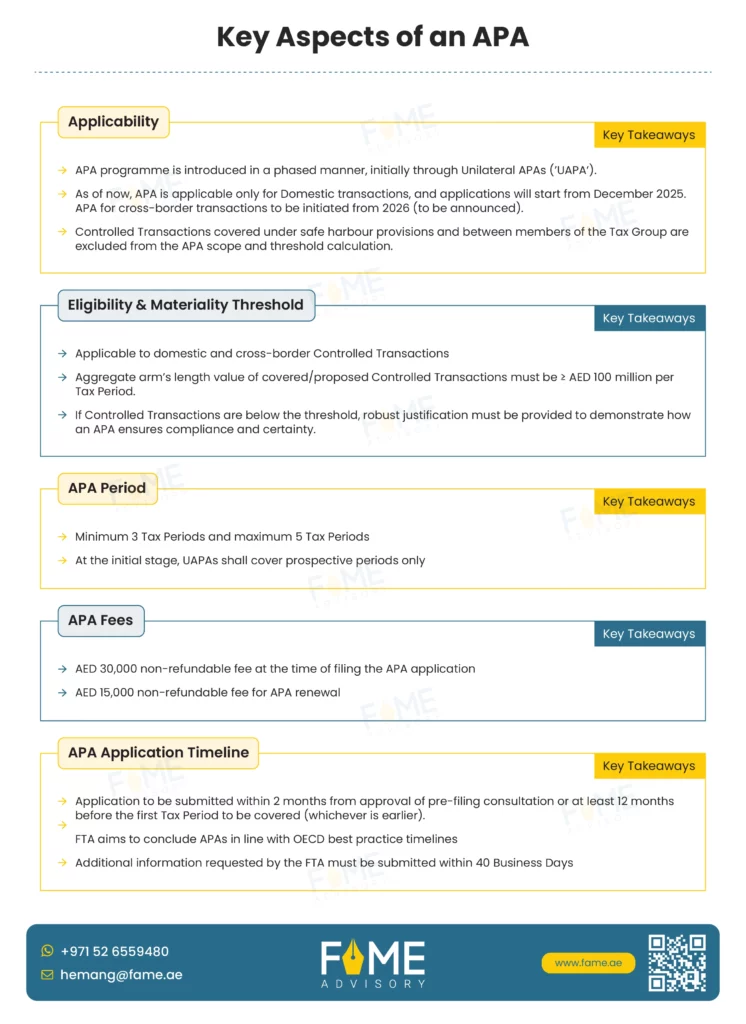
An APA can be of the following types:
Stage 1 – Pre-filing consultation
A Person proposing to enter into an APA must make a request to the FTA for a pre filing consultation. The purpose pre-filing consultation is to enable the FTA and the Person to understand the possibility of entering into an APA. Only a Tax Agent registered for Corporate Tax purposes with the FTA can submit the APA Request on behalf of the Person in the prescribed form. Communication with the FTA on the APA programme can be submitted from 30 December 2025. FTA aims to conclude pre-filing consultations within 6–9 months of receiving the request.
A pre-filing consultation does not bind the FTA to enter into an APA and does not constitute an APA application. The FTA may reject a Person’s request, for any of the following reasons:
Stage 2 – Filing of an APA application
A Person may submit an APA application upon receiving notification to proceed. The application must be filed within 2 months of the FTA notification or at least 12 months prior to the commencement of the first Tax Period to be covered under the APA, whichever is earlier.
Indicative UAPA timelines (assuming January – December as the tax period)
APA pre-filing | APA pre-filing approval by FTA (assumed as six months) | APA application | APA covered tax periods |
|---|---|---|---|
1-Jan-2026 | 30-Jun-2026 | 31-Aug-2026 | 2028-2032 |
1-Apr-2026 | 30-Sep-2026 | 30-Nov-2026 | 2028-2032 |
1-Jul-2026 | 31-Dec-2026 | 28-feb-2027 | 2029-2033 |
The FTA may reject an APA application under certain circumstances, including but not limited to:
Stage 3 – Evaluation and negotiation
Once site visits, interviews, meetings, and the collection of all required information and documents are complete, the FTA will commence its evaluation and analysis. FTA shall prepare a Transfer Pricing analysis that addresses manner and key criteria of determining ALP, any other terms and conditions, including critical assumptions
The Person must provide written feedback on the FTA’s TP analysis within 30 Business Days. The FTA may allow a discussion of the TP analysis upon the Person’s request. If no mutual agreement is reached after negotiations, the APA may be closed without conclusion, with no refund of fees.
Stage 4 – Conclusion and Implementation of APA
The FTA shall discuss the implementation of the agreement with the Person. The FTA and the Person shall sign the APA agreement based on terms mutually agreed. A Person may withdraw an APA application anytime before conclusion. Withdrawal without valid justification, especially at an advanced stage, is discouraged. No refund of fees will be provided.
An APA is binding on signatories to the APA with respect to the Controlled Transactions for the Tax Periods covered under an APA. APA does not establish a precedent for any other Tax Periods of the Person, nor for any other Person that is not covered under the APA.
A Person with an APA agreement must file an APA Annual Declaration for each covered Tax Period, in the format prescribed by the FTA. The APA Annual Declaration must be filed by the later of the following:
FTA May Revise an APA under following circumstances:
If revision is not feasible or no mutual agreement is reached, APA may be cancelled prospectively from the Tax Period in which the event occurred, remaining valid for prior periods.
FTA May Revoke or Cancel an APA under following circumstances:
APA may be revoked from the first Tax Period covered; previously governed Controlled Transactions become subject to Corporate Tax Law and Tax Procedures Law. Depending on severity, FTA may cancel APA prospectively, starting from the Tax Period of breach and applying to subsequent periods.
Application of renewal of APA may be made by the Person if there are no material changes to facts of the Controlled Transactions and the critical assumptions remain valid.
Renewal application shall be made at least three months before the expiry of the existing APA. Renewal request shall follow same procedures as filing of APA application, with the exception that a pre-filing consultation is not required.
The APA programme provides an effective framework for achieving transfer pricing certainty and minimizing disputes by allowing taxpayers to agree in advance on arm’s length pricing for Controlled Transactions. With clearly defined eligibility criteria, timelines, and compliance requirements, APAs promote predictability, transparency, and alignment with OECD best practices. For eligible taxpayers, the programme serves as a valuable tool to manage transfer pricing risks and ensure sustained compliance under the UAE Corporate Tax regime.
Search
Recent Insights


The Government of Bahrain has announced a series of initiatives aimed at improving the country’s financial situation while ensuring continued support for citizens. The measures, approved by the Cabinet, focus on optimizing government spending, increasing revenue, and promoting sustainable economic growth. The initiatives include:
Corporate Revenue Law
Reducing Administrative Expenses
All government entities will cut administrative costs by 20% while maintaining the service quality of services provided to citizens.
Increasing Contributions from State-Owned Companies
Government-owned companies will contribute more to the state budget.
Selective Tax on Soft Drinks
A law will be referred to the legislature to increase selective taxes on soft drinks, promoting healthier consumption, improving public health, and optimizing healthcare resources.
Investment Land Fees
Sewerage Service Fees
Work Permit Fees for Foreigners
Search
Recent Insights